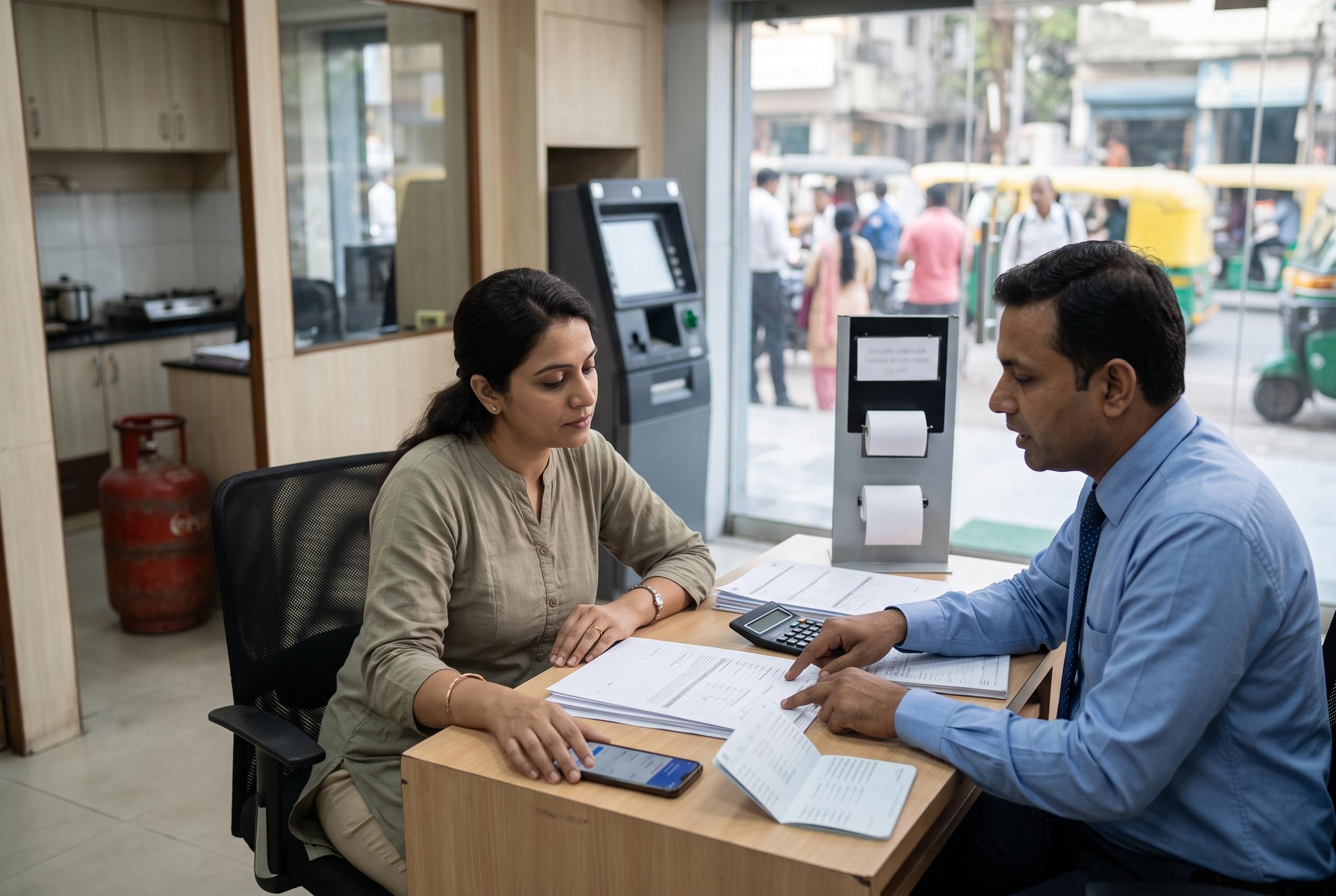

A series of major financial policy shifts in India from October will alter ATM usage, deposit transparency, UPI payments, property tax deductions, and LPG subsidy access, affecting households, savers, and investors nationwide.
October will bring a cluster of money-rule changes that will affect bank customers, savers, landlords, taxpayers and households across India, according to India Today and other financial publications. The biggest immediate shifts include tighter free ATM limits for some State Bank of India salary account holders, new disclosure rules for bulk deposits, a fresh compliance simplification for property purchases from non-residents and an Aadhaar deadline for subsidised LPG refills.
State Bank of India is cutting the number of free monthly withdrawals and other transactions available at rival banks’ ATMs for salary package account holders from 10 to five from 1 October, Livemint reported. The revised cap applies to both cash withdrawals and non-cash services, and charges kick in once the free allowance is exhausted. Economic Times said the bank will levy ₹23 plus GST on cash withdrawals beyond the free limit and ₹11 plus GST on non-financial transactions.
Bank customers will also see changes in how bulk fixed deposits are priced and disclosed. According to India Today, the Reserve Bank of India is changing the framework from 1 October so commercial banks must publish bulk deposit rates in advance and update the applicable rates daily at 10 am. The aim is to make pricing more transparent, although banks can still vary rates depending on the liquidity treatment of the deposit.
Another change takes effect on 15 October, when a merchant discount rate, or MDR, is due to be applied to certain UPI merchant payments above ₹2,000. India Today said lower-value transactions, and those covered by the zero-MDR framework for smaller traders, will remain free. The proposal has already been challenged in the Supreme Court, which has not paused the policy and has asked for responses from the Centre, the RBI, the National Payments Corporation of India and others.
There is also a compliance change for people buying property from non-residents. From 1 October, resident individuals and Hindu undivided families will no longer need to obtain a separate Tax Deduction and Collection Account Number, or TAN, to deduct tax at source on such purchases, according to India Today. Instead, the buyer can use a permanent account number, or PAN, to deduct, deposit and report the tax, a move intended to reduce paperwork as the system shifts under the new income-tax law.
Households relying on subsidised LPG also face a deadline. India Today reported that consumers must complete biometric Aadhaar authentication by 1 October to keep booking refills at the regulated price with the applicable subsidy. At the same time, the government is expected to announce interest rates for small savings schemes for the October-December quarter around the end of September, which will determine whether popular products such as the Public Provident Fund, National Savings Certificate, Senior Citizens’ Savings Scheme and Sukanya Samriddhi Account see any change.
Disclaimer: This article is intended to inform and educate, not to recommend or endorse any financial product, investment or strategy. Please consider your own financial circumstances and seek professional advice where appropriate before making financial decisions.