

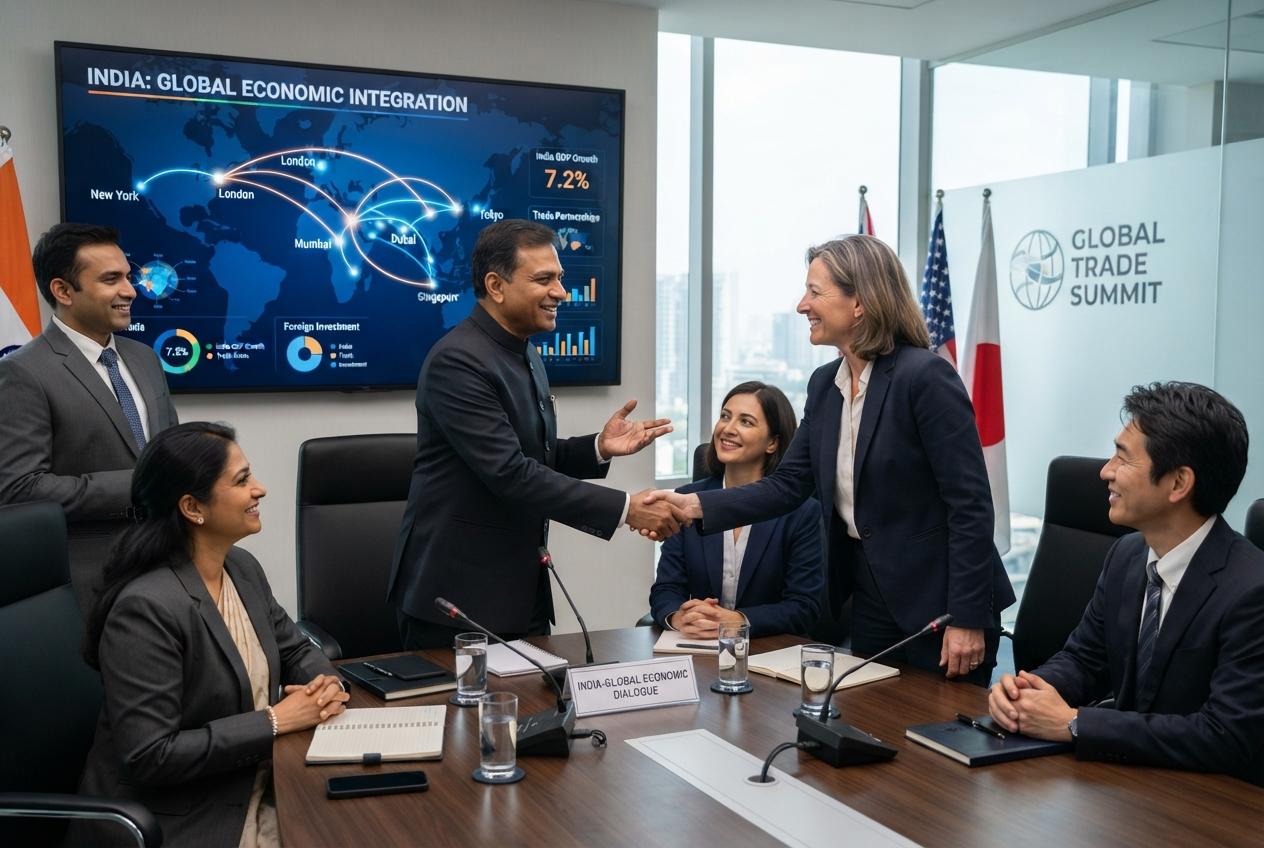

Despite escalating expenses on Prime Minister Narendra Modi’s overseas trips, India has seen a surge in foreign direct investment, prompting debate over the strategic value of diplomatic expenditures amid increasing costs from 2021 to 2025.
India’s overseas diplomacy has become steadily more expensive since the pandemic, but government figures suggest the cost has run alongside a sharp rise in foreign investment. Data tabled in Parliament and reported by Business Today show that between April 2021 and December 2025, India received $381.8 billion in foreign direct investment while the government spent ₹482.92 crore on Narendra Modi’s foreign visits. On a simple arithmetic basis, that works out to roughly ₹66,000 in investment for every ₹1 spent on the trips, though the calculation does not show any direct causal link.
The expenditure trend has risen year by year. The government spent ₹36.12 crore on three foreign visits in 2021, followed by ₹55.83 crore across seven trips in 2022 and ₹93.63 crore for six visits in 2023. Costs moved above ₹100 crore in 2024, when 11 overseas engagements came to ₹109.51 crore, and climbed further in 2025 to ₹187.83 crore for another 11 visits. For 2026, the government has disclosed about ₹74.59 crore so far, although officials say some bills, including the France leg of a June visit, are still being settled.
The Ministry of External Affairs said in its reply that high-level visits are a long-standing way to deepen ties with other countries and strengthen India’s engagement at bilateral, regional and global levels. The government said those trips have helped advance cooperation in technology, innovation, trade, investment, defence, energy and supply chains, and it listed a wide range of agreements concluded during the visits.
According to the parliamentary reply, the visits have produced memoranda of understanding covering areas from artificial intelligence and digital technologies to renewable energy, space, healthcare, agriculture, semiconductors and telecommunications. France featured prominently, with cooperation on AI governance, digital sciences, startups, railways, healthcare, nuclear energy, space and UPI expansion. Other agreements have involved countries including Australia, Germany, Indonesia, Brazil, Bhutan, Cyprus, Ethiopia and Guyana, reflecting a wider push to pair diplomatic travel with economic and strategic outreach.
Separate reports by India Today, NDTV and The Economic Times earlier put the cost of Modi’s foreign travel since 2021 at about ₹295 crore through 2024, with more than ₹67 crore spent in 2025 alone on visits to five countries, including the United States and France. The latest parliamentary data, which includes more recent trips and provisional entries, pushes the total much higher, underscoring how quickly the bill has accumulated even as India seeks to convert diplomacy into longer-term commercial and technological gains.
Disclaimer: This article is intended to inform and educate, not to recommend or endorse any financial product, investment or strategy. Please consider your own financial circumstances and seek professional advice where appropriate before making financial decisions.



