

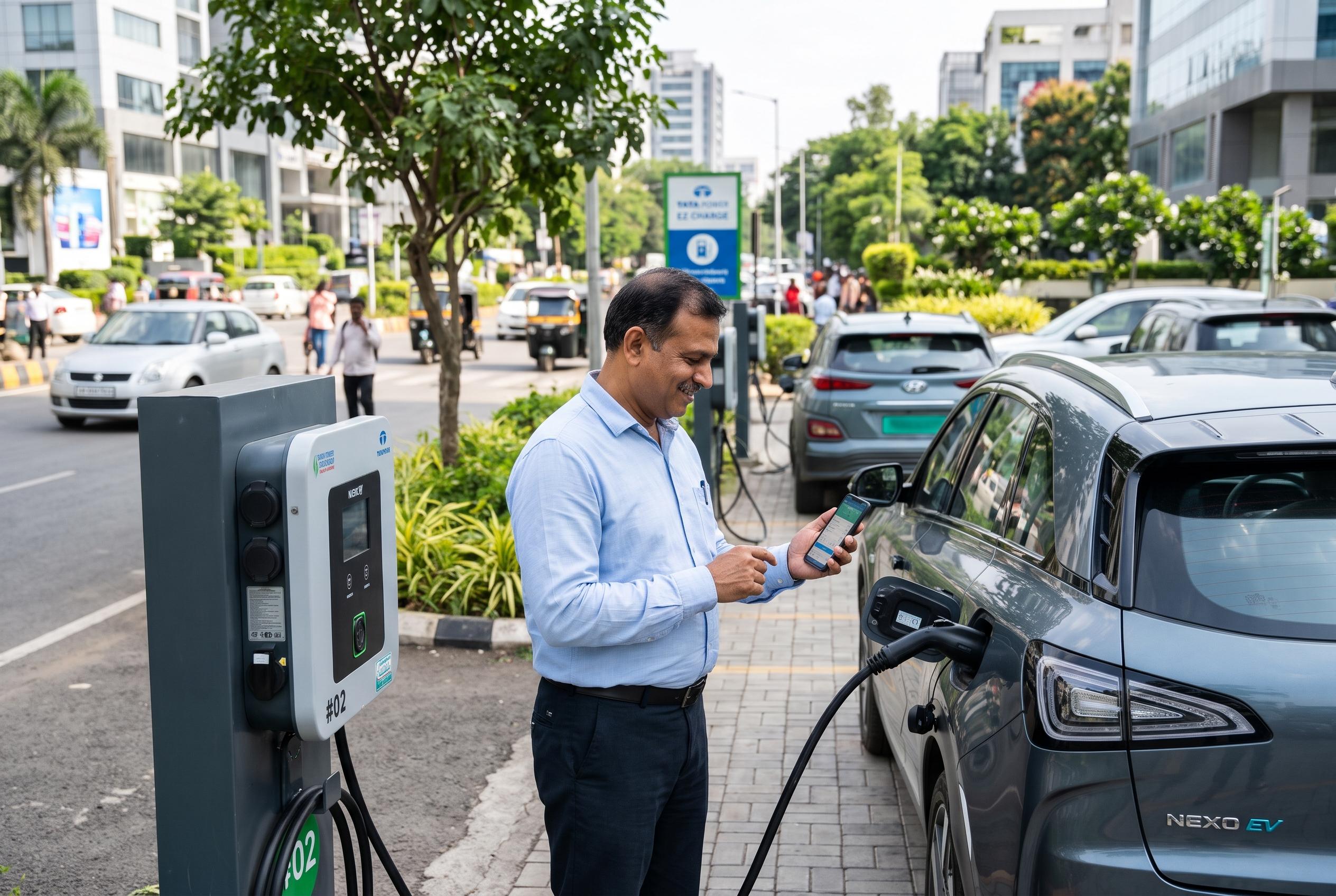

Unified Bharat e-Charge aims to let drivers find, use and pay for chargers across different networks through compatible apps, with more than 10,000 charging points already linked to BHIM UPI.
Unified Bharat e-Charge, or UBC, is being pitched as a way to make India’s electric vehicle charging network feel less fragmented for drivers. The initiative is designed to let charging networks and customer apps talk to one another through a common digital layer, so motorists can find a charger, check whether it is available and pay without having to download a new app every time they switch operators. According to the UBC website, the framework is being developed by the Ministry of Heavy Industries, Bharat Heavy Electricals and the National Payments Corporation of India, with Beckn providing the underlying open protocol.
That matters because India’s public charging market is still a patchwork of operators, charger management systems, vehicle makers, apps and payment tools. In practice, that can leave drivers facing a series of small hurdles on a single journey: which network runs the charger, whether the plug is compatible, how much the session will cost and which payment method will work. UBC is meant to reduce that friction by standardising how information about chargers is shared across participating platforms, rather than by building chargers itself.
The system is intended to work through interoperability rather than a single central app. A driver would use a compatible application to search for nearby charging points, see information such as location, availability and tariff, and then initiate a charging session through the connected network. The operator’s back-end system would supply the live data, while the customer-facing app would handle discovery and the transaction flow. In that sense, UBC is closer to an open network standard than a consumer service on its own.
The most visible consumer-facing example so far has been BHIM. Industry reporting says users can discover UBC-enabled charging points in the BHIM app and pay directly through UPI, which is the real-time payments system widely used across India. That does not mean every charging station in the country is already connected, or that every app with UPI support can offer the full UBC experience. Participation still depends on whether the operator and technology provider have completed integration.
Recent developments suggest the ecosystem is starting to scale. Energetica India reported that Pulse Energy has connected more than 10,000 chargers to BHIM UPI through UBC, making it one of the early certified technology enablers in the network. Separately, Kazam said in July that it would run a seven-day free integration drive for eligible charge point operators, offering network assessment, integration support, testing and transaction validation without initial integration fees. Those announcements point to a push to lower technical and commercial barriers for operators that want to join.
For charge point operators, the appeal is greater visibility: a charger listed in one network can, in theory, become discoverable through several compatible apps. For drivers, the upside is a simpler experience on intercity trips and fewer account logins and payment steps. But the success of UBC will depend on more than software. Live charger status must be accurate, tariffs need to be clear, and failed sessions will require a straightforward way to handle complaints and refunds. If those basics are not reliable, interoperability alone will not be enough to restore confidence at the roadside.
Disclaimer: This article is intended to inform and educate, not to recommend or endorse any financial product, investment or strategy. Please consider your own financial circumstances and seek professional advice where appropriate before making financial decisions.



