

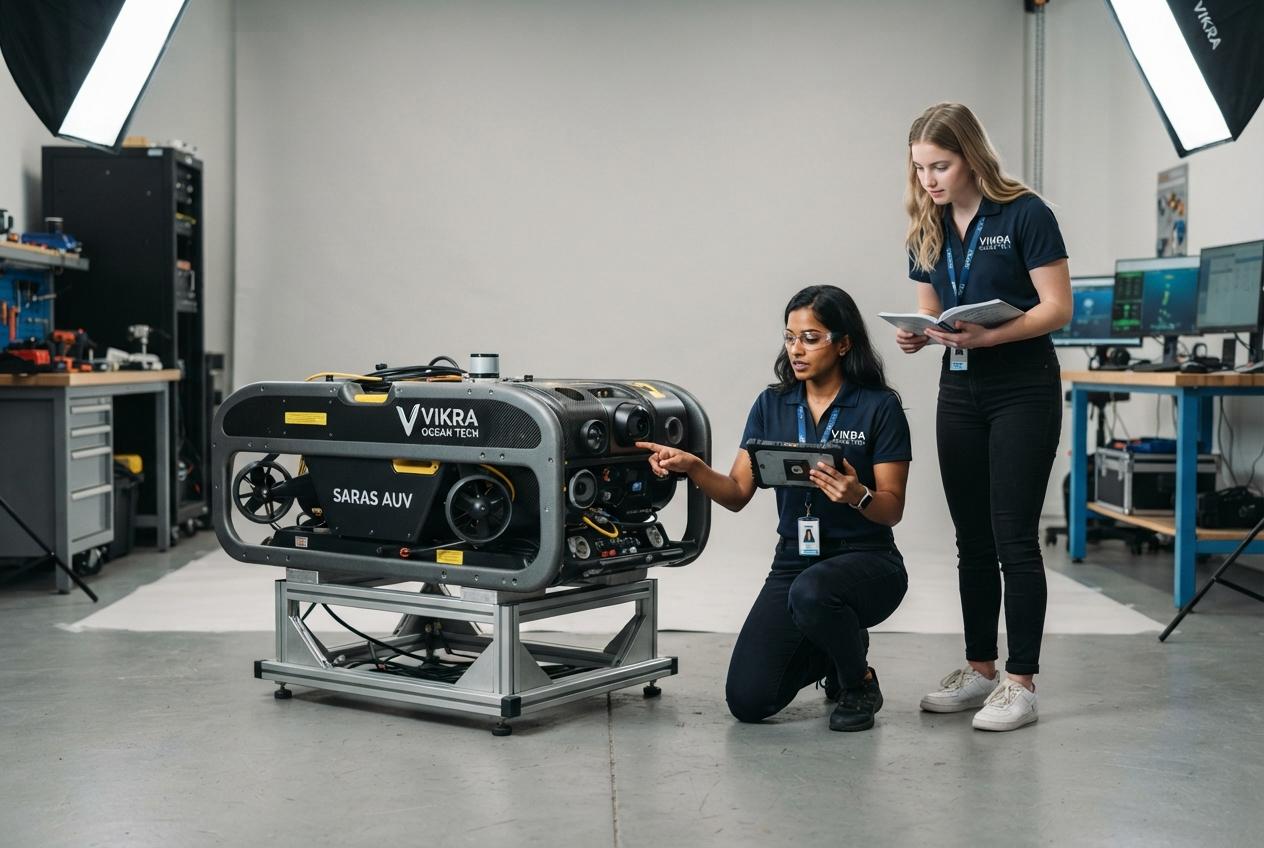

Chennai-based startup Vikra Ocean Tech is developing domestically manufactured underwater systems to replace imports, with promising funding and government support signalling a potential shift in India’s marine technology capabilities.
Vikra Ocean Tech, a Chennai-based marine robotics company, is trying to build in India the underwater systems that the country has long imported. Founded by Rajeuv Govindan and Rajagurunathan Krishnasamy, the startup says its aim is to create an indigenous ocean robotics stack for both submerged and surface operations, designed for Indian conditions rather than adapted from foreign equipment.
The company’s product line spans deep-water remotely operated vehicles, autonomous surface vessels and amphibious crawling robots, supported by its own imaging, lighting and communications systems. Vikra says the idea is to give operators one control platform across different machines, rather than forcing them to learn separate systems for each task. Its deep-ocean camera and lighting systems are rated to 2,000 metres, a depth that underscores the engineering challenge involved.
That technology has uses well beyond offshore defence. According to the company’s website, the machines can be used for dam, bridge and reservoir inspections, aquaculture and environmental research, in addition to subsea infrastructure work and disaster response. In a country with a long coastline, numerous dams and ageing water-bound structures, the civilian market could be as important as the military one.
Vikra’s financing story points to growing investor interest in that opportunity. The company said in April that it had raised about ₹8.8 crore, or $1 million, in seed funding co-led by Finvolve and India Accelerator. The investors said the money would help expand manufacturing, build sales across defence and public sector customers and establish recurring revenue from service and maintenance contracts.
The startup has also received two iDEX grants, one from the Indian Army and one from the Indian Coast Guard, under the Ministry of Defence’s Innovation for Defence Excellence programme. Those awards do not amount to a commercial contract, but they do suggest that the technology has attracted interest from potential users. Publicly available data compiled by Inc42 indicates Vikra had 24 employees and reported revenue of ₹78.5 lakh in fiscal 2025, up 0.69% from the previous year.
For now, the bigger test is whether Vikra can turn prototype-grade hardware into a business with repeatable sales. No customer names, contract values or delivery numbers have been made public, leaving the company’s next stage to hinge on whether its domestically built systems can compete with imported alternatives on cost, servicing and reliability.
Disclaimer: This article is intended to inform and educate, not to recommend or endorse any financial product, investment or strategy. Please consider your own financial circumstances and seek professional advice where appropriate before making financial decisions.



