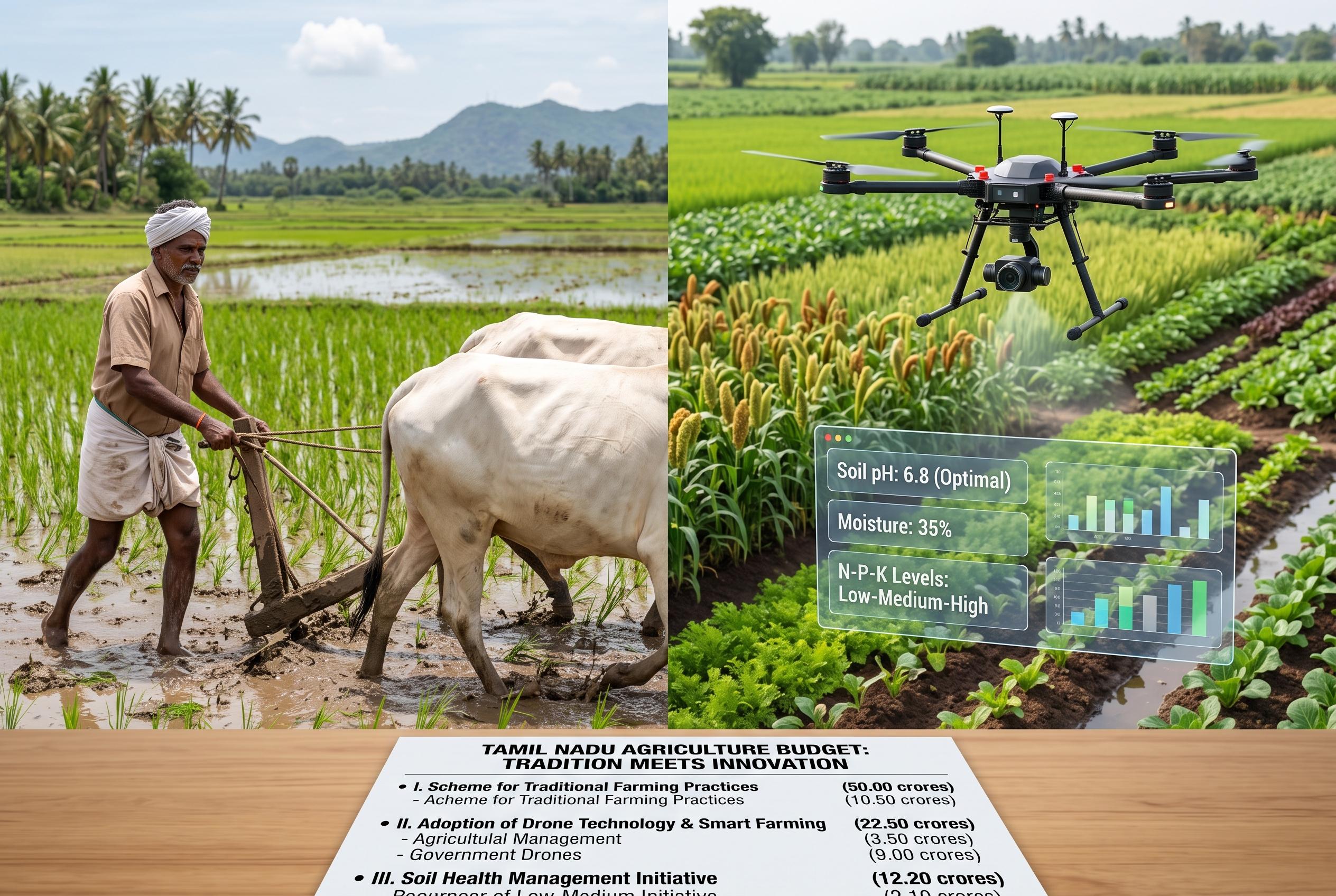

Tamil Nadu’s inaugural agriculture budget under the Tamilaga Vettri Kazhagam government introduces modern farming tools alongside traditional practices, while fostering closer ties with the Centre through new schemes focused on soil health, crop diversification, and AI-driven advisory services.
Tamil Nadu’s first agriculture Budget under the Tamilaga Vettri Kazhagam government sets out an effort to blend older farming practices with newer tools, while signalling a warmer working relationship with the Centre. Presented in the Assembly on Thursday by Agriculture Minister R Vinoth, the package spans natural and organic farming, soil improvement, pulses and oilseeds, cotton, millets and artificial intelligence, while leaving intact free power for farmers through a ₹7,433 crore reimbursement to the state utility.
The Budget also marks a clear departure from the previous administration’s emphasis on drawing rural labour away from farming and into manufacturing. Instead, the new government is framing agriculture as a sector to be upgraded rather than reduced, with a strong emphasis on productivity and diversification. The state’s decision to align more closely with Union schemes reinforces that approach, suggesting an attempt to tap central funding and reduce friction between Chennai and New Delhi.
Among the bigger announcements is a five-year Tamil Nadu Soil Fertility Mission, with an estimated outlay of ₹600 crore. For the first time in the state, farmers will receive soil health cards, though only those holding farmer IDs will be eligible. The government appears keen to use that condition to avoid the kind of disputes seen elsewhere over beneficiary identification. The Budget also includes a five-year Cotton Renaissance Mission that will promote high-density planting, ultra high-density planting, integrated crop management and nipping, while encouraging extra-long staple cotton and intercropping to lift farm incomes.
Crop insurance is another key plank. The Pradhan Mantri Fasal Bima Yojana will be rolled out in Tamil Nadu in FY27 across 14 clusters covering 37 districts and all three sowing seasons, with ₹649 crore set aside for the scheme. According to the government, the plan is expected to cover 36 lakh acres and benefit 15 lakh farmers. The move comes as the Union government has kept a substantial national allocation for the programme and has separately pushed new technology-led farm tools, including the multilingual Bharat-VISTAAR artificial intelligence platform, underscoring the growing overlap between policy, data and farm advisory services.
Disclaimer: This article is intended to inform and educate, not to recommend or endorse any financial product, investment or strategy. Please consider your own financial circumstances and seek professional advice where appropriate before making financial decisions.