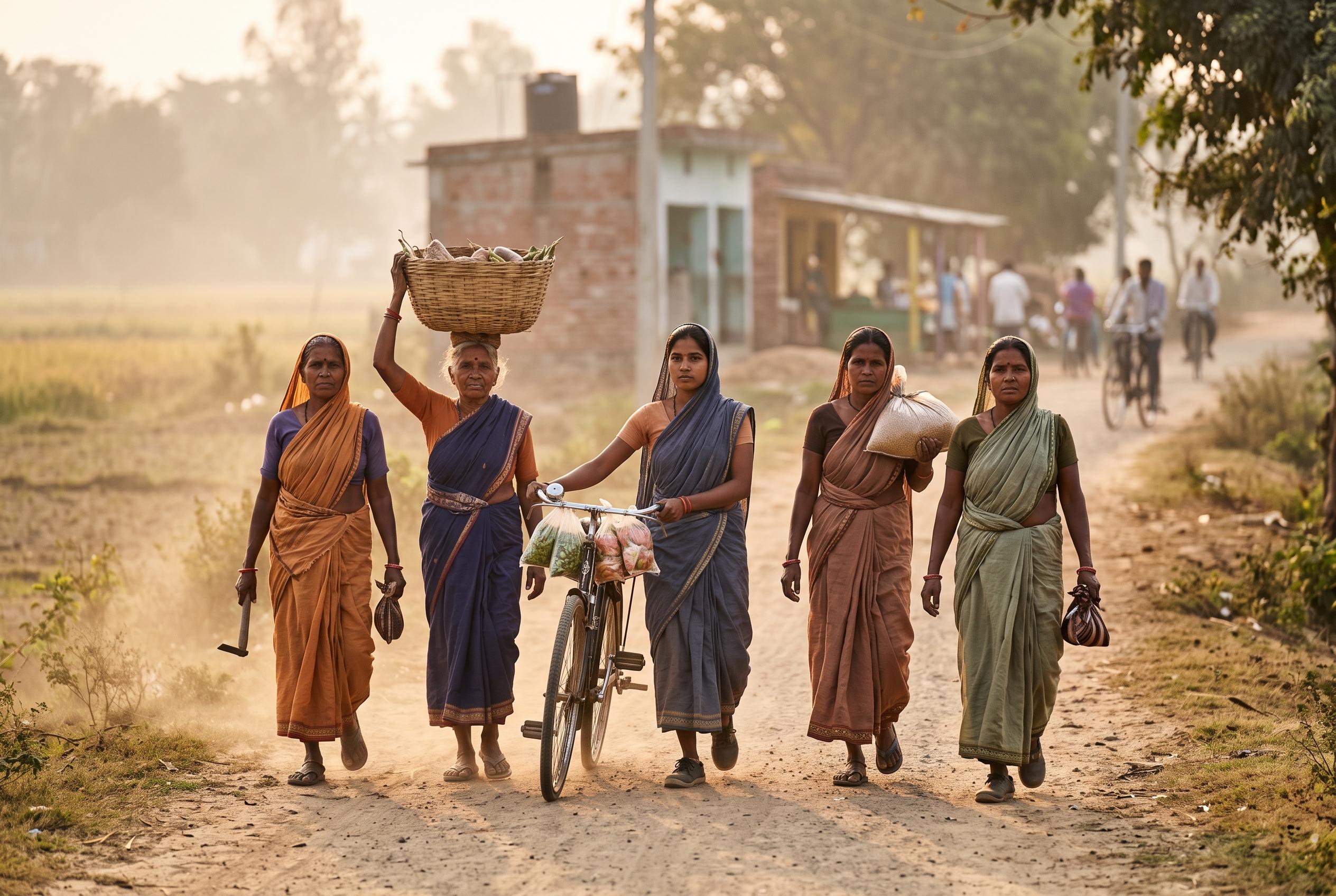

India’s female workforce has grown significantly since the pandemic, with rural areas driving the majority of gains, revealing an uneven but promising recovery pattern across states and regions.
India’s female labour force participation has climbed sharply since the pandemic, but the gains have not been even. The Periodic Labour Force Survey for 2025 shows the participation rate for women aged 15 and above rising to 40% from 30% in 2019-20, with the improvement driven far more by rural India than by cities. Rural female participation increased from 33% to 45.9% over the period, while the urban figure moved from 23.3% to 27.7%.
That rural-urban gap matters because it points to very different labour markets. A fuller reading of the survey suggests that women’s participation has risen alongside a broader strengthening in India’s workforce, with the overall labour force participation rate holding at 59.3% and the worker population ratio at 57.4%. The survey also indicates that more workers are moving into regular wage or salaried jobs, even as self-employment remains dominant.
The state-level picture is more uneven still. In rural areas, West Bengal, Uttar Pradesh, Gujarat, Odisha, Bihar, Rajasthan and Haryana recorded annual average percentage-point gains above the all-India pace. In urban India, Rajasthan and Gujarat stood out with gains of more than two percentage points a year, while Uttarakhand, Kerala, Chhattisgarh, Karnataka, Odisha, Bihar and Andhra Pradesh also outperformed the national average.
Yet the pace of change tells only part of the story. States such as Bihar, Uttar Pradesh, West Bengal and Haryana started from low rural participation levels but still improved quickly, while Goa and Punjab improved more slowly despite having room to catch up. In cities, Rajasthan, Gujarat, Uttarakhand and Bihar combined low starting points with faster growth, whereas Kerala, Karnataka, Chhattisgarh, Odisha and Andhra Pradesh made strong gains from comparatively higher bases. The pattern underlines a wider point: a high growth rate does not necessarily mean high participation, and a slower rise may still leave a state with a stronger overall position.
According to wider reporting on the PLFS, the rise in women’s participation has also been accompanied by a decade-long expansion in social protection coverage and large-scale mobilisation of women through self-help groups and livelihood programmes. Taken together, the data suggest that the post-pandemic recovery in women’s work is real, but uneven, with rural India leading and the urban rebound still lagging behind.
Disclaimer: This article is intended to inform and educate, not to recommend or endorse any financial product, investment or strategy. Please consider your own financial circumstances and seek professional advice where appropriate before making financial decisions.