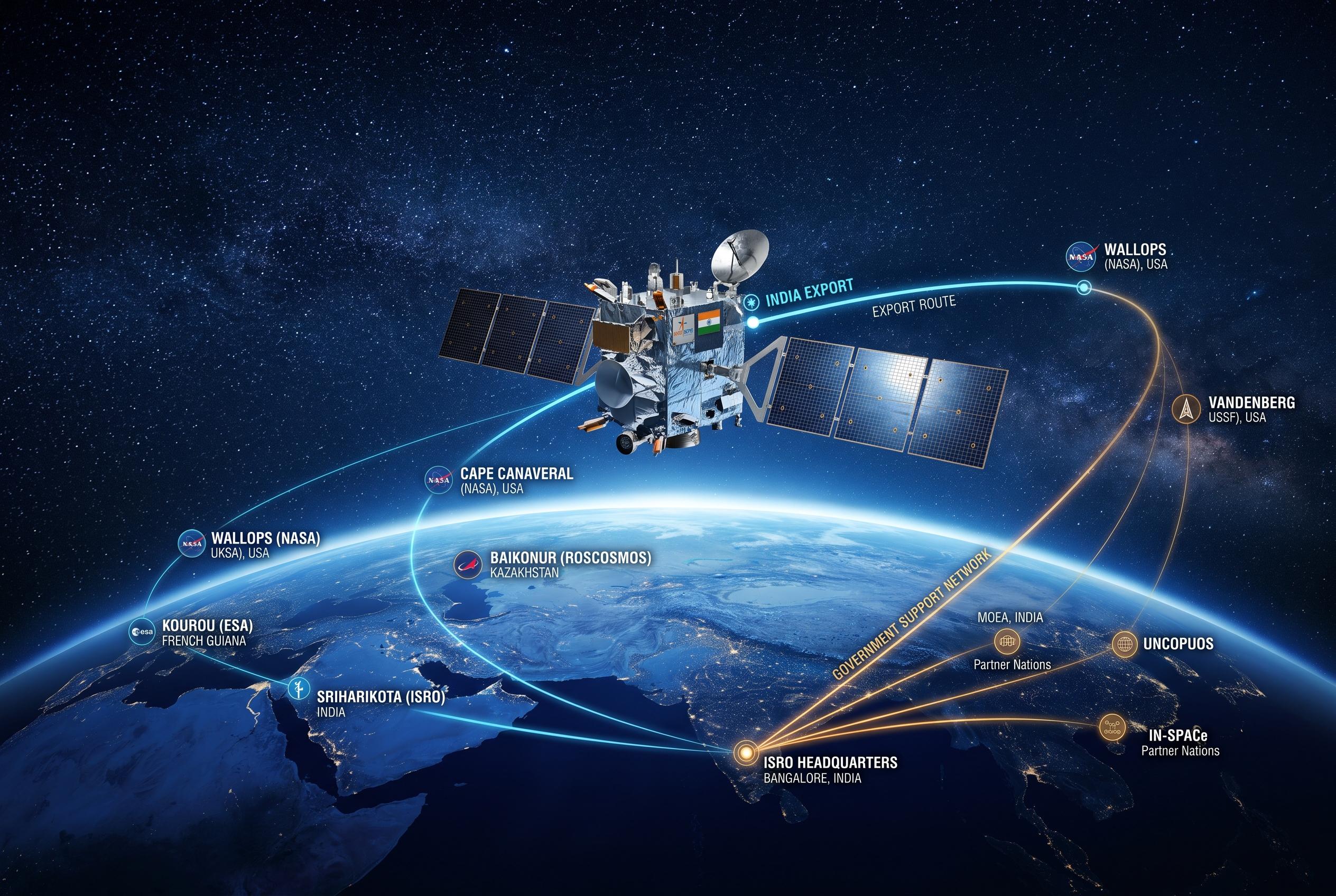

While Indian deeptech startups face challenges in commercialisation and scaling, spacetech firms are breaking new ground by tapping into global markets and benefiting from established industrial and government support networks, positioning themselves as a model for strategic sector growth.
India’s deeptech startups are entering a more demanding phase. The easy wins of proving a concept in the lab or clearing technical validation are increasingly giving way to the harder task of turning complex hardware into repeatable products, winning contracts and building businesses that can scale. The Zinnov-Nasscom Startup Report 2025 says that while many ventures have moved beyond prototype stage, commercialisation remains the sector’s biggest bottleneck, with too many firms stuck between seed and Series A or trapped in long pilot cycles.
The wider funding backdrop shows both momentum and strain. According to the report, deeptech funding in India rose 37% year on year in 2025 to $2.3 billion, with artificial intelligence as the main driver. More broadly, Indian technology startups raised $9.1 billion last year, up 23%, but capital is becoming more selective and more closely tied to execution. Even so, 74% of deals were still at seed and early stage, underlining how many companies remain far from scale.
Within that difficult landscape, spacetech has emerged as an outlier. Startups in the sector have been able to move hardware more effectively than many peers because they were not building only for India. Moin SPM of Agnikul Cosmos said the global nature of the market forced the company to think about reliability and commercial terms from the outset, while Ranendu Ghosh of SatLeo Labs argued that international customers helped Indian spacetech firms test themselves against tougher benchmarks. Their view is that space is one of the few deeptech categories where a startup can aim straight at export markets rather than waiting for domestic demand to mature.
India’s space ecosystem also benefits from an inherited industrial base. CVS Kiran of Red Balloon Aerospace said startups can draw on decades of work by ISRO, which helped create suppliers for machining, composites, avionics and environmental testing. That matters because space hardware is a low-volume, high-value business, unlike the capital-heavy, mass-production logic of semiconductors. Kiran also pointed to a crucial advantage: in space, the state is not just a regulator but often the first customer, giving companies a route to revenue through anchor orders from government agencies.
The relationship with ISRO is likely to change rather than disappear. Ghosh said private spacetech firms will depend less on the agency over time, but ISRO will remain an important mentor. That is one reason some founders see lessons for other strategic sectors, particularly semiconductors. Hareesh Chandrasekar of AGNIT Semiconductors said the spacetech model shows how government can accelerate industry by acting as an early buyer and offering long-term contracts for strategically important work. AGNIT is developing gallium nitride semiconductors, which are used in high-power applications and compete with conventional silicon-based technologies.
Still, the sector has limits, and its next test will be technical as much as commercial. Venkat Athmanathan, a senior research scientist working on high-speed propulsion in the US, said Indian launch firms must now push hardware to much higher flow rates, chamber pressures and temperatures if they want to approach the performance of leading providers in the US and Europe. He also warned that global commercial demand may not be enough on its own, since many countries reserve launch work for domestic operators, especially for defence and national security. His view is that Indian firms will need a broader market across Asia and the Middle East, along with more transparent benchmarking, if the industry is to measure progress more clearly and close the gap with international leaders.
Disclaimer: This article is intended to inform and educate, not to recommend or endorse any financial product, investment or strategy. Please consider your own financial circumstances and seek professional advice where appropriate before making financial decisions.