

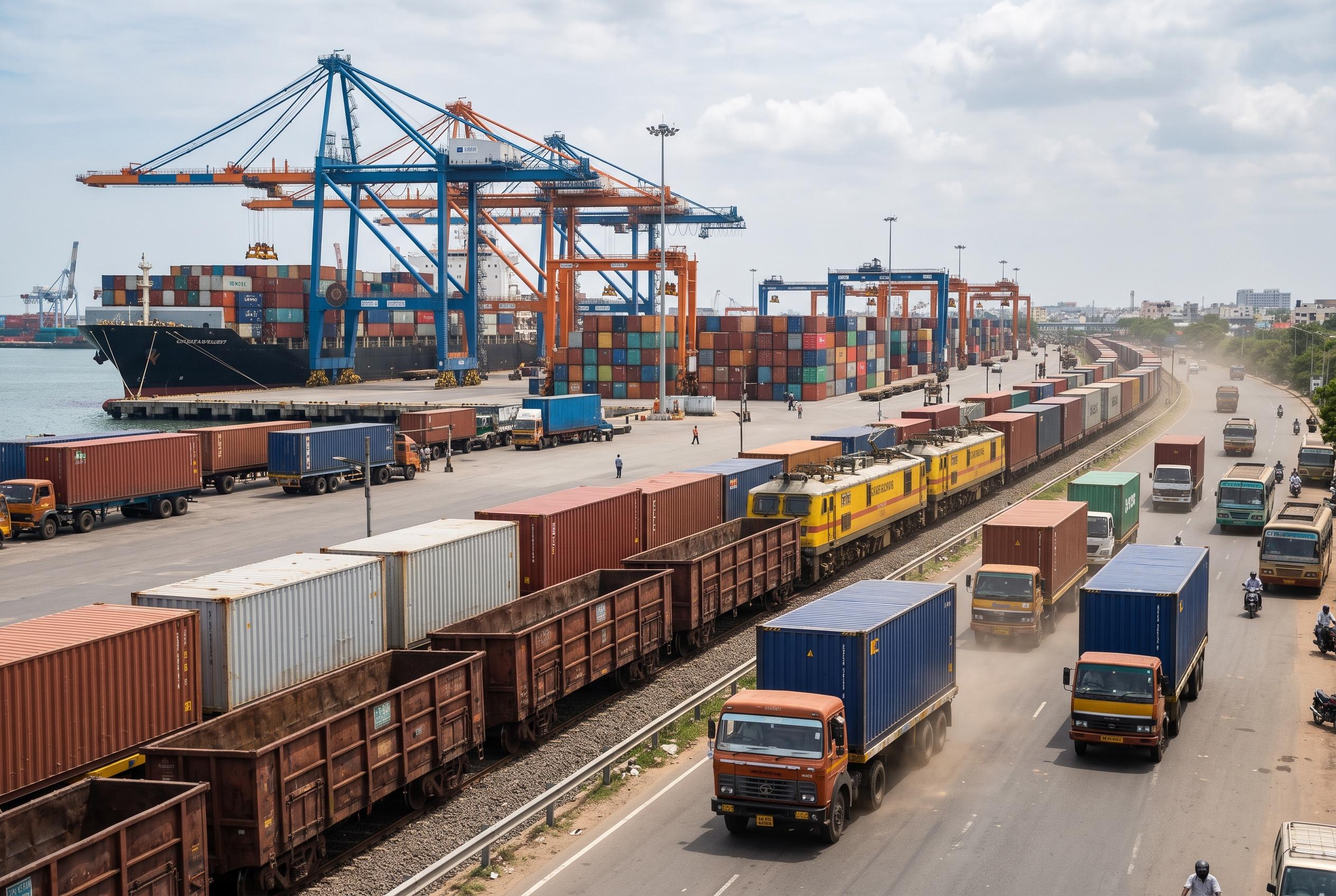

A FICCI-Kearney report says the next phase of maritime growth depends on connecting ports to inland markets and shipping networks, as delays beyond customs and reliance on foreign transshipment hubs remain obstacles.
India should stop treating port capacity as the main measure of maritime strength and focus instead on whether its gateways are truly linked to inland markets, shipping networks and industrial clusters, according to a report by FICCI and Kearney released in Mumbai.
The report argues that the next stage of maritime growth will depend less on building more berths and cranes than on creating trade gateways that move cargo smoothly between ports, factories and export markets. It calls for distinct strategies by 2030 for four types of gateway: container hubs, transshipment centres, industrial and energy gateways, and specialised export corridors.
The report’s case is built on a decade of expansion. India’s major and non-major ports handled 38% more cargo between fiscal 2017-18 and fiscal 2025-26, rising from 1,209 million tonnes to 1,668 million tonnes, while annual capacity increased 22% to 2.8 billion tonnes. Government data released alongside the Maritime India Vision 2030 programme broadly matches those figures and shows that port cargo throughput remains below the official 2030 target, even as private participation and capacity continue to rise.
But the authors say the bigger bottlenecks now lie beyond the quay. The Press Information Bureau’s National Time Release Study for 2025 found that for exports at the seaports it examined, average regulatory clearance took about 30 hours, while the period after approval and before vessel departure stretched to roughly 158 hours. At Jawaharlal Nehru Custom House, the Ministry of Finance later reported that export customs clearance averaged just over two hours, even though the full release cycle took far longer because of logistics operations.
That distinction matters because it suggests the challenge is no longer only customs processing. The FICCI-Kearney report says much of the remaining time in the export chain is shaped by scheduling, coordination and the movement of cargo through the wider logistics system. It therefore urges officials to use shipment data more effectively to identify where cargo waits and why, rather than assuming that more terminal capacity alone will solve the problem.
Transshipment is another weak spot. The report says about three-quarters of India’s transshipment containers were still being handled at foreign ports as of May 2025. The opening of Vizhinjam in Kerala was a significant step towards retaining more of that traffic at home, but the report notes that attracting and keeping shipping-line rotations is still difficult.
The wider infrastructure picture is mixed. Official figures cited by the government show that 84 of 294 road and rail projects meant to connect ports with their hinterland had been completed by July 2026, while the Western Dedicated Freight Corridor linking Jawaharlal Nehru Port Authority with Dadri was fully commissioned in March 2026. Even so, the report says port-to-market links remain uneven and should be planned around actual cargo flows rather than built in isolation.
Private operators have also taken on a much larger role. Under the Major Port Authorities Act 2021, privately run terminals now handle about two-thirds of major-port cargo, and the government has set a target of 85% by 2030, according to official releases. The report says that progress should be matched by clearer coordination, with each priority gateway assigned a lead, a funding route and measurable milestones tied to costs, reliability, market access and commercial returns.
To guide that effort, the report draws lessons from Shanghai-Ningbo, Rotterdam, Jebel Ali and Singapore, and measures Indian gateways against factors including berth productivity, liner connectivity, industrial clustering and digital border systems. Its central argument is that India’s ports are improving, but the country will only capture the full economic benefit if it treats them as connected trade gateways rather than isolated pieces of infrastructure.
Disclaimer: This article is intended to inform and educate, not to recommend or endorse any financial product, investment or strategy. Please consider your own financial circumstances and seek professional advice where appropriate before making financial decisions.



