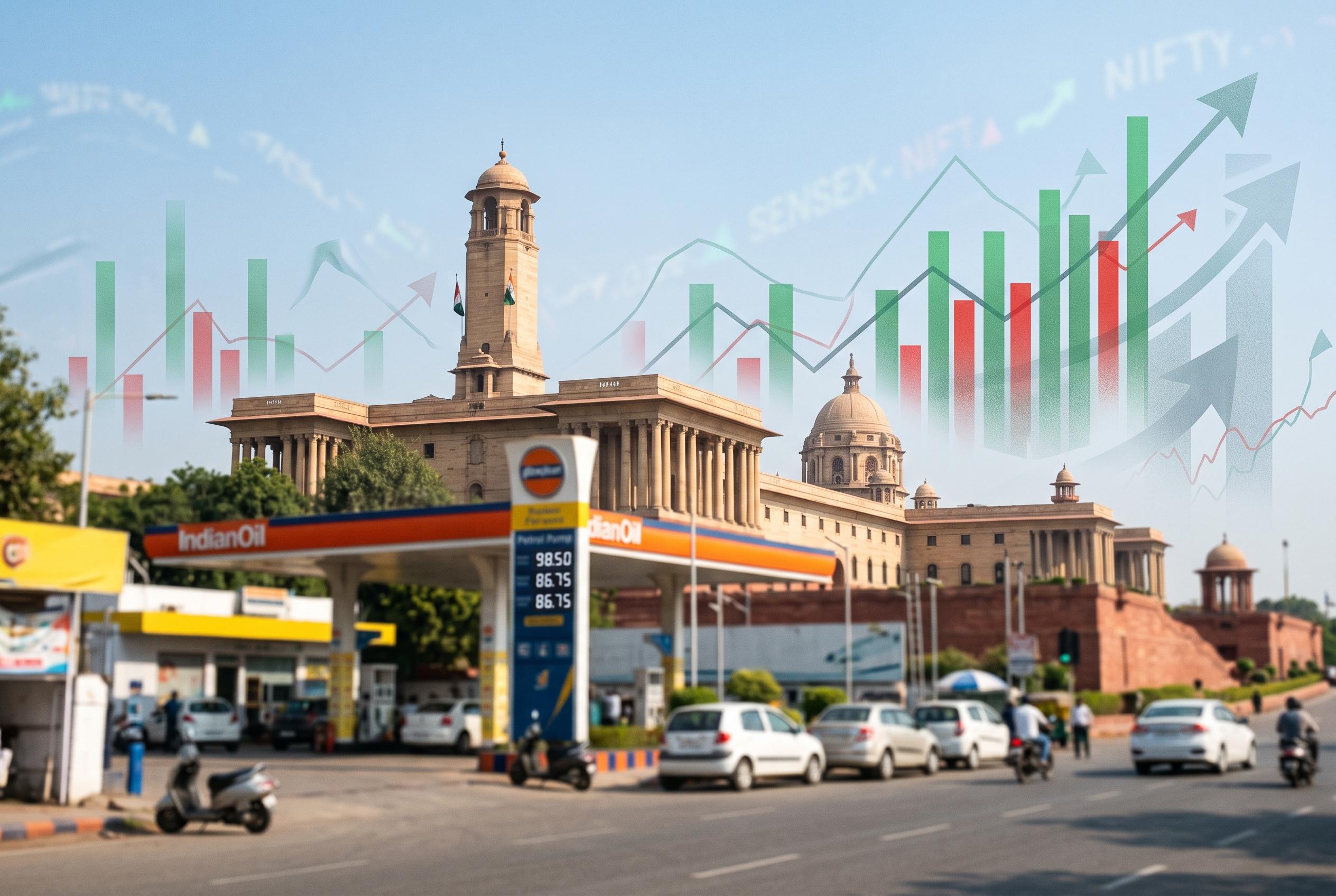

Despite international crude prices soaring to nearly double, India’s petrol and diesel rates stay uncut, with the government citing market conditions and regional taxes as key factors behind the steady retail prices, causing financial strain on state-owned oil companies.
India’s petrol and diesel prices have not been cut again, with the Centre saying retail rates are set by state-run oil marketing companies and remain linked to market conditions rather than a direct government formula. In a reply in the Rajya Sabha, Suresh Gopi said the government has no direct role in fixing pump prices, even as international crude has moved sharply over recent months.
According to the petroleum ministry, India’s crude oil basket was about $69 a barrel in February 2026 before surging to $136.68 a barrel in March, driven by geopolitical tensions and broader market volatility. The ministry said public sector oil firms absorbed much of the increase instead of passing the full shock on to consumers, a decision that has weighed heavily on their finances.
That pressure is already visible in first-quarter results for 2026-27. Indian Oil Corporation reported a loss of ₹2,662 crore, Bharat Petroleum Corporation Ltd posted a loss of ₹3,962 crore and Hindustan Petroleum Corporation Ltd reported a loss of ₹11,526 crore. Indian media reports have also said the state-owned retailers are still losing roughly ₹20 a litre on petrol and about ₹100 a litre on diesel, underlining how far selling prices have lagged market costs.
The government has pointed to the excise duty cut of ₹10 a litre on petrol and diesel in March 2026 as one of the main steps taken to cushion consumers from higher crude prices. Even so, retail fuel rates continue to vary widely across India because of state taxes and local levies, with Delhi, Mumbai, Chennai and Bengaluru all showing different pump prices. The broader pricing structure, as explained by the Petroleum Planning and Analysis Cell and other industry summaries, depends on crude costs, exchange rates, freight, refining charges and taxation, which leaves little room for a uniform national retail price cut.
Disclaimer: This article is intended to inform and educate, not to recommend or endorse any financial product, investment or strategy. Please consider your own financial circumstances and seek professional advice where appropriate before making financial decisions.