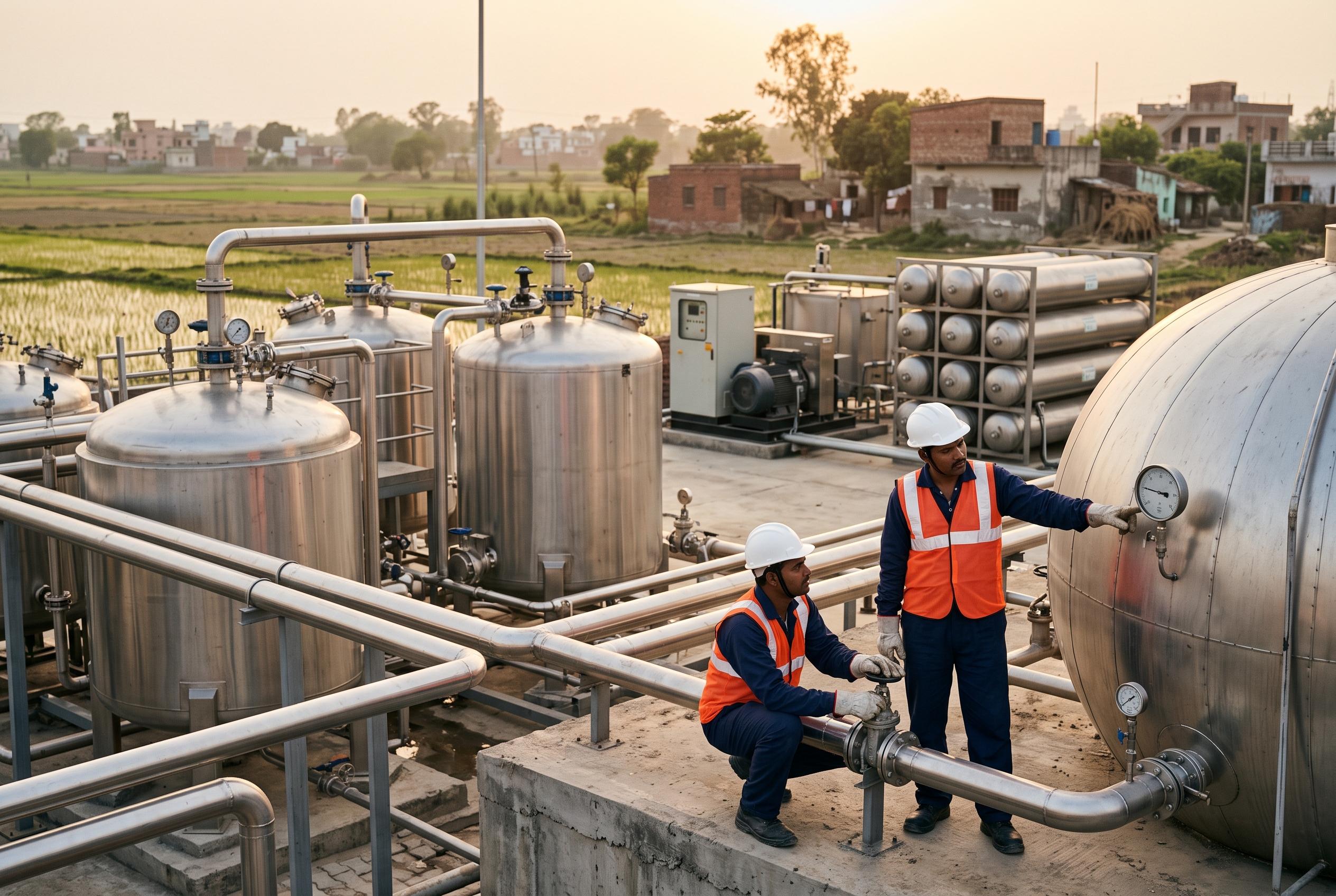

India has launched the Rs 23,731-crore GOBARdhan scheme, featuring assured off-take, pricing support, and capital assistance, to significantly boost domestic compressed biogas production and advance its circular bioenergy goals.
India has operationalised a Rs 23,731-crore scheme to push compressed biogas production, offering assured offtake, an administered price, capital support and financing measures in an effort to make the sector more bankable for private investors. The programme, known as GOBARdhan, is scheduled to run from financial year 2026-27 to 2035-36 and is designed to turn organic waste into compressed biogas and organic manure, according to the government and reports carried by PTI.
The Ministry of Petroleum and Natural Gas says the framework is intended to lift domestic compressed biogas output by nearly ten times. The plan covers agricultural residue, cattle dung, food waste, press mud and other biomass, and is meant to build a more integrated circular bioenergy system while reducing reliance on imported fossil fuels, according to Cabinet documents and industry reports.
A central feature of the scheme is guaranteed market access. Eligible producers can sell up to all of their output, subject to technical and operational limits, with supplies tied to city gas distribution companies or designated aggregation clusters for pipeline injection. The government has also set a notified buying obligation for city gas distributors in the compressed natural gas transport and domestic piped gas segments, beginning at 3% in FY2026-27 and rising to 5% from FY2028-29 onwards.
Pricing support is another major plank. The framework sets an administered compressed biogas price of Rs 2,110 per million British thermal units for at least 10 years, while also allowing affordability support of up to Rs 10 per kg to the designated synchronisation operator. GAIL has been named as that operator, giving it responsibility for procurement, pooling and the synchronisation mechanism between compressed biogas producers and city gas networks.
The scheme also broadens support for project development through capital assistance for greenfield and brownfield plants, as well as for feedstock aggregation and organic manure value addition. Unlike an upfront grant, the support is tied to milestones such as statutory clearances, the start of commercial sales and verified plant performance. The government says the package also includes pipeline infrastructure, credit guarantees and a dedicated challenge fund, replacing the earlier SATAT approach with a unified policy framework under the petroleum ministry. As of August 13, 2026, 1,929 compressed biogas or bio-CNG plants had been registered nationwide, of which 217 were commissioned and 357 were under construction.
Disclaimer: This article is intended to inform and educate, not to recommend or endorse any financial product, investment or strategy. Please consider your own financial circumstances and seek professional advice where appropriate before making financial decisions.