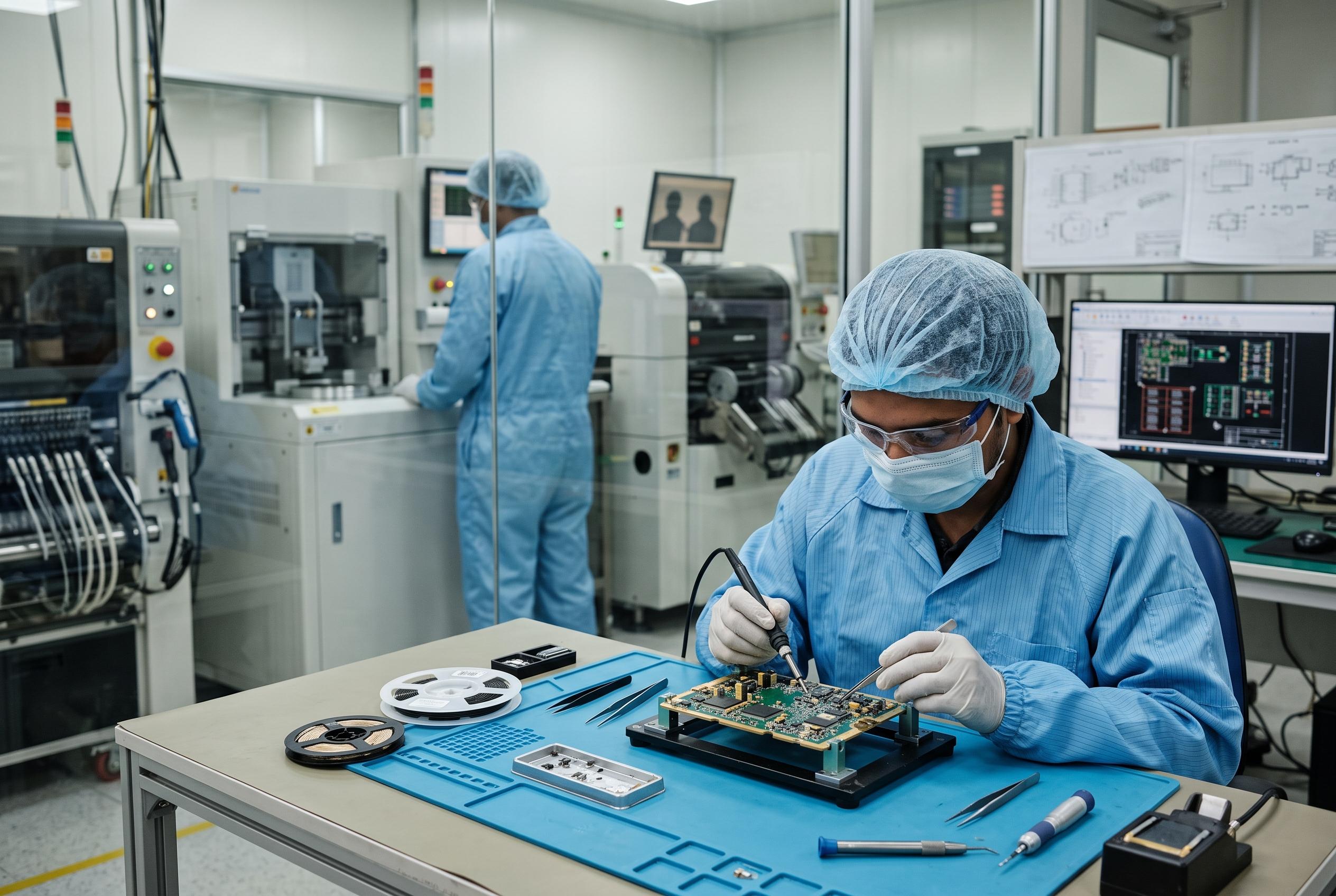

At Semicon India 2026, industry experts emphasised the need for India to move beyond assembly, prioritising product design, local component production, and skills development to boost high-value manufacturing and reduce dependence on imports.
India’s electronics industry is being pushed to move up the value chain, with panellists at Semicon India 2026 arguing that the country must go beyond high-volume assembly if it wants to capture more of the profit pool. Industry executives said stronger product design, local component manufacturing and ownership of intellectual property would be essential if India is to raise domestic value addition and reduce dependence on imported parts. KPMG has similarly argued that India’s next stage of growth will depend less on adding assembly capacity and more on building a deeper ecosystem around components, engineering and high-complexity manufacturing.
At the event, Tata Electronics’ Ranganathan V said Indian firms often enter programmes too late, after key decisions on component selection and suppliers have already been made. Cyient DLM’s Rajendra Velagapudi pointed to imported electronic components as a supply-chain risk, while calling for technology partnerships and joint ventures that would help build local capability. Raminder Singh Soin of Resolute said India needed national quality benchmarks tied to incentives and stressed that export-oriented production must match global yield and process standards.
Speakers also framed the challenge in terms of industrial policy and supply-chain resilience. Pallavi Verma of Guidance Tamil Nadu said India should move into higher-value manufacturing while addressing shortages in materials and in the processing of rare earths and critical minerals. That message aligns with the government’s broader push through the Electronics Component Manufacturing Scheme, which is designed to strengthen domestic production of components, sub-assemblies and materials and cut import dependence as electronics output and exports continue to climb sharply.
Technology and skills were presented as the other critical pillars. Siemens’ Aditya Ramakrishna said digital twins, which let factories be modelled and tested virtually before construction, could shorten timelines and reduce errors, while software-defined automation could help manufacturers adapt as product cycles get shorter. On the workforce side, speakers called for closer links between industry and universities so that engineering courses better match industrial needs. The remarks come as India expands its semiconductor ambitions as well, including a wider push on design, equipment, materials, fabrication and talent development, along with new international supply-chain partnerships aimed at reducing reliance on China.
Disclaimer: This article is intended to inform and educate, not to recommend or endorse any financial product, investment or strategy. Please consider your own financial circumstances and seek professional advice where appropriate before making financial decisions.