

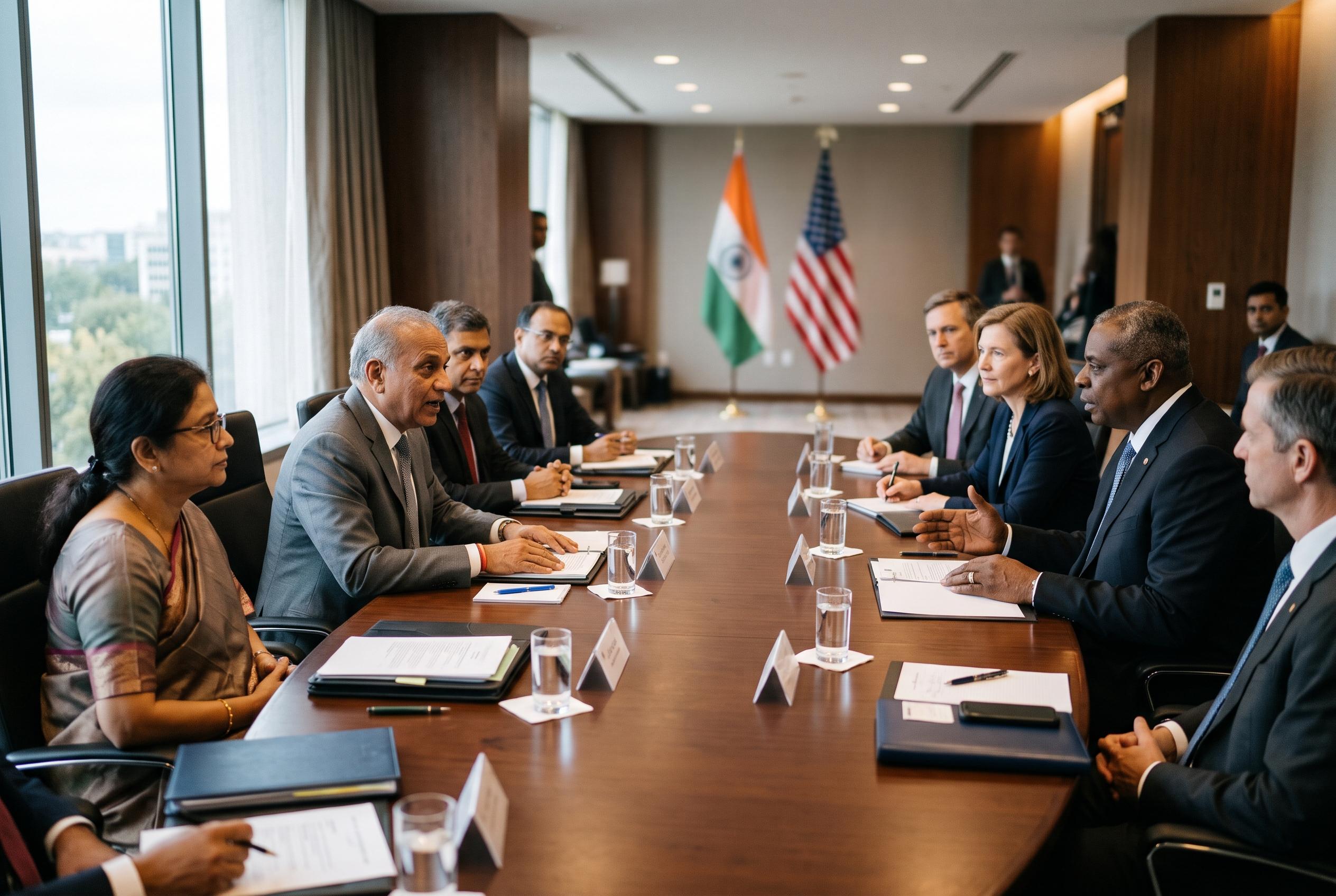

As Washington and New Delhi signal that a long-delayed trade agreement is close, India must weigh economic access against tariff uncertainty, disputed claims over the Pakistan ceasefire and pressure on its strategic autonomy.
India and the United States are once again speaking the language of partnership, but the more important question is whether that partnership is becoming more balanced or merely more transactional. After months of tariff friction, disagreements over Russian oil purchases and Donald Trump’s repeated assertions that he personally halted the India-Pakistan fighting in May 2025, Washington is signalling that a long-delayed trade agreement may finally be close.
The latest burst of optimism has come from Marco Rubio’s recent visit to India, during which the US secretary of state met S Jaishankar and spoke with business leaders. According to Reuters and other recent reports, Rubio described the talks as “incredibly close”, while Trump has also said the two sides are “pretty close” to a deal, even if it would not resemble the agreements Washington has struck elsewhere. India has heard similar language before, which is why the real measure of progress will be the content of any agreement, not the confidence with which it is announced.
Trump’s method of negotiation is by now familiar. He applies pressure through tariffs, public warnings and threats, then presents a possible settlement as an opening the other side should not miss. That approach has already left a mark on Indian exporters. Tariffs imposed on Indian goods, along with additional duties linked to New Delhi’s purchases of Russian oil, unsettled companies and raised doubts about how dependable the United States can be as a strategic partner. For India, the problem is not only the cost of tariffs but the unpredictability of policy. A trade relationship can support investment and exports only if businesses believe the rules will hold long enough for them to plan.
Prime Minister Narendra Modi has so far avoided a public clash with Trump, choosing instead to keep channels open while India’s diplomatic establishment defends the country’s position on trade, energy security and Pakistan. That restraint makes strategic sense. The United States remains important to India on defence technology, advanced manufacturing, investment, education and access for Indian professionals, and it is also central to India’s wider calculations in the Indo-Pacific, particularly in balancing China. But restraint should not be mistaken for concession. India’s insistence on strategic autonomy means it cannot allow another country to dictate its energy choices or its regional relationships.
There is also a political cost to prolonged silence. Trump has repeatedly claimed credit for stopping the India-Pakistan conflict, saying he helped bring the confrontation to an end after the April 22, 2025, Pahalgam terror attack and India’s Operation Sindoor. India has maintained that the ceasefire understanding on May 10 was reached directly between the two militaries, without US mediation, and that no trade deal formed part of the talks. Media reports have counted dozens of such claims by Trump, which has made the issue more than a dispute over credit. For New Delhi, it is also about preventing a contested American version of events from hardening into an accepted international narrative.
Still, the trade talks do appear to have moved. Recent reporting from AP and The Economic Times suggests Rubio’s trip in May 2026 was intended to steady a relationship strained by tariffs, energy disputes and concerns about India’s ties with Russia, even as both sides continued to talk up cooperation on trade, defence, maritime security and energy. The Council on Foreign Relations has described the interim framework announced in February 2026 as a broader effort to lower tariffs and expand market access, while also supporting more resilient supply chains. Yet the details remain sensitive. Agriculture, industrial goods, tariff treatment and regulatory barriers are all likely to be difficult. India will be wary of any deal that offers political theatre but places too much pressure on farmers, smaller manufacturers or other vulnerable sectors.
That caution is justified. The United States remains India’s largest trading partner, and nearly a fifth of India’s merchandise exports go there, according to the Council on Foreign Relations. Several sectors, including textiles, gems and jewellery, and auto parts, have felt the strain of tariff policy, even as pharmaceuticals, electronics and energy have been shielded in some cases. At the same time, Chatham House has noted that New Delhi continues to hedge strategically, keeping its options open rather than aligning fully with Washington. That broader pattern explains why India wants improved ties without surrendering room to manoeuvre.
The case for cooperation remains strong. Defence links, technology, semiconductors, maritime security and the Quad all bind the two countries together, and the Indian diaspora deepens the relationship further. But friendship between India and the United States cannot rest on flattering language alone. It requires stable policy, mutual respect and the willingness to accept that each side will defend its own interests. Modi has sensibly avoided turning this into a personal confrontation with Trump. The challenge now is to preserve that calm while negotiating firmly enough to secure terms that are genuinely workable, rather than merely welcome in Washington.
Disclaimer: This article is intended to inform and educate, not to recommend or endorse any financial product, investment or strategy. Please consider your own financial circumstances and seek professional advice where appropriate before making financial decisions.



