

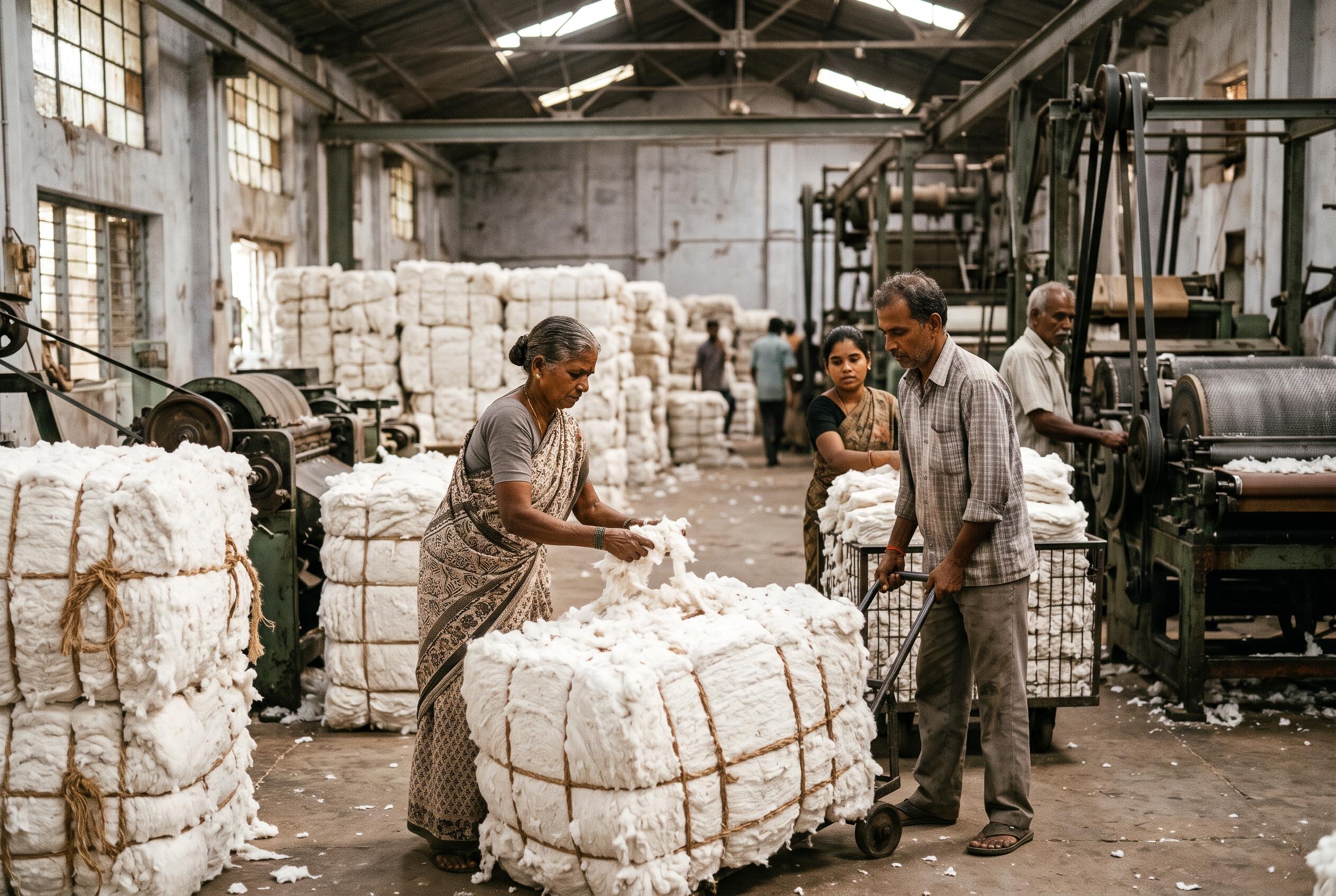

The expected extension of the 11% customs-duty exemption through December would give mills more time to source cheaper fibre abroad as domestic prices remain elevated and production prospects weaken.
India is expected to keep duty-free cotton imports in place until the end of December, a move that would give textile mills a longer window to source cheaper fibre abroad and could ease pressure on domestic prices, according to industry and government sources cited by Business Standard. The current exemption on the 11% customs duty, which began on 1 June and was due to end on 31 October, was introduced to support supplies during the lean season.
The extension comes as domestic cotton prices have stayed firm despite the usual seasonal arrival of fresh supplies in October. Business Standard reported that mills have pressed for a longer duty-free period because crop prospects have weakened this year, while Economic Times said output is now expected to fall below 29 million bales in 2026-27 against demand of more than 34 million bales. That mismatch has left buyers seeking imported cotton from the US, Brazil and Australia.
Prices in the local market are already above ₹9,000 per 100 kg, above the government’s floor price of ₹8,717 for the new season, Business Standard reported. Dipanshi Agarwal, principal analyst at S&P Global, said a tight stock-to-use ratio of about 31%, the lowest level in five years, together with weak production prospects and healthy textile demand, supported the case for extending the exemption. She added that the measure could nonetheless weigh on domestic rates.
The impact on imports may still be constrained by cost pressures. A dealer with a global trading house told Business Standard that US cotton futures, freight costs and a weaker rupee could curb larger buying even if the tax break is prolonged. Trade ministry data show cotton imports rose 63% year on year to $1.1bn in the first six months of the current fiscal year. Chandrima Chatterjee, secretary-general of the Confederation of Indian Textile Industry, said the duty should be removed for a longer period because it has lifted manufacturers’ costs and reduced their ability to compete with Vietnam and Bangladesh.
Disclaimer: This article is intended to inform and educate, not to recommend or endorse any financial product, investment or strategy. Please consider your own financial circumstances and seek professional advice where appropriate before making financial decisions.



