

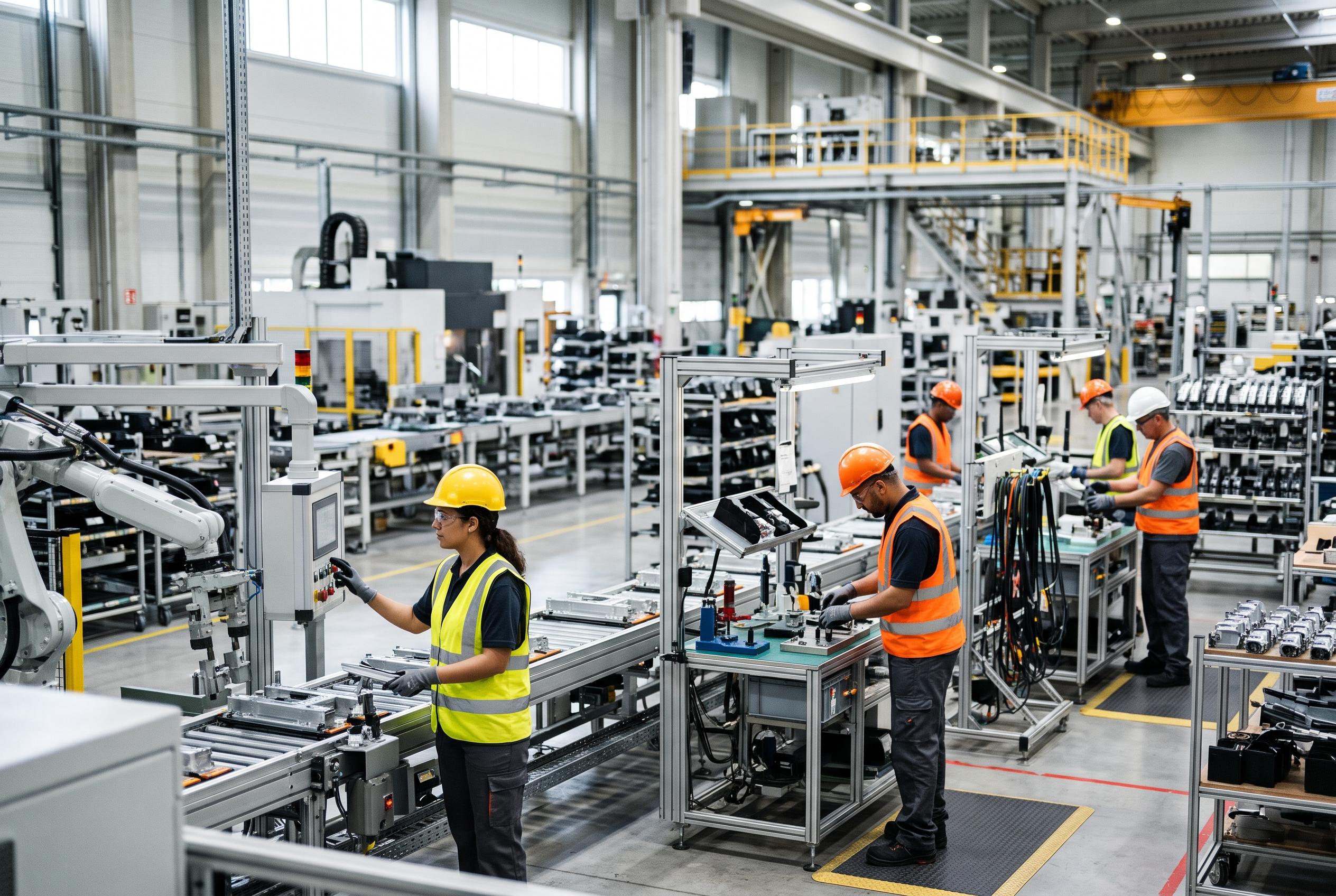

India’s commerce minister Piyush Goyal says rising European production costs and supply-chain uncertainty could drive companies towards India, as New Delhi and Brussels work towards a free trade deal.
European manufacturing will increasingly depend on trusted partner countries as production costs at home climb, India’s commerce and industry minister Piyush Goyal said after talks in Berlin, framing India as a natural destination for firms seeking a more stable industrial base. Speaking late on Thursday, Goyal said goods that are becoming “very expensive” in Europe could be made elsewhere, pointing to India as a country that global companies already regard as dependable for advanced manufacturing and digital infrastructure.
His remarks come as Europe contends with weak growth, high energy costs and disrupted supply chains. The International Monetary Fund has projected gross domestic product growth of 1.3% for the European Union in 2026, while lifting India’s forecast to 7% for fiscal 2027, reinforcing India’s position as the fastest-growing major economy. Separate reporting has also highlighted the strain on European industry from elevated energy prices, which have pushed up producer costs and intensified pressure on supply chains.
The timing is significant because India and the 27-member EU are working towards a free trade agreement that Goyal said could be signed by the end of this calendar year, with implementation expected within four to five months after that. CNBC and other outlets have reported that the pact is expected to take effect in early 2027 and would connect India with a market spanning roughly a quarter of global GDP. Goyal said the agreement would not merely cut tariffs, but would signal certainty, continuity and open supply chains at a time when businesses are reassessing where to manufacture.
He also used the briefing to argue that India is well placed to benefit from the EU’s carbon border adjustment mechanism, the bloc’s levy on carbon-intensive imports. According to Goyal, India’s own decarbonisation efforts should give its exporters an advantage, while competitors may bear more of the cost. He said New Delhi has secured a most-favoured nation assurance from the EU, under which any flexibility granted to other countries under the carbon rules would also apply to India.
Goyal added that India is already attracting investment from sectors that place a premium on trusted jurisdictions, including electronics, semiconductors and data centres. He said about $200 billion would be invested in data centres in India, an industry that depends heavily on political stability, reliable power and secure networks. He also pointed to the government’s export promotion mission, saying it would help smaller firms cover certification costs and support companies seeking to sell abroad. Germany remains India’s largest trading partner within the EU, with bilateral trade reaching $31 billion in fiscal 2026, up 4.83% from the previous year, according to India’s commerce ministry.
Disclaimer: This article is intended to inform and educate, not to recommend or endorse any financial product, investment or strategy. Please consider your own financial circumstances and seek professional advice where appropriate before making financial decisions.



