

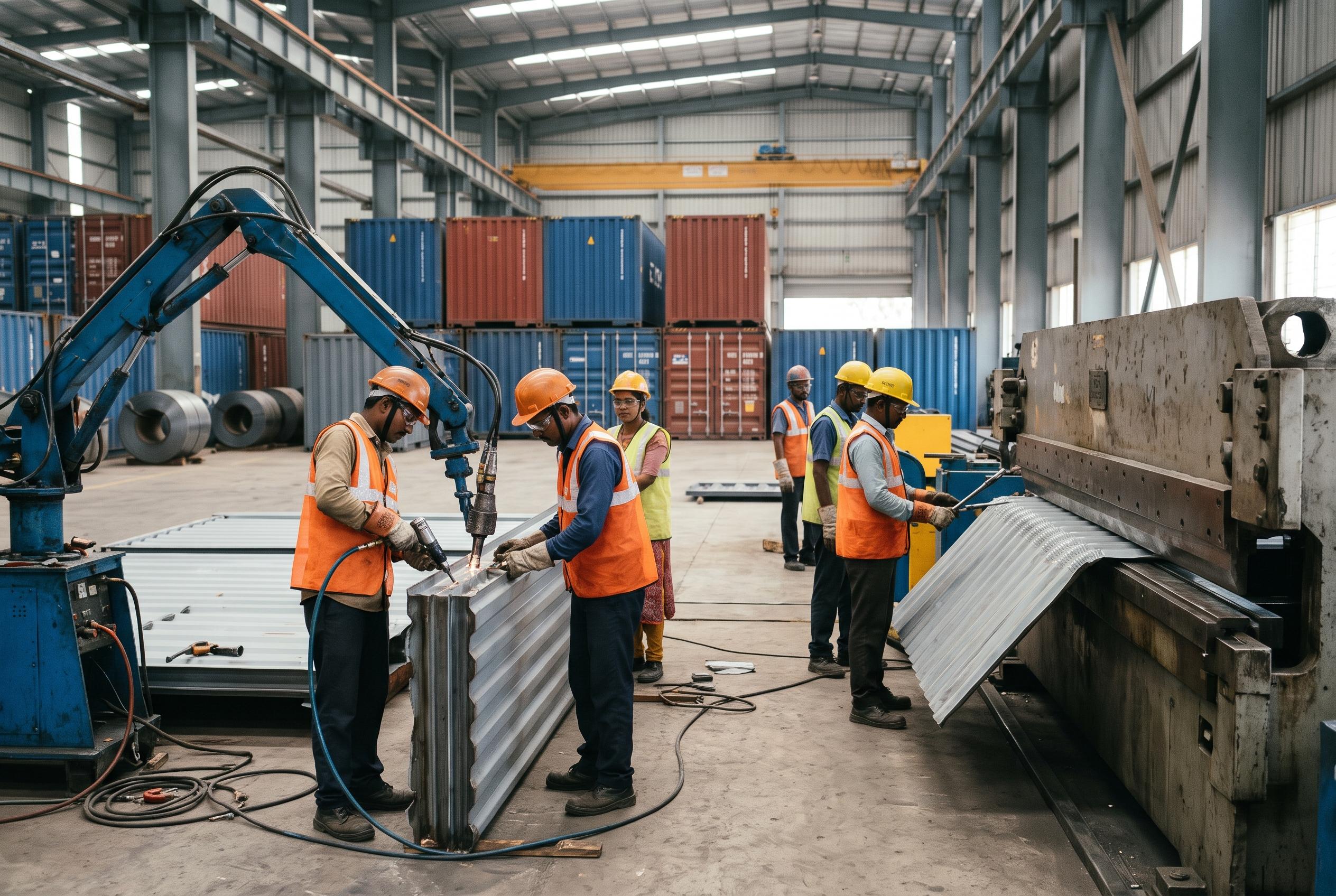

A 13-year government scheme will support factories, testing facilities and skills as India seeks to build up to 7.5 lakh TEUs of annual container capacity.
India’s Union Cabinet has approved a Rs 10,000 crore scheme to expand domestic container manufacturing and cut the country’s dependence on imports, according to the Press Information Bureau and reports in Economic Times and Business Standard. The Container Manufacturing Promotion Scheme, which replaces an earlier draft known as the Container Manufacturing Assistance Scheme, will run over 13 years to FY2039-40 and is designed to support new plants, upgrades to existing facilities, testing infrastructure and skills development. Officials have said the plan is intended to lift India’s annual container-making capacity to as much as 7.5 lakh TEUs, or twenty-foot equivalent units, and to create around 3,000 direct jobs and more than 50,000 indirect roles across the wider supply chain. The package includes Rs 859 crore in interest support for capital spending, Rs 150 crore for shared testing facilities and Rs 8,891 crore in operational support for containers made to global shipping standards and sold by eligible producers. The scheme comes as India pushes ahead with broader maritime and industrial ambitions, including a separate Rs 69,725 crore package for shipbuilding and maritime development, while recent deliveries of India-made export-import containers to A.P. Moller-Maersk and an order for 1,000 domestically made boxes from DCM Shriram Group point to growing local capability. The government has also linked the initiative to infrastructure expansion at Galathea Bay, Vadhavan, Tuna Tekra and V.O. Chidambaranar port, in what officials describe as a wider effort to strengthen supply chains and maritime self-reliance.
Disclaimer: This article is intended to inform and educate, not to recommend or endorse any financial product, investment or strategy. Please consider your own financial circumstances and seek professional advice where appropriate before making financial decisions.



