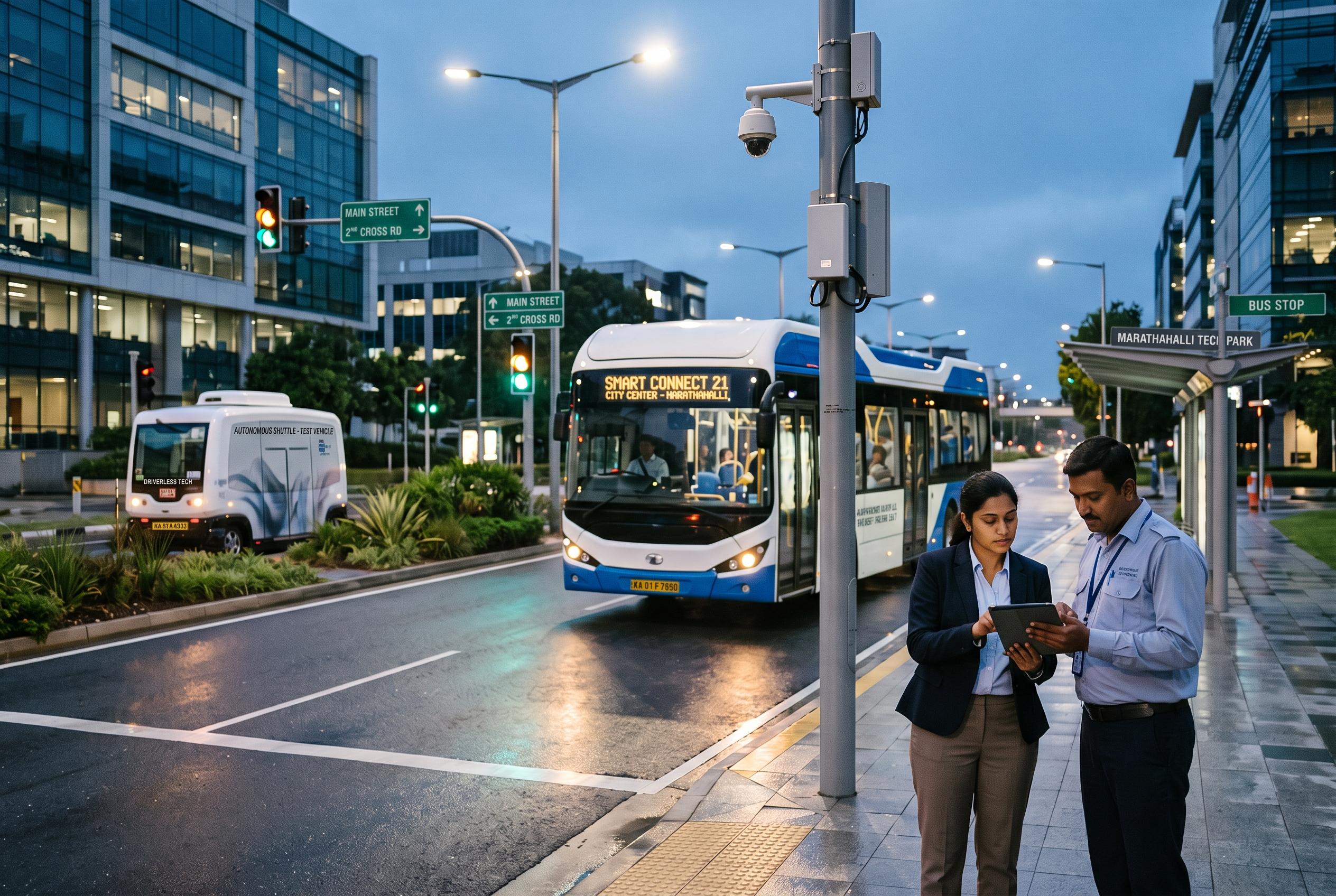

India’s standards body is aligning its evolving urban transport technology with international benchmarks to facilitate safer, interoperable, and greener mobility solutions across the country, with a focus on autonomous vehicles, smart buses, and digital network integration.
India’s standards body is moving to align the country’s connected transport ambitions with global technical rules, as autonomous vehicles, smart buses and electric mobility gain importance in urban transport planning. The Bureau of Indian Standards is adapting international specifications for intelligent transport systems and automated driving test scenarios to Indian conditions, while also developing domestic standards for smart community transport. That work is aimed at making vehicles, roads and digital networks more interoperable and safer as the country builds towards smarter, lower-emission mobility.
At the centre of that effort is intelligent transport systems, or ITS, a broad term for technology that uses real-time data and communications to make road transport safer and more efficient. According to BIS, that includes advanced traffic management systems and vehicle-to-everything links, a set-up that covers vehicle-to-vehicle and vehicle-to-infrastructure communication. ISO’s standard for ITS station architecture, ISO 21217, sets out the communications framework for these networks, and BIS says it is working through its technical committees to harmonise Indian standards with relevant international benchmarks.
The government is already backing parts of that shift. It has launched support for advanced information and communication technology in public buses operated by state transport undertakings, and it has rolled out automated traffic management systems on major highway projects including the Delhi-Mumbai Expressway, the Trans-Haryana Expressway, the Delhi-Dehradun Expressway and the Amritsar-Jamnagar Expressway. In the Bangalore-Mysuru Expressway project, officials reviewed accident data before and after ATMS installation and found a drop in fatalities after the system went live in July 2024, according to the report.
Regulatory changes are also making it easier to deploy the technology behind connected and automated driving. India has removed licensing requirements for certain radio spectrum used by radar sensors in the 77GHz to 81GHz band and for systems operating in the 5.9GHz band, which supports vehicle-to-vehicle and vehicle-to-infrastructure communication. Those steps bring the country closer to rules used in the US and the European Union and could reduce the need for India-specific hardware. BIS is also examining standards for logistics visibility, including ISO 23354, as the ecosystem expands beyond private cars to buses, freight and other public transport uses.
Disclaimer: This article is intended to inform and educate, not to recommend or endorse any financial product, investment or strategy. Please consider your own financial circumstances and seek professional advice where appropriate before making financial decisions.