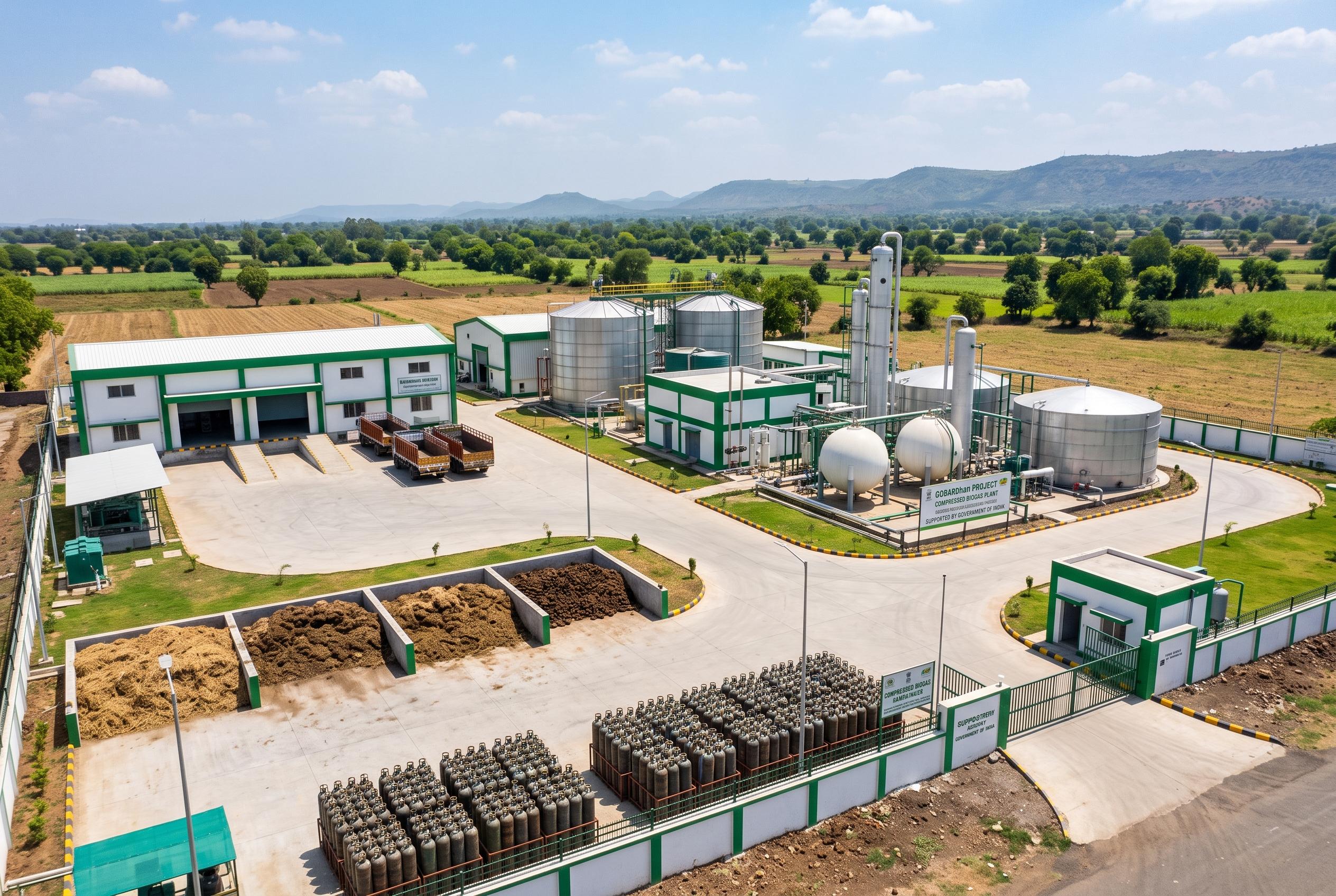

India’s government has approved a ₹23,731 crore package to fast-track the production of compressed biogas under the GOBARdhan programme, aiming to strengthen bioenergy, improve waste management, and meet ambitious renewable energy goals amid slow sector growth.
India’s Cabinet has approved a ₹23,731 crore package to speed up compressed biogas production under the GOBARdhan programme, a move the government says will strengthen bioenergy, improve waste management and support the circular economy. According to the announcement, the scheme is designed to give producers clearer long-term signals on demand and pricing, a response to one of the sector’s biggest barriers: uncertainty over who will buy the fuel and at what price.
The plan is being built around six policy levers, including guaranteed offtake, an administered pricing framework, capital support for new projects, pipeline infrastructure, credit guarantees and a challenge fund for new technology. That combination is meant to make projects easier to finance and more attractive to private investors, while reducing reliance on fossil fuels. The Financial Express reported that the wider Sampoorn GOBARdhan Scheme is intended to support 5,000 plants and annual output of 15 million metric tonnes by 2030.
GOBARdhan, short for Galvanizing Organic Bio-Agro Resources Dhan, focuses on turning agricultural residue, cattle dung and other biodegradable waste into biogas, compressed biogas and organic manure. The Department of Drinking Water and Sanitation serves as the nodal agency for the programme. Government material on the scheme says the wider push is intended to create a cleaner waste-to-energy system while also generating rural jobs and income.
The new funding commitment also reflects how far the sector still has to go to meet earlier targets. Drishti IAS said only 115 compressed biogas plants were functional as of December 2024, well short of the 2030 goal of 5,000. At the same time, the government has said registration is picking up: the PIB reported that 426 CBG plants and more than 1,163 biogas plants had registered on the unified GOBARdhan portal, with registered projects eligible for market development assistance. Industry updates have pointed to hundreds more projects either registered or under construction, suggesting the pipeline is growing even if operational capacity remains limited.
Disclaimer: This article is intended to inform and educate, not to recommend or endorse any financial product, investment or strategy. Please consider your own financial circumstances and seek professional advice where appropriate before making financial decisions.