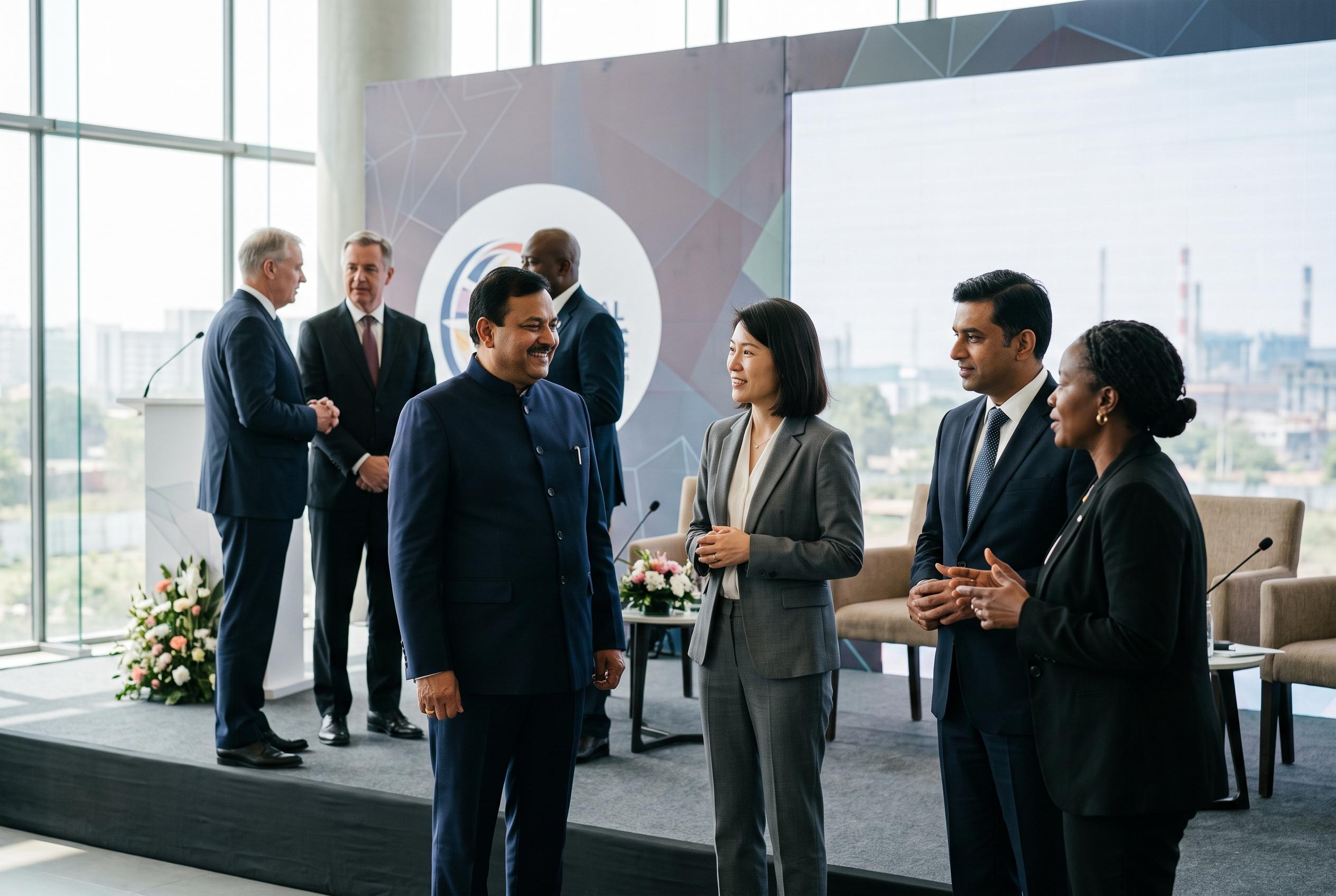

Ministers from Assam, West Bengal and Bihar showcase regional strengths and investment opportunities at the ICC Global Business Summit 2026, aiming to position eastern India as the next manufacturing and services frontier.
At the ICC Global Business Summit 2026 in New Delhi, ministers from Assam, West Bengal and Bihar used the platform to make a broader case for eastern India as the next frontier for investment, manufacturing and services. The session, held on September 18 at Taj Palace, was framed around growth, risk and resilience, with the states presenting themselves as complementary rather than competing destinations.
Assam Chief Minister Himanta Biswa Sarma led with an argument that the state’s recent gains are no longer just aspirational. According to the Assam government’s own summit material, the state has been pursuing a concentrated investment pitch since Advantage Assam 2.0 in February 2025, when it positioned itself as a hub for food processing, tourism, information technology and other sectors. The state also points to a 19.5 per cent rise in gross state domestic product in 2023, while the budget for 2025-26 projects GSDP at Rs 7,41,626 crore. Sarma told delegates that Assam’s economy is expanding quickly, with industry now taking a larger share of state output, and he highlighted the Tata semiconductor assembly and test project at Jagiroad as a sign that the state can attract large-scale, high-value investment.
The Assam chief minister also sought to reassure investors on execution, not just ambition. He said more than 3,700 factories have opened since May 2021 and that the state’s single-window clearance system has processed millions of approvals. That emphasis on delivery is important because the government has been under pressure to show that summit promises are converting into actual projects. Reporting after Advantage Assam 2.0 suggested that a large share of the investment pipeline was already moving forward, with some estimates putting commitments at roughly Rs 4.91 lakh crore and more than 60 per cent said to be in advanced implementation.
Sarma also underlined logistics and infrastructure, citing airports, a new terminal at Guwahati and a wider push to link the Brahmaputra corridor with industrial activity. He argued that Assam’s geography, combined with policy support and renewable energy plans, gives the state a chance to become a regional manufacturing base. In a striking sign-off, he told investors that senior officials would respond quickly at any hour, an appeal designed to project administrative accessibility as a competitive advantage.
West Bengal Finance Minister Swapan Dasgupta took a more self-critical line, acknowledging that his state had fallen behind in industrial momentum. He argued that Bengal’s recovery depends on using its position as a gateway to Assam and the Northeast, while improving predictability for investors. Bihar Industry Minister Shreyasi Singh, meanwhile, portrayed her state as an emerging success story, citing a sharp rise in investment inflows and a growing export base. Together, the three ministers presented eastern India as a region with distinct strengths but a shared need for infrastructure, policy continuity and investor confidence. The summit also featured memoranda of understanding and business awards, reinforcing the event’s attempt to link policy messaging with commercial partnerships.
Disclaimer: This article is intended to inform and educate, not to recommend or endorse any financial product, investment or strategy. Please consider your own financial circumstances and seek professional advice where appropriate before making financial decisions.