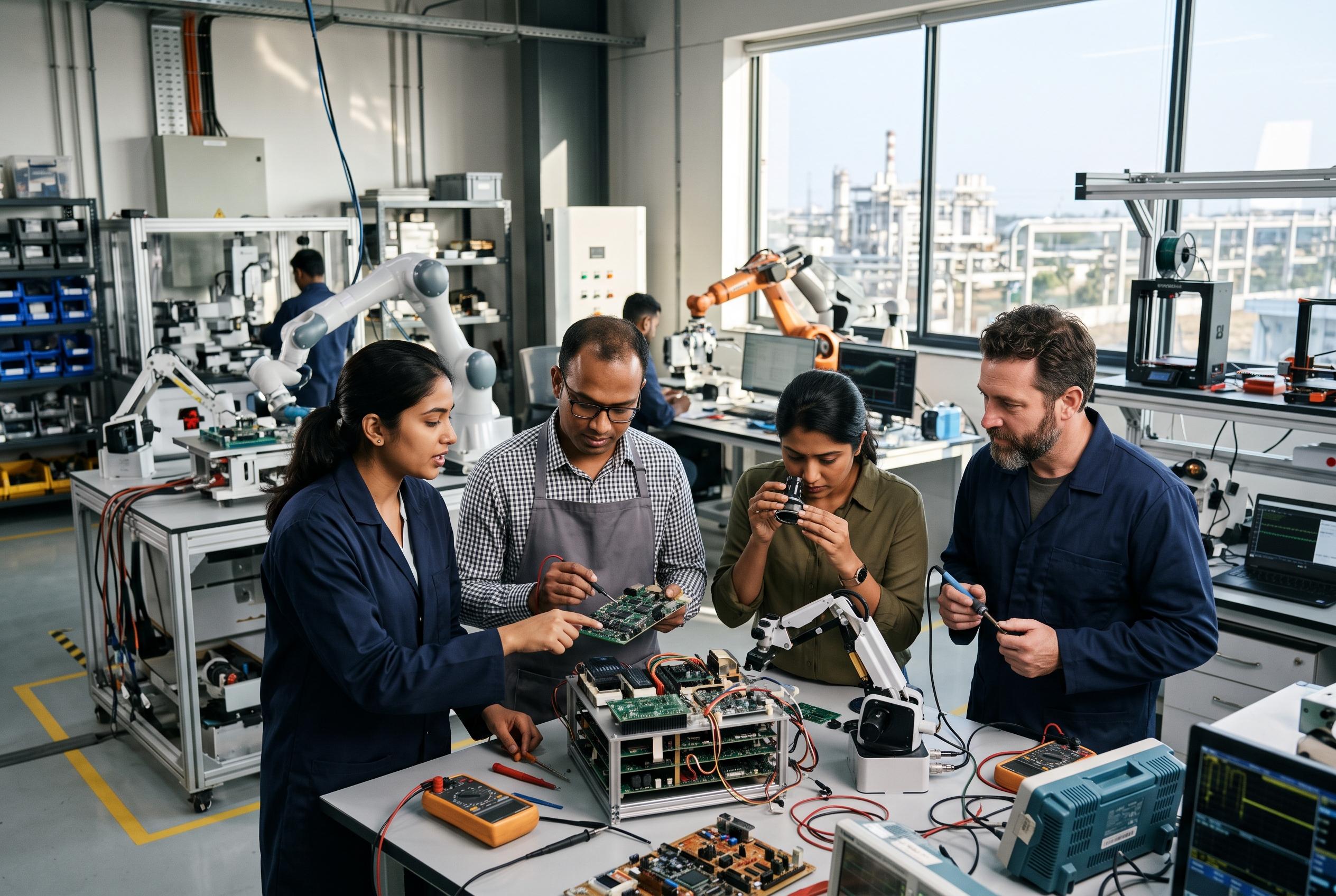

Andhra Pradesh is transforming its policy announcements into a comprehensive industrial strategy, emphasising deep-tech start-ups, hardware ecosystems, and regional innovation hubs to drive manufacturing-led growth beyond traditional software solutions.
Andhra Pradesh is trying to turn a policy announcement into an industrial strategy. In May, the state government and the Small Industries Development Bank of India said they would set up an angel fund for deep-tech start-ups, with a focus on artificial intelligence, electronics, quantum technologies and advanced manufacturing. The effort is being channelled through the Ratan Tata Innovation Hub, which the state presents as its main platform for entrepreneurship and technology-led growth.
The wider ambition goes beyond funding alone. According to the Ratan Tata Innovation Hub, the state is building a hub-and-spoke network anchored in Amaravati and supported by regional centres in Visakhapatnam, Vijayawada, Rajahmundry, Tirupati and Anantapur. The hub says it wants to connect start-ups with markets and research while backing work in AI, biotech, clean energy, advanced manufacturing and other emerging technologies.
That matters because Andhra Pradesh already has the outline of a hardware ecosystem. The state’s industrial electronics base stretches across Tirupati and Sri City, Kadapa, Visakhapatnam and Anantapur, with activity in mobile components, consumer electronics, batteries, displays and semiconductors. For founders, that changes the playbook: the opportunity is not simply to build another software product, but to solve industrial problems with hardware and embedded systems that can be prototyped, tested and manufactured closer to home.
The strongest use cases are likely to be practical ones. That could include predictive maintenance sensors for factories, machine-vision tools for quality control, battery-management systems for electric vehicles, low-cost medical devices for clinics, crop-disease detection for farmers and industrial AI products that work at the edge, where connectivity is patchy. The lesson is to begin with a concrete local problem, match it to a feasible technology and then test whether customers will pay for a product that is reliable, affordable and easy to deploy.
The timing may be favourable. The article published by Way2World points to official estimates that roughly 48% of India’s registered start-ups now come from Tier-2 and Tier-3 cities, a sign that innovation is spreading beyond the biggest metropolitan centres. If Andhra Pradesh can convert that shift into manufacturing-led deep tech, its real test will be less about slogans than execution: whether founders can move from prototype to production, and from ambition to repeatable sales.
Disclaimer: This article is intended to inform and educate, not to recommend or endorse any financial product, investment or strategy. Please consider your own financial circumstances and seek professional advice where appropriate before making financial decisions.