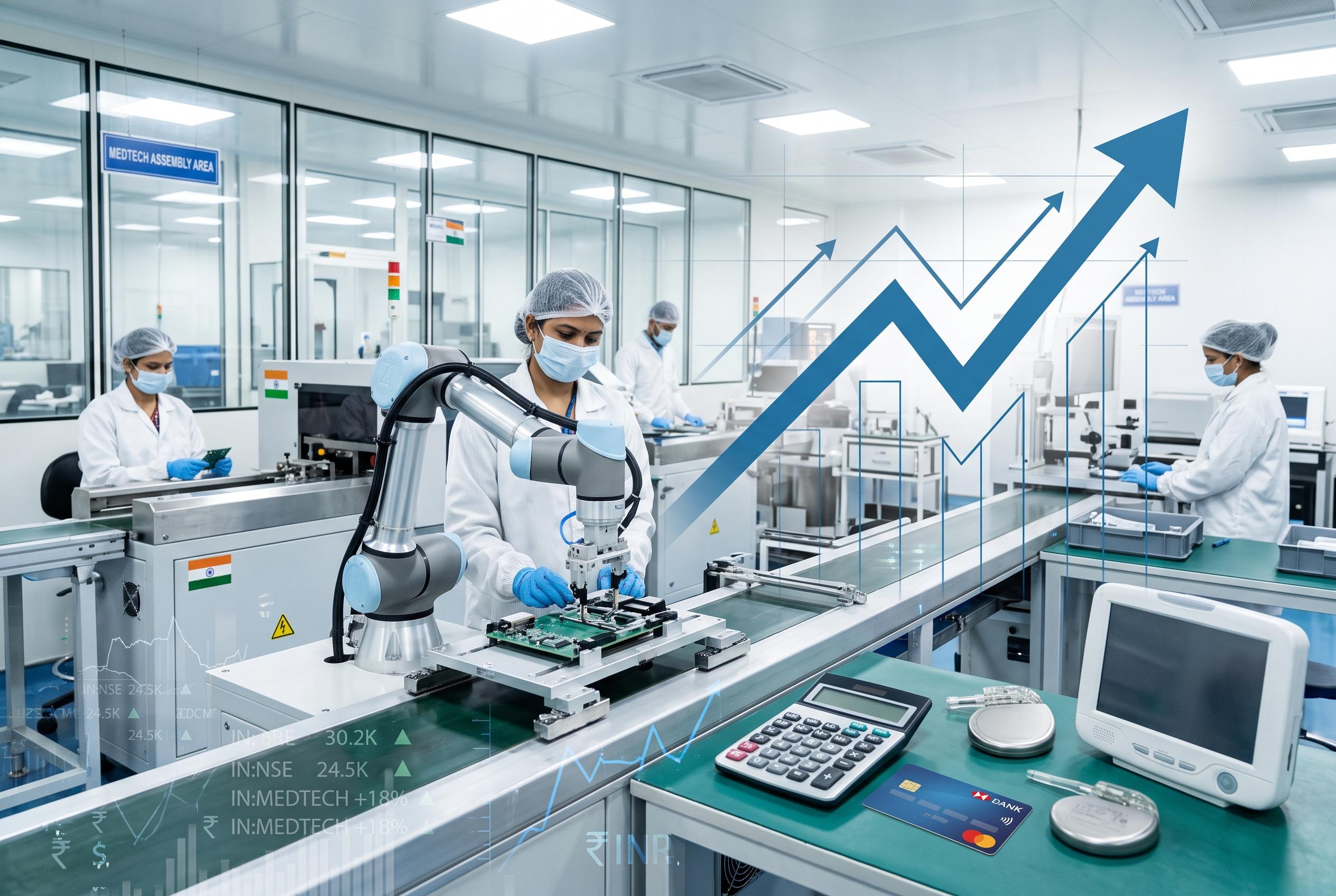

India’s medical device sector is expected to surge to $250 billion by 2047, driven by domestic manufacturing, technological advancement, and strategic policy initiatives, positioning the country as a key global player in healthcare technology.
India’s medical device industry is being cast as a future heavyweight, with a new white paper presented at a conference in New Delhi projecting that the market could swell to $250 billion by 2047 from about $14 billion today. The forecast was unveiled at India Medical Device 2026, where policymakers, regulators and executives gathered to discuss how the country can position itself as a global hub for quality medical technology.
The study, jointly prepared by FICCI and DUA Consulting, argues that the sector could reach $30 billion to $50 billion before the end of this decade if current momentum holds. It says that will depend not only on more factories and larger output, but also on a stronger system for servicing, calibration, maintenance and lifecycle management of equipment, which it describes as essential for patient safety, reliability and better use of healthcare spending. The paper also calls for a hybrid maintenance model, a national certification system for service engineers, better technical training and wider use of digital tools such as predictive maintenance.
At the conference, Manoj Joshi, secretary in the Department of Pharmaceuticals, said India should stop seeing the sector only through the lens of domestic substitution and instead build an export-focused industry with deeper value addition. He said the country has made progress in consumables, disposables and the assembly of complex diagnostic and imaging equipment, but must strengthen component manufacturing, quality standards and links to global supply chains. According to government and industry data cited in related reports, India’s medical devices market was valued at about $11 billion to $15.2 billion in 2025, while projections for 2030 range from roughly $50 billion to $50.1 billion.
Dr Rajeev Singh Raghuvanshi, the drugs controller general of India, said the industry is moving away from import dependence towards domestic manufacturing, but that the next stage will require stronger local capability in high-end Class C and Class D devices and in-vitro diagnostics. Separate industry reports cited government initiatives including the National Medical Devices Policy, the production-linked incentive scheme, medical device parks and MedTech Mitra as key drivers of expansion, even as imports still outweigh exports in advanced categories.
The conference also highlighted the role of artificial intelligence in the next phase of growth. A paper released during the event said AI-enabled diagnostics are likely to be the first large-scale use case, extending specialist expertise into primary and secondary care. It warned, however, that wider adoption will require better clinical evidence, clearer regulation for adaptive AI and practical reimbursement systems. In another session, Dr Rajiv Bahl said medical innovation must be backed by evidence if it is to remain affordable, accessible and sustainable.
Disclaimer: This article is intended to inform and educate, not to recommend or endorse any financial product, investment or strategy. Please consider your own financial circumstances and seek professional advice where appropriate before making financial decisions.