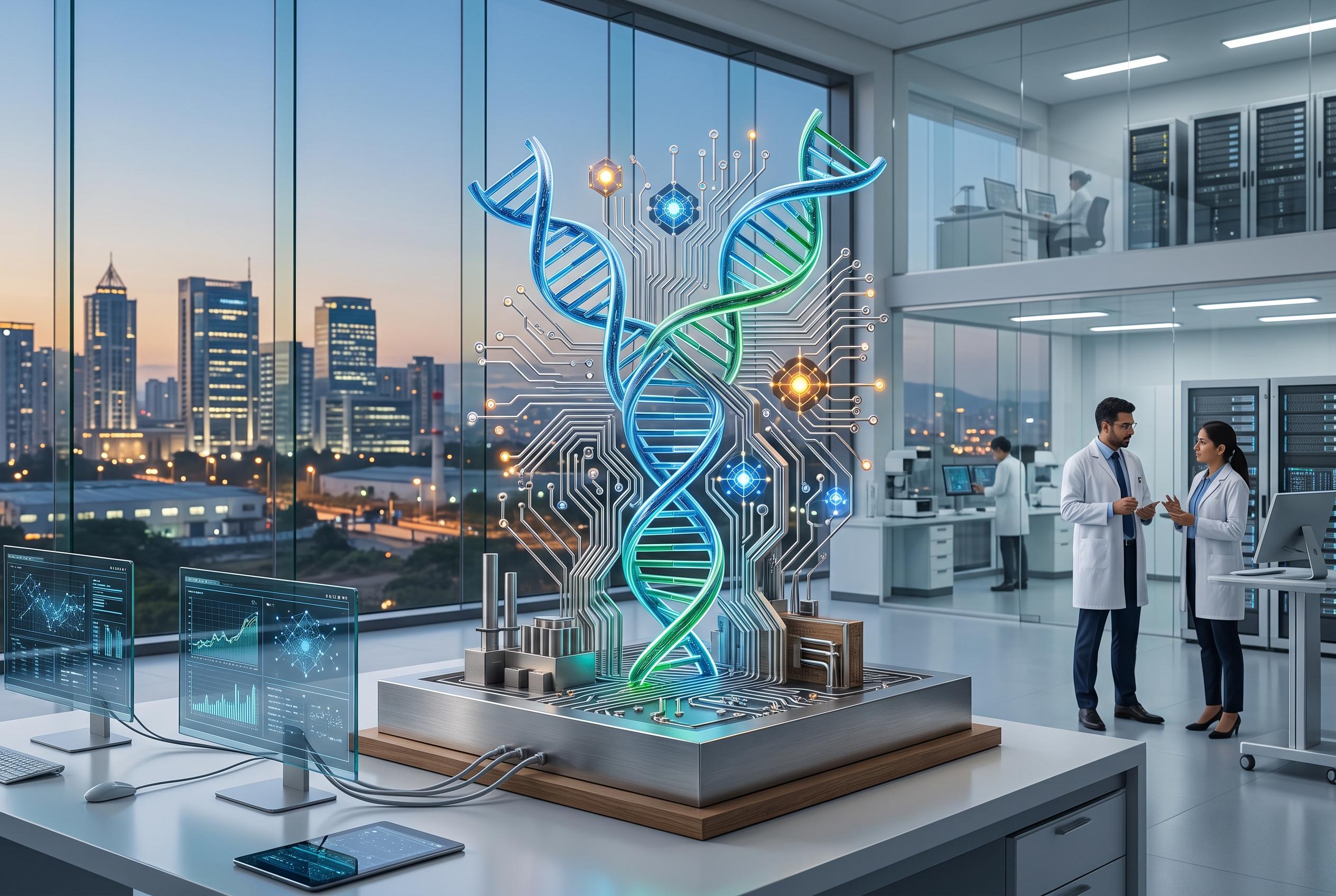

India is positioning itself at the forefront of the next industrial revolution by ramping up investments in biotechnology, AI, and quantum computing, aiming to build a trillion-dollar bioeconomy and lead technological advances over the coming decades.
India is trying to position itself at the centre of the next wave of industrial change, with Union Minister of State Dr Jitendra Singh arguing that artificial intelligence and biotechnology will define the coming era. Speaking at a media conclave in New Delhi on Sunday, Singh said India had moved early in several frontier sectors and was no longer waiting to catch up with global technology shifts.
The minister pointed to the BioE3 policy, short for biotechnology for economy, employment and environment, as evidence of that push. According to industry data cited by the India Brand Equity Foundation, India is aiming to build a bioeconomy worth ₹90.86 lakh crore, or $1 trillion, by 2047, while the number of biotech start-ups has risen from fewer than 100 in 2014 to more than 11,000 today. That expansion is being backed by new infrastructure, including a national biofoundry network and advanced research facilities.
India is also widening its bet on quantum technologies. The government approved the National Quantum Mission in 2023 with a budget of ₹6,003.65 crore for the period from 2023-24 to 2030-31, according to publicly available mission details. Its goals include building quantum computers with 50 to 1,000 physical qubits, creating secure communication networks and developing research hubs across quantum computing, communication, sensing and materials. A separate report this year said officials are targeting computers with up to 1,000 qubits and a 2,000-kilometre quantum network.
Artificial intelligence is being treated with similar urgency. The IndiaAI Mission has been allocated ₹10,300 crore over five years, according to the India Brand Equity Foundation, with plans for high-performance computing, an open GPU marketplace and AI centres of excellence in sectors such as healthcare, agriculture and education. Gadgets 360 reported that senior officials have described AI as a new industrial revolution and have highlighted the need for tighter safeguards, especially around deepfakes.
Research published by Nature also suggests the shift is becoming visible on the ground. It described new biofoundries in Delhi and Chennai that use automation, AI and synthetic biology to speed up the design of microbe-based products such as fuels, cosmetics and speciality chemicals. But the publication also noted that scaling these efforts will depend on expanding trained talent, underscoring the gap between ambition and execution. Singh, meanwhile, cited India’s space economy as another example of the country’s technological leap, saying it has grown from a negligible base to about $9 billion and could reach $40 billion to $45 billion in the next eight to nine years after private participation was opened up in 2020.
Disclaimer: This article is intended to inform and educate, not to recommend or endorse any financial product, investment or strategy. Please consider your own financial circumstances and seek professional advice where appropriate before making financial decisions.