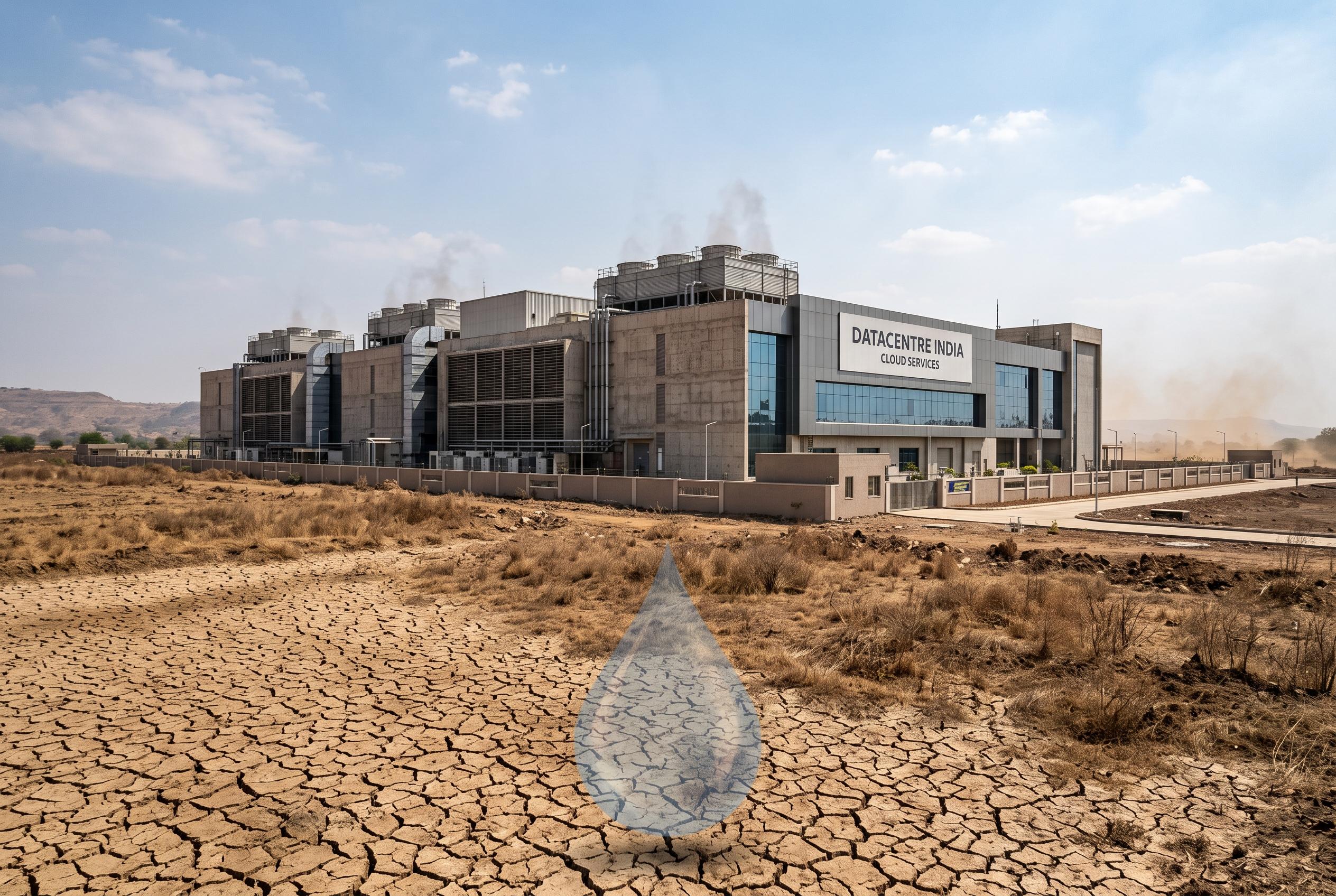

As India accelerates its digital transformation with new data centres and AI applications, mounting water consumption and environmental concerns threaten to stall its ambitious growth plans, prompting calls for sustainable solutions.
The rush to build the infrastructure behind artificial intelligence is colliding with a less visible constraint: water. Research from the University of California, Riverside, suggests that a single ChatGPT conversation of 20 to 50 exchanges can use about half a litre of water, a figure that reflects both the cooling systems needed for servers and the water used indirectly to generate electricity. The finding has sharpened concern over the environmental cost of the digital economy just as demand for AI tools accelerates worldwide.
India is at the centre of that expansion. Industry data shows the country’s data centre capacity has climbed from about 375 MW in 2020 to roughly 1,500 MW by 2025, with projections pointing far higher over the next decade. Government estimates cited by Mint suggest data centres could require an extra 26.3 GW of power by 2031-32, most of it tied to AI workloads. Other industry forecasts point to capacity reaching 4,500 MW or even 6.5 GW by 2030, underlining how quickly the sector is scaling.
That growth is being encouraged by state-level incentives and major corporate bets. Andhra Pradesh’s Data Centre Policy 4.0 offers tax reimbursements, stamp duty relief and easier access to power for large projects. Uttar Pradesh has approved a policy aimed at more than 2 GW of additional capacity, while Gujarat wants to build 7.5 GW by 2026-29. Google and AdaniConneX are planning a 1 GW AI hub in Visakhapatnam, while other large projects are being developed in Jamnagar and elsewhere, even as similar proposals have drawn protests in Visakhapatnam and Thane over strain on water and electricity.
The concern is not abstract. The Central Ground Water Board’s 2024 assessment puts India’s overall groundwater extraction at 60.47%, with 11.1% of assessment units already classed as over-exploited. Gautam Buddha Nagar, which hosts at least 17 operational or planned data centres, is drawing 104.79% of the groundwater available to it each year. Hyderabad is officially over-exploited, while Visakhapatnam has relatively low reserves and Gujarat’s coastal belts face seawater ingress and salinity.
Some operators are looking to seawater cooling as a partial answer, and Google has used Baltic seawater for a Finnish data centre for more than a decade. But environmental specialists warn that this brings its own risks, particularly brine discharge into marine ecosystems. Shaolei Ren of the University of California, Riverside, has argued for mandatory disclosure of water use and water sources, while B.V. Subba Rao, a former official with the Central Ground Water Board, says clustering large facilities in water-stressed areas could worsen local shortages. For India’s digital build-out, the challenge is increasingly not just how fast to grow, but how to do so without draining the resources that make that growth possible.
Disclaimer: This article is intended to inform and educate, not to recommend or endorse any financial product, investment or strategy. Please consider your own financial circumstances and seek professional advice where appropriate before making financial decisions.