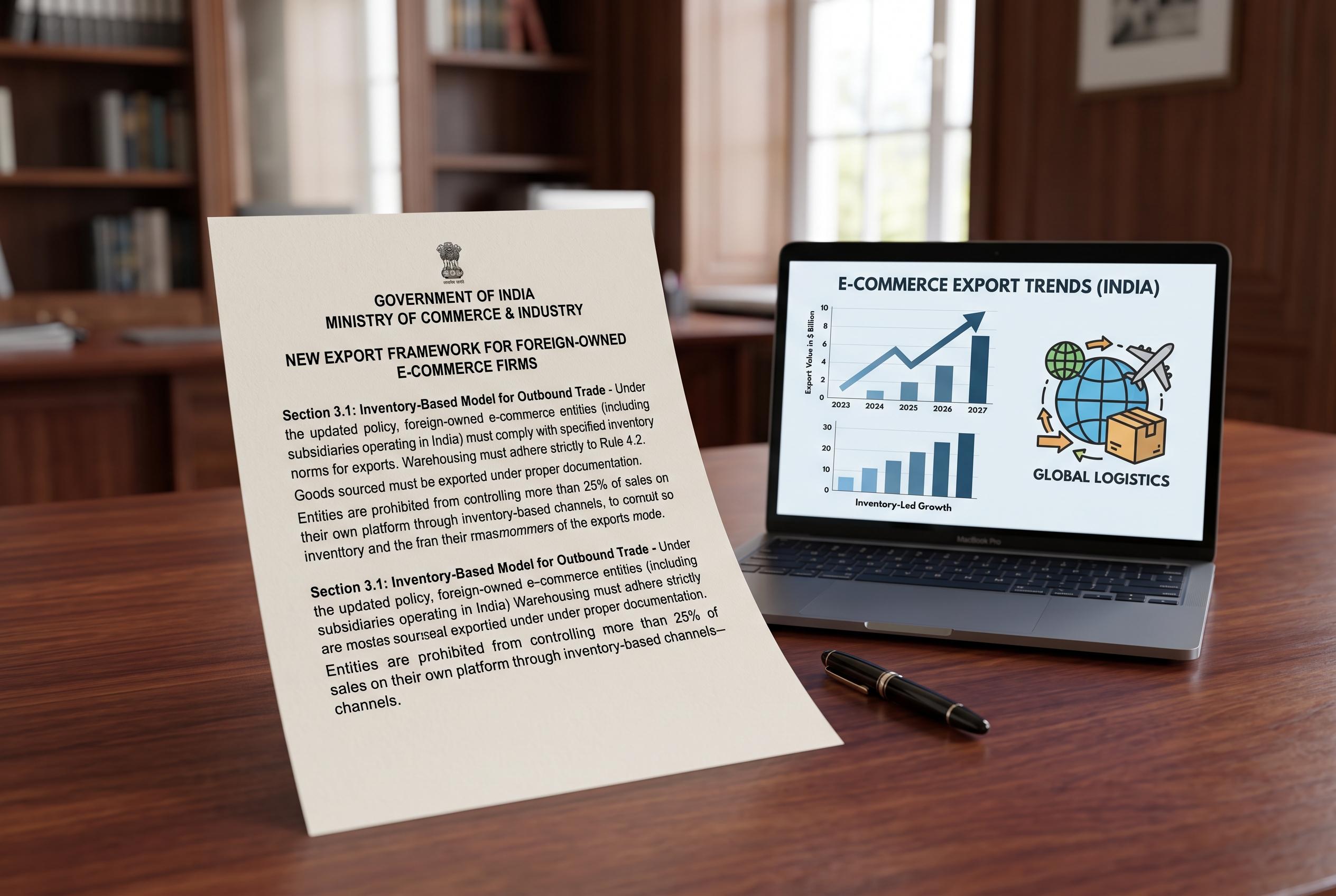

India introduces a framework allowing foreign-owned e-commerce companies like Amazon and Flipkart to use inventory-based models for exports, aiming to boost outbound trade while maintaining domestic retail restrictions.
India has notified a framework that will allow foreign-owned e-commerce companies such as Amazon and Flipkart to use inventory-based models for exports, opening a new route for overseas sales of goods made in India while leaving domestic retail restrictions intact. According to the Directorate General of Foreign Trade, the move follows the Department for Promotion of Industry and Internal Trade’s Press Note 3 of 2026 and is designed to support outbound trade without altering the ban on inventory-led business-to-consumer e-commerce for the home market.
Under the new rules, companies must set up a separate legal entity in India and register that entity with the DGFT as an Exporter-on-Record, with both an Importer-Exporter Code and Goods and Services Tax registration. Domestic suppliers, described as Sellers-on-Record, must also be GST-registered and can supply only goods of Indian origin. Business Standard reported that the policy keeps the focus squarely on exports of domestically manufactured products.
The framework places tight controls on stock handling and fulfilment. Exporters may buy goods only against confirmed orders, not in anticipation of demand, and export inventory must be kept separately and digitally connected to the seller, overseas customer order and export paperwork. Returned or rejected goods cannot be resold in India, either directly or through another entity. The DGFT also said exporters can use notified e-commerce export hubs to help manage cross-border trade.
Industry reaction has been broadly positive. Amazon said the policy gives clarity on inventory-based export operations and supports its goal of enabling $80 billion in cumulative exports from India by 2030. Trade specialists told KNN and other publications that the framework could help smaller manufacturers and micro, small and medium-sized enterprises reach foreign buyers through the logistics, payments and market access of large platforms. Ajay Srivastava of the Global Trade Research Initiative said the model resembles the export house system, while Spencer Cohen of High Peak Strategy said it could widen India’s exporter base and strengthen sales of “Made in India” products abroad.
Disclaimer: This article is intended to inform and educate, not to recommend or endorse any financial product, investment or strategy. Please consider your own financial circumstances and seek professional advice where appropriate before making financial decisions.