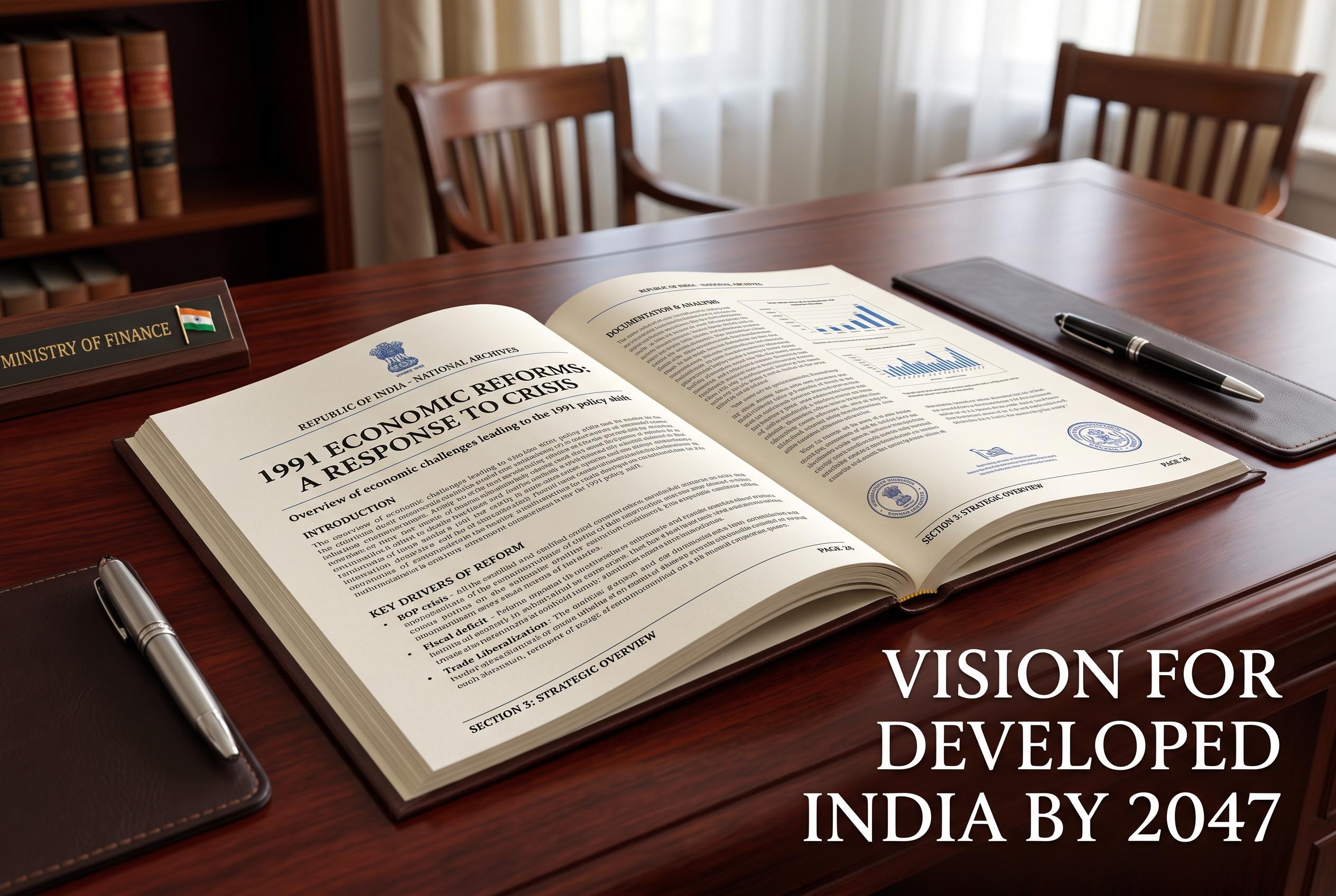

Union Finance Minister Nirmala Sitharaman highlights that India’s 1991 economic liberalisation was driven by necessity rather than choice, emphasizing progress since then and outlining her vision for a developed India by 2047 focused on growth, sustainability, and cultural pride.
Union Finance Minister Nirmala Sitharaman said India’s 1991 economic reforms were forced by crisis rather than chosen freely, arguing that the liberalisation drive of the PV Narasimha Rao government came in response to an acute balance-of-payments emergency. Delivering the CD Deshmukh Memorial Lecture at the 23rd India Policy Forum in New Delhi, she said the reforms were “born of compulsion rather than of choice” and marked a turning point in the country’s economic direction.
Sitharaman said the pace of development quickened around the turn of the millennium, when economic progress, physical connectivity and digital infrastructure rose to the top of the policy agenda. She suggested that the momentum built during that period carried through the years that followed, including the United Progressive Alliance government’s time in office from 2004 to 2014, and helped prepare the ground for later expansion.
Looking back on the past 12 years under Narendra Modi, she said India had continued to build momentum even as the global environment deteriorated. Sitharaman described the period as one in which repeated shocks and rare “black swan” events became a regular feature, but said these did not turn into an excuse for stagnation. She said millions of people had moved out of poverty during this period.
Turning to the government’s Viksit Bharat agenda, Sitharaman said the goal of making India a developed country by 2047 should be seen not as a new ambition but as a restoration of a long-term national purpose. She called for the country to discard what she described as the remnants of a colonial mindset and the “psychology of victimhood”, and argued for a model of growth that is prosperous without becoming consumerist, wealthy without becoming materialistic and globally successful without losing civilisational character. Related policy documents and commentary on Viksit Bharat have framed the plan as a broad development vision stretching across economic growth, social equity, technology, sustainability and governance.
Disclaimer: This article is intended to inform and educate, not to recommend or endorse any financial product, investment or strategy. Please consider your own financial circumstances and seek professional advice where appropriate before making financial decisions.