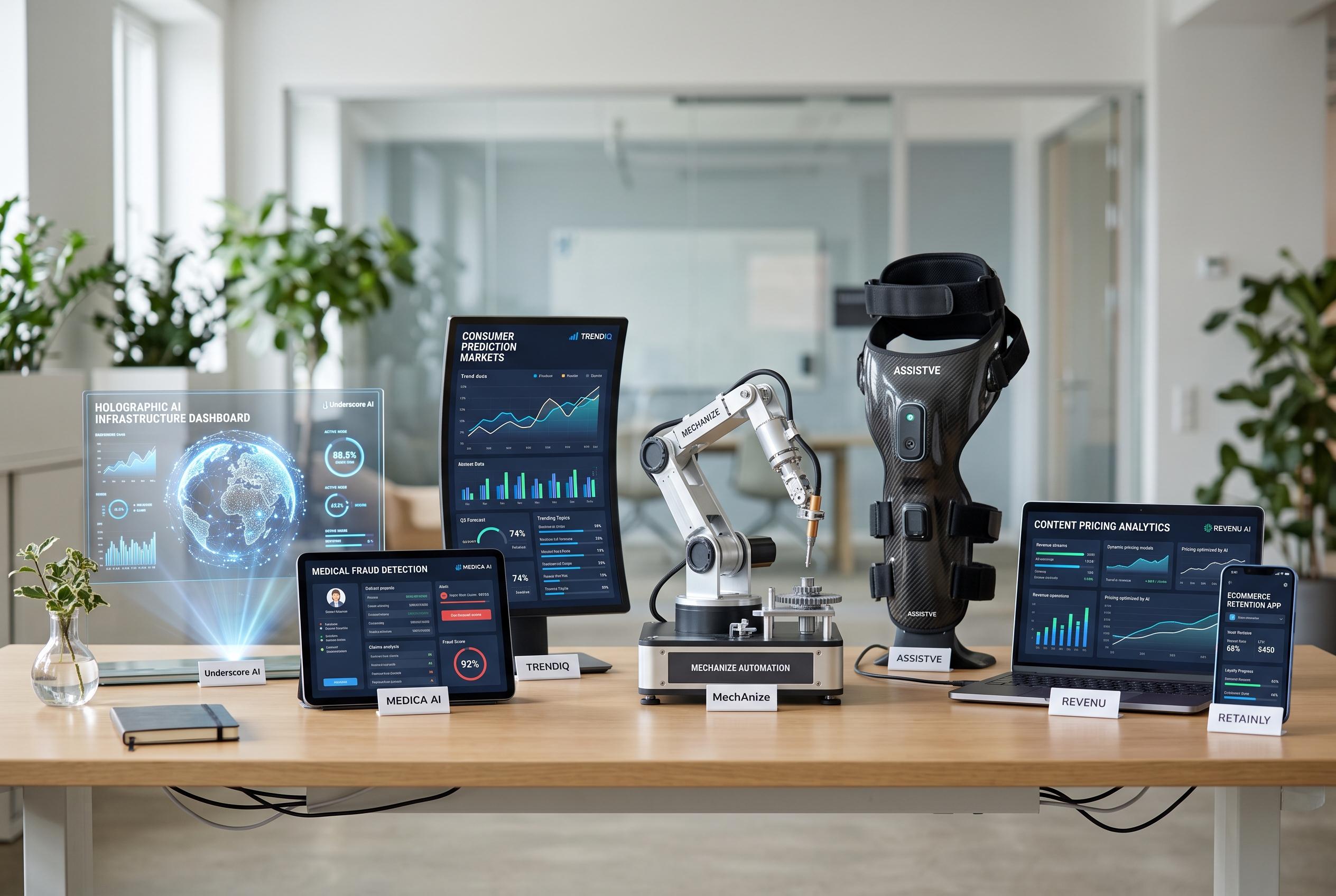

Underscore Capital’s Pearce Summer Fellowship supports seven early-stage companies developing disruptive technologies in AI-enabled infrastructure, healthcare fraud detection, consumer prediction markets, manufacturing automation, assistive mobility, AI content pricing, and ecommerce retention strategies, fostering momentum for future growth.
Underscore Capital is using the second year of its Pearce Summer Fellowship to back seven early-stage teams it says are building for markets that have not yet caught up with the way people and businesses now behave. The programme is designed for founders who are already under way as well as those still testing an idea, with flexible funding, mentorship and access to the firm’s network.
Several of the startups are aimed at infrastructure that is being reshaped by AI. Marty Coleman’s Second Wind is focused on helping companies sell to AI agents as Gartner projects that more than $15 trillion in B2B spend will move through AI systems by 2028. The company is building tools to explain why businesses lose AI-influenced deals, create machine-readable evidence and track commercial impact, while Coleman said his summer priorities are to improve the product, recruit engineers and win customers.
Rema Ali’s Rybera is targeting healthcare claims fraud, a problem that Healthcare IT News says costs the US about $68 billion a year. The company is using a multilayer detection system to spot suspicious billing patterns and cross-network connections before claims are paid, including schemes that may be amplified by generative AI-written clinical notes. Ali, who previously worked on claims at McKinsey, plans to spend the summer meeting insurers and fraud specialists as she refines the business.
Other fellows are building around new forms of consumer behaviour. Abbi Park’s Spike is a prediction market for short-form video virality, turning TikTok-style attention into a game around whether a clip will outperform or underperform expectations. Park, who already has a large TikTok following and has built award-winning software, is seeking a strong launch and partnerships with creators and entertainment contacts as she tests demand for a market built on cultural instinct.
On the manufacturing side, Tyler Mangini and Arshaan Ali’s Interlock Systems is trying to shorten the long gap between design and production. Industry reporting says factories can spend weeks preparing work that takes only hours to execute, largely because engineers still have to stitch together disconnected systems and reconcile machine limits with design files. Interlock is building an agentic platform that plugs into ERP systems and workflows to automate much of that engineering work, and the team is already working with design partners ahead of scheduled first deployments.
Bradley Wagman and Viktor Bokisch’s Sole 1 is taking aim at assistive mobility devices that too many patients stop wearing. Research cited by the National Library of Medicine puts lower-limb mobility loss at around 24 million people in the US, yet braces and similar devices are often abandoned because they are uncomfortable, stigmatising or hard to wear with normal shoes. Sole 1 is developing a smart sock that fits inside everyday footwear, with the summer focused on a pre-commercial prototype and pilot testing with physical therapists.
Noa Schwartz’s Offprint is building what she sees as a new pricing layer for publishers as AI agents begin consuming content at scale. The company is developing dynamic pricing and metering for retrievals rather than human subscriptions, aiming to help publishers capture value as traffic shifts from people to agents. Schwartz plans to test the model through a paid pilot, ideally with an academic publisher or data aggregator.
Audrey Hansen and Olivia Davis’s Siren is targeting the post-purchase stage of ecommerce, which they argue has been left without much infrastructure despite its importance to retention and repeat sales. The company has already gone live with its first customer, a mid-sized apparel brand on Shopify, and is using native iMessage agents to keep a 1:1 relationship going after checkout. Underscore says the wider goal of the fellowship is not polish but momentum: helping founders prove their models in the real world, meet the right people and lay the groundwork for what comes next.
Disclaimer: This article is intended to inform and educate, not to recommend or endorse any financial product, investment or strategy. Please consider your own financial circumstances and seek professional advice where appropriate before making financial decisions.