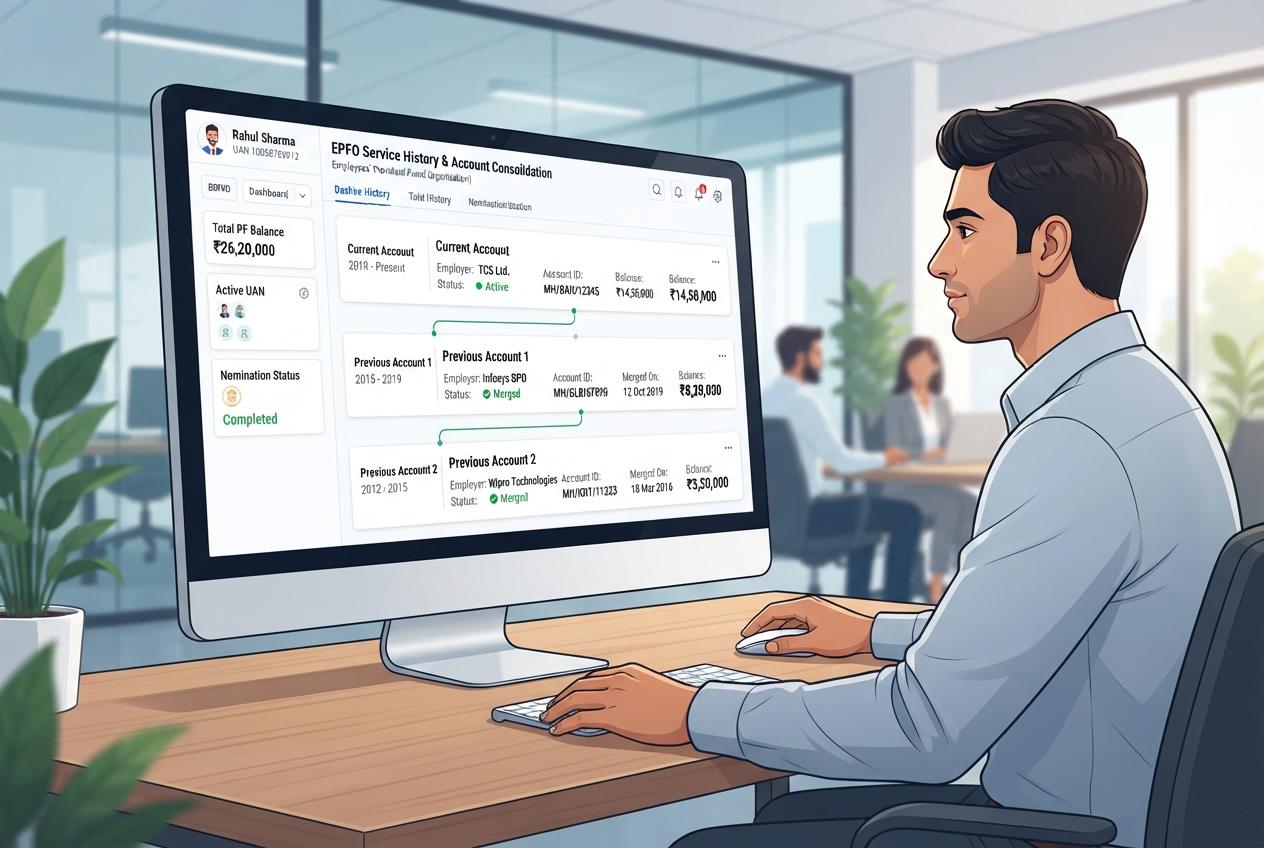

The Employees’ Provident Fund Organisation has launched an upgraded portal with a Service History tool to help workers identify and link multiple old PF accounts, reducing administrative hurdles during transfers and pension claims.
Employees who changed jobs before the Universal Account Number became the norm may have more than one provident fund trail hidden in EPFO’s system, and that can quietly complicate transfers, withdrawals and even pension claims. According to Business Standard, the Employees’ Provident Fund Organisation has now added a Service History feature to its upgraded Unified Member Portal to help members spot older jobs and PF accounts that were never fully linked to their current UAN. Mint, Financial Express and Moneycontrol have reported the same update, saying the aim is to make old employment records easier to see in one place.
The problem is simple enough: before UAN was introduced, each employer typically opened a separate EPF Member ID. That meant a worker who switched jobs several times could end up with a string of PF accounts. EPFO later pushed the system towards one permanent UAN for each member, but not every older account was migrated cleanly. Name mismatches, missing exit dates, incomplete employer records and KYC gaps are among the reasons some balances still sit outside a worker’s current UAN, even though the money has not disappeared.
The new Service History tab gives members a consolidated view of linked employers, Member IDs, joining dates, exit dates and pension-related service details. That matters because PF and Employees’ Pension Scheme claims often depend on clean records. For someone nearing retirement, a missing job stint is more than an admin nuisance: it can affect how continuous service is counted and whether paperwork is processed smoothly.
To check it, members need to log in to the Unified Member Portal with their UAN and password, then open the member dashboard and review the Service History section. If an old employer is missing, the next step is usually to go back to the former employer and confirm whether the EPF records were correctly filed. If the earlier UAN or Member ID is forgotten, the employer can often retrieve it through the EPFO employer portal, after which the account may be linked or transferred under the current UAN, subject to EPFO procedure.
The wider point for workers is that this feature is as much about prevention as recovery. People who have changed jobs repeatedly are the most likely to discover gaps only when they try to move money or make a claim. With EPFO continuing to push its portal upgrade, the Service History tool could reduce delays for millions of subscribers by making it easier to spot problems early and by improving the accuracy of the records behind them.
Disclaimer: This article is intended to inform and educate, not to recommend or endorse any financial product, investment or strategy. Please consider your own financial circumstances and seek professional advice where appropriate before making financial decisions.