

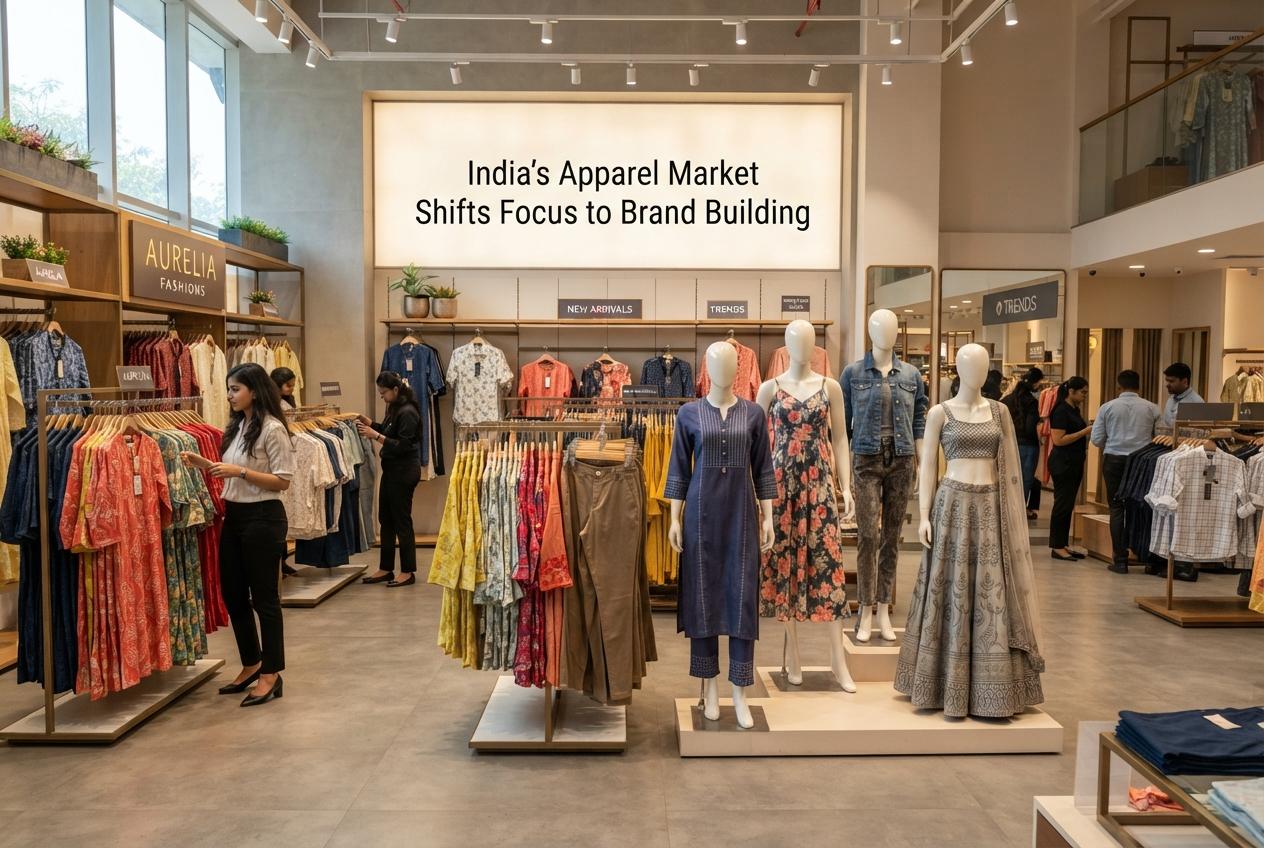

India’s apparel industry is entering a new phase, emphasising brand development and consumer experience as market size approaches $200 billion, driven by rising incomes and digital access.
India’s apparel market is entering a new phase, with industry leaders arguing that the real opportunity lies not only in scale but in building brands that can win across a far more varied consumer base. At Bharat Tex 2026, a panel organised by the Clothing Manufacturers Association of India and the Confederation of Indian Textile Industry focused on how rising incomes, wider digital access and a larger middle class are reshaping the country’s fashion and retail landscape.
Rahul Mehta, chief mentor at CMAI, said the domestic fashion market is now worth nearly $98 billion, yet branded apparel still has relatively low per-capita consumption, leaving significant room for expansion. The wider backdrop is one of strong market momentum: industry estimates cited by IBEF put India’s apparel retail market on course to reach nearly ₹16 lakh crore, or $193 billion, by FY30, while another market study projects the fashion retail market could rise from $115.5 billion in 2025 to $218.4 billion by 2032.
Panelists said the consumer base is changing fast. P. Venkatesalu of Trent said younger shoppers want trend-led clothes, convenience and more choice, while digital exposure has narrowed the gap between metro and smaller-city consumers. Gautam Saraogi of Go Colors said shoppers are increasingly willing to travel for a better retail experience, prompting brands to invest in larger, more experiential stores. Sidhant Keshwani of Libas argued that online and offline retail will have to work together, with ecommerce and quick commerce serving convenience-led buying and physical stores remaining central to discovery and brand building.
The discussion also stressed that growth will depend on identity, not just distribution. Siddharth Bindra of Biba said brands must scale without losing their core promise, while Nikhil Upadhye of Benetton India said many established labels are returning to their original purpose. Rajesh Jain of Lacoste India said India’s premium consumer segment is expanding, but brands that want global scale will need international reach as well. Maya Pradeep of Haute Couture and Shweta Agarwal of Tradyl said Indian fashion companies are increasingly focused on quality, sustainability, transparency and regional differences rather than treating the country as one uniform market.
Harminder Sahni of Wazir Advisors said India’s branded apparel space remains underpenetrated compared with developed markets, suggesting substantial room for organised retail to grow. He said the next decade is likely to be shaped by consolidation, formalisation and stronger operational discipline. The broad message from the panel was clear: India’s next retail wave will favour companies that combine sharp consumer insight, efficient supply chains, omnichannel execution and the confidence to build brands with global ambition.
Disclaimer: This article is intended to inform and educate, not to recommend or endorse any financial product, investment or strategy. Please consider your own financial circumstances and seek professional advice where appropriate before making financial decisions.



