

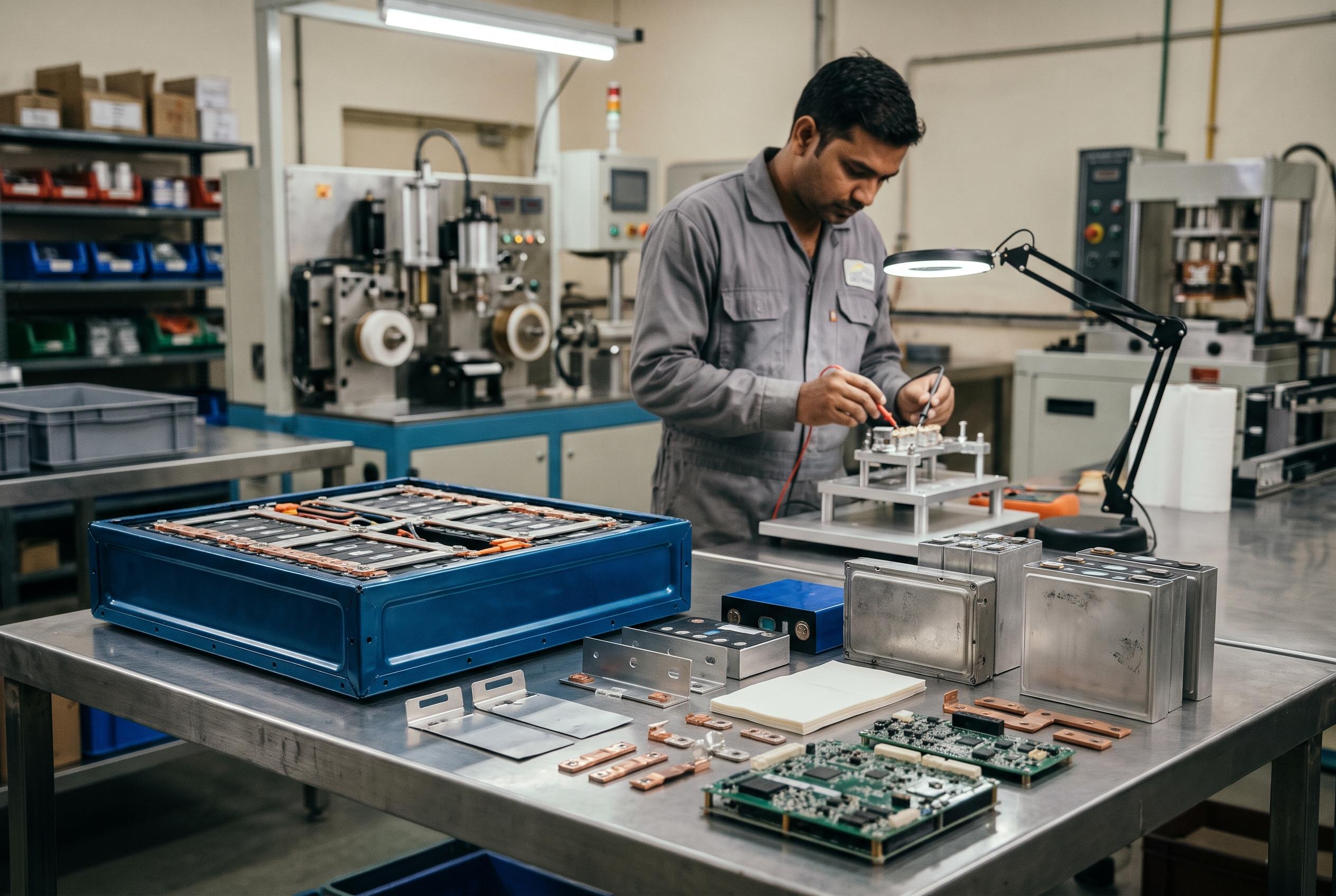

A Ministry of Heavy Industries-backed study calls for targeted support to address component-specific cost pressures, high borrowing costs and reliance on imported technology.
India’s battery component makers are facing a steep competitiveness problem, with a Ministry of Heavy Industries-backed study finding that domestic production costs can run 18% to 61% above imported alternatives. The report, “Accelerating India’s ACC Component Manufacturing Ecosystem”, argues that the gap is wide enough to slow the country’s efforts to build a local supply chain for advanced chemistry cell batteries, even as demand for storage is expected to surge over the rest of the decade.
According to the ministry’s report, prepared by the Netzero Energy Transition Alliance with ARCI, CSIR-NCL, IIT Madras and Deloitte, the pressure points differ by component. Cathode materials, electrolytes and copper foil are said to be hit mainly by expensive raw materials, while graphite anode producers face heavier conversion, power, depreciation and financing costs. Separator manufacturing, meanwhile, requires large upfront investment and specialised imported technology, with low early plant utilisation adding to the burden.
China remains the benchmark India is struggling to match. The study says that in 2025 China accounted for almost the entire global supply of LFP cathode material, as well as the overwhelming majority of anode material, electrolyte, separators and copper foil. It also points to the effect of finance costs: Indian borrowers can face interest rates of 8.5% to 16%, compared with about 3.1% in China, while new suppliers may need 18 to 24 months to pass qualification checks with battery cell manufacturers.
The report argues that a single subsidy model would miss those differences and instead proposes three component-specific support options. One combines capital support with a sales-linked operating incentive; another relies mainly on operating assistance over five to seven years; and a third mirrors the Semicon India approach with a 50% capital subsidy tied to investor spending. Beyond incentives, it recommends a national testing and certification network, stronger support for domestic raw-material processing, specialised machinery production and integrated battery material clusters. The study also notes that existing government support for battery components is aimed largely at digital devices, even though electric mobility and grid-scale storage are expected to account for more than 90% of future battery demand in India.
Disclaimer: This article is intended to inform and educate, not to recommend or endorse any financial product, investment or strategy. Please consider your own financial circumstances and seek professional advice where appropriate before making financial decisions.



