

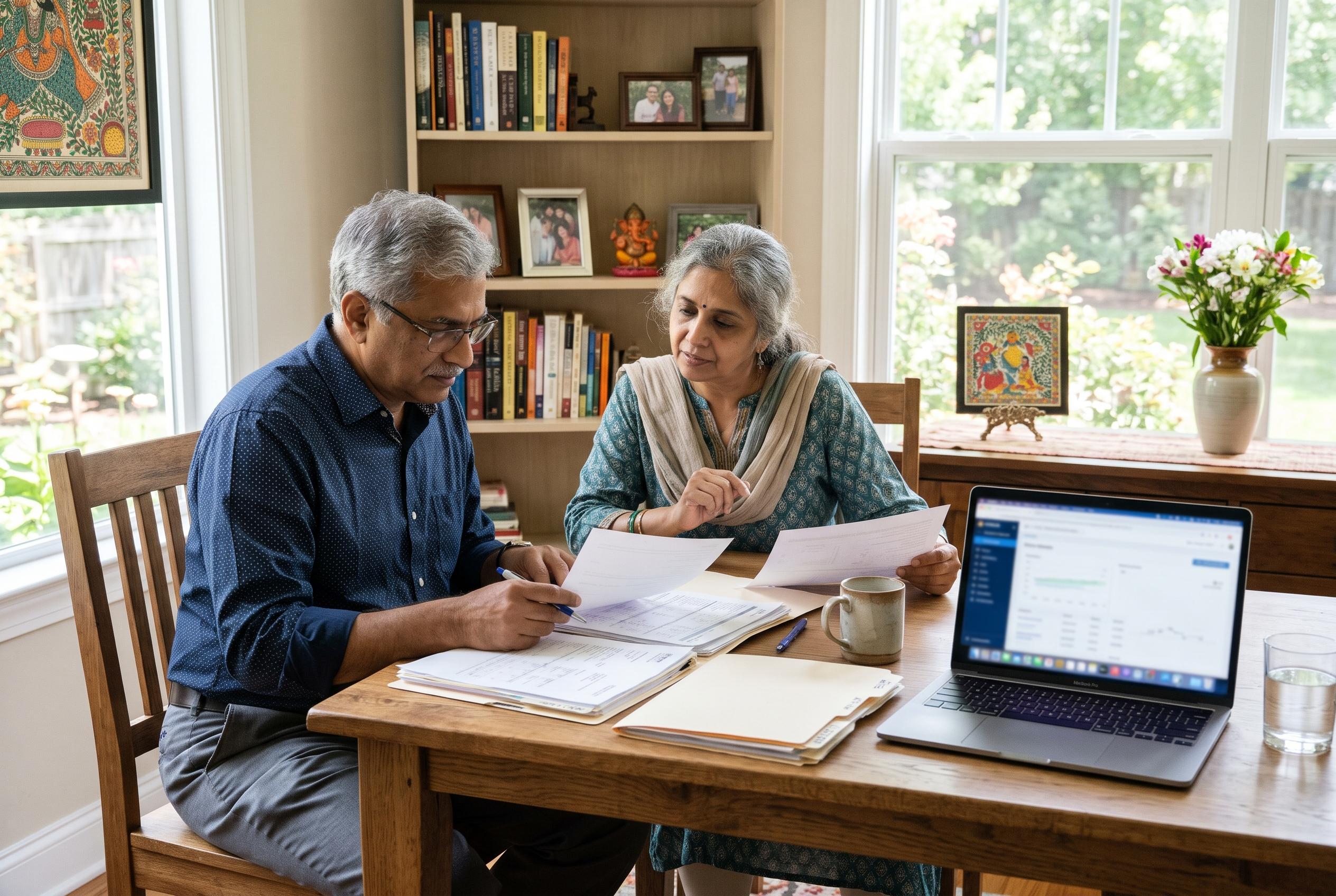

Indian parents settling with adult children in the US face a complex reset involving worldwide taxation, foreign-account reporting, healthcare, cross-border transfers and wills in two countries.
When retired parents move from India to the United States to live with adult children, the family often discovers that the hardest part is not housing or daily routines but the financial and legal reset that follows. In the case of the Raos, who have recently settled with their son after receiving green cards, the transition touches almost every part of their wealth picture: Indian pensions, bank accounts, business interests, property, reporting duties and day-to-day cash flow. For green-card holders, the move can bring them into the US tax system on a worldwide basis, while their Indian assets remain subject to rules in both countries. Returning NRI guidance on US estate tax also highlights how citizenship, domicile and the location of assets can reshape the tax bill far more than many families expect.
That means the first task is often education. A cross-border adviser or CPA can help the family map where each asset belongs, when income should be recognised and which filings are triggered by foreign accounts. As Kiplinger has noted in its retirement-planning guidance, estate planning works best when it is tied closely to tax planning, because beneficiary choices, inherited retirement accounts and the timing of withdrawals can all affect the after-tax value of the estate. For retirees with pensions, the same principle applies to cash-flow design: the family needs to think about how pension income, savings and any sales of Indian assets fit together rather than treating each account in isolation.
Reporting rules can be especially unforgiving. Once the Raos become US tax residents, their Indian accounts and investments may have to be reported through annual tax forms and, if aggregate foreign balances are high enough, through the foreign bank account report known as FBAR. Depending on the structure of their holdings, additional filings may also be needed for foreign corporations, trusts or mutual funds that the US classifies in an unfavourable way. Tax advisers who work with green-card holders warn that the rules can be easy to miss, particularly for families that have spent years building wealth in India and are only now adapting to the US system. If the couple later gives up their green cards after years of residence, specialist commentary also warns that exit-tax rules can become relevant.
Moving money across borders adds another layer. The family will want a plan that matches the currency of the asset with the currency of spending, rather than relying on ad hoc transfers whenever a bill arrives. That may mean wiring funds from India, using transfer services or holding more cash in the US sooner rather than later. But as Kiplinger’s retirement checklist points out, tax efficiency matters as much as convenience: the timing of asset sales, the treatment of gains and the sequencing of withdrawals can all change the after-tax result. In India, where asset-holding periods are measured differently for tax purposes, a sale that seems straightforward can carry consequences that are very different from those in the US.
Estate planning is where the stakes become clearest. Financial advisers and legal commentators alike stress that families with assets in more than one country should not rely on a single document to cover everything. Separate wills may be needed in the US and India, and the family should review powers of attorney, executors and beneficiary designations before a crisis forces the issue. US estate-tax rules can reach worldwide assets for US tax residents, while the absence of an inheritance tax in India does not remove the risk of US tax exposure. For the Raos, that means their planning has to take into account not only what they own today, but also what they hope to pass on to children and grandchildren, some of whom may live outside the US.
The same broad planning exercise should also cover healthcare, residence and the human side of retirement. Green-card holders who were never employed in the US generally will not qualify for Social Security, so they must depend on their own resources and family support. They also need health coverage quickly, since they cannot simply be added to an adult child’s policy. Once they have been US residents long enough, Medicare becomes available, but the five-year clock starts from arrival as permanent residents, not from past visitor stays. None of this fully captures the emotional adjustment, though. Families in this position often face a version of expat grief: the loss of familiar routines, friendships and identity after a move that was meant to be permanent. Successful retirement in the US, therefore, is not just a matter of taxes and forms. It also depends on helping older parents build a life that still feels like their own.
Disclaimer: This article is intended to inform and educate, not to recommend or endorse any financial product, investment or strategy. Please consider your own financial circumstances and seek professional advice where appropriate before making financial decisions.



