

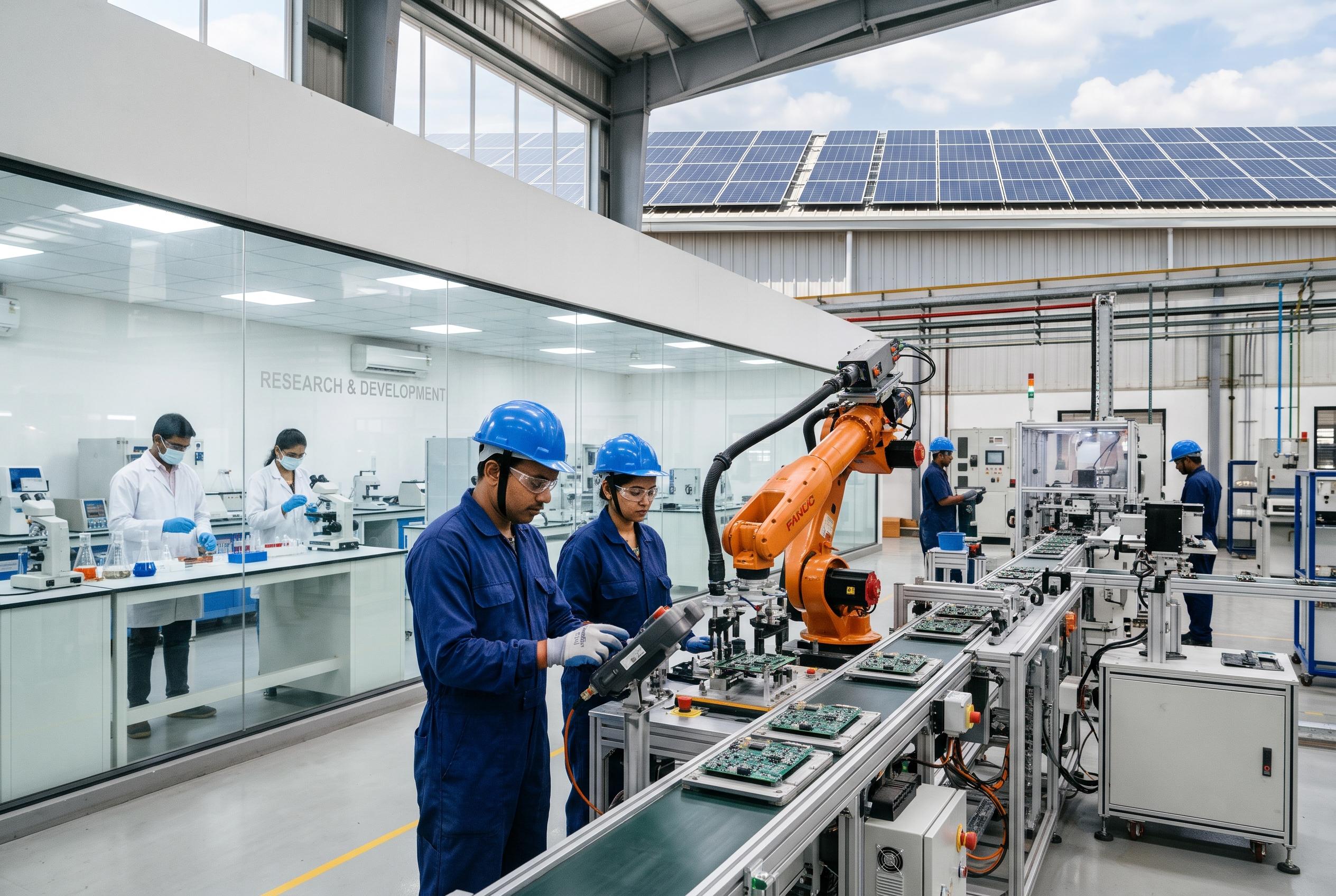

Trade barriers are prompting Indian companies to invest in advanced manufacturing, pharmaceuticals, clean energy, technology and brands that can compete beyond price.
Donald Trump’s tariff offensive may be producing an unintended result: it is pushing Indian business to adapt faster than it otherwise might have done. Rather than treating trade friction as a dead end, many exporters are using it as a prompt to move up the value chain, shift into more complex manufacturing and invest in research, development and brands that can survive beyond price competition.
The clearest example is petroleum refining. The Council on Foreign Relations has noted that India’s growing purchases of discounted Russian crude have supported the country’s refining system and helped turn it into a major exporter of fuels such as diesel, petrol, aviation fuel and naphtha. With large-scale capacity and the ability to process crude into higher-value products, Indian refiners have been able to redirect cargoes to different markets while still serving domestic demand, strengthening both energy security and export earnings.
That flexibility has also given India room to navigate geopolitical pressure. Hydrocarbon Processing reported earlier this year that Reliance Industries loaded a jet fuel cargo for Italy, marking India’s first fuel export to Europe since the European Union’s ban on products derived from Russian crude took effect. More recently, other reports have described India as an increasingly important diesel supplier to Europe as Russian and US flows weakened, underlining how Indian refiners have been able to capture demand created by disruption elsewhere.
The same pattern is visible in pharmaceuticals. Indian drugmakers remain heavily exposed to the United States, which accounts for a large share of their generic-formulation exports, but the threat of much higher import duties has reinforced the industry’s incentive to shift from commodity medicines towards more specialised and higher-margin products. Sun Pharma’s purchase of Organon and Lupin’s planned investment in Florida reflect a broader change: the model is moving from export-only production towards local manufacturing, research and development, and deeper footholds in the US market.
Clean energy is following a similar path. When Washington imposed steep preliminary countervailing duties on Indian solar cells, companies did not simply retreat. Instead, they redirected sales to Europe and West Asia while using India’s production-linked incentive scheme to move into higher-efficiency modules and broader manufacturing capability. In effect, tariff pressure has encouraged firms to stop relying on low-value cell exports and climb further up the clean-energy supply chain.
Trade data suggests that this shift is beginning to show up in the numbers. Merchandise exports rose sharply in the second quarter of 2026-27, while total goods-and-services exports also expanded at a brisk pace. Electronics has been one of the stand-out gainers, with exports climbing from a relatively small base to become a far more meaningful part of India’s merchandise basket. Engineering goods have also grown in importance, helping reduce the country’s dependence on petroleum and other traditional export lines.
The services economy is changing as well. The older model of cheap offshore labour is under pressure from tighter visa rules and talk of border taxes on cross-border data flows. In response, major Indian technology firms are repositioning themselves around artificial intelligence, cloud architecture and cybersecurity, while expanding delivery networks in Latin America and eastern Europe to hedge against regulatory shocks in any single market.
That said, tariffs alone do not make an economy more competitive. They can squeeze margins, unsettle workers and expose weak balance sheets. The deeper lesson for India is that external pressure can only be useful if it accelerates reforms that are needed anyway: lower logistics costs, more predictable regulation, better infrastructure, stronger skills and access to patient capital. If those conditions are met, tariff walls may end up functioning less as barriers than as ladders, pushing Indian enterprise towards a more resilient and higher-value role in global trade.
Disclaimer: This article is intended to inform and educate, not to recommend or endorse any financial product, investment or strategy. Please consider your own financial circumstances and seek professional advice where appropriate before making financial decisions.



