

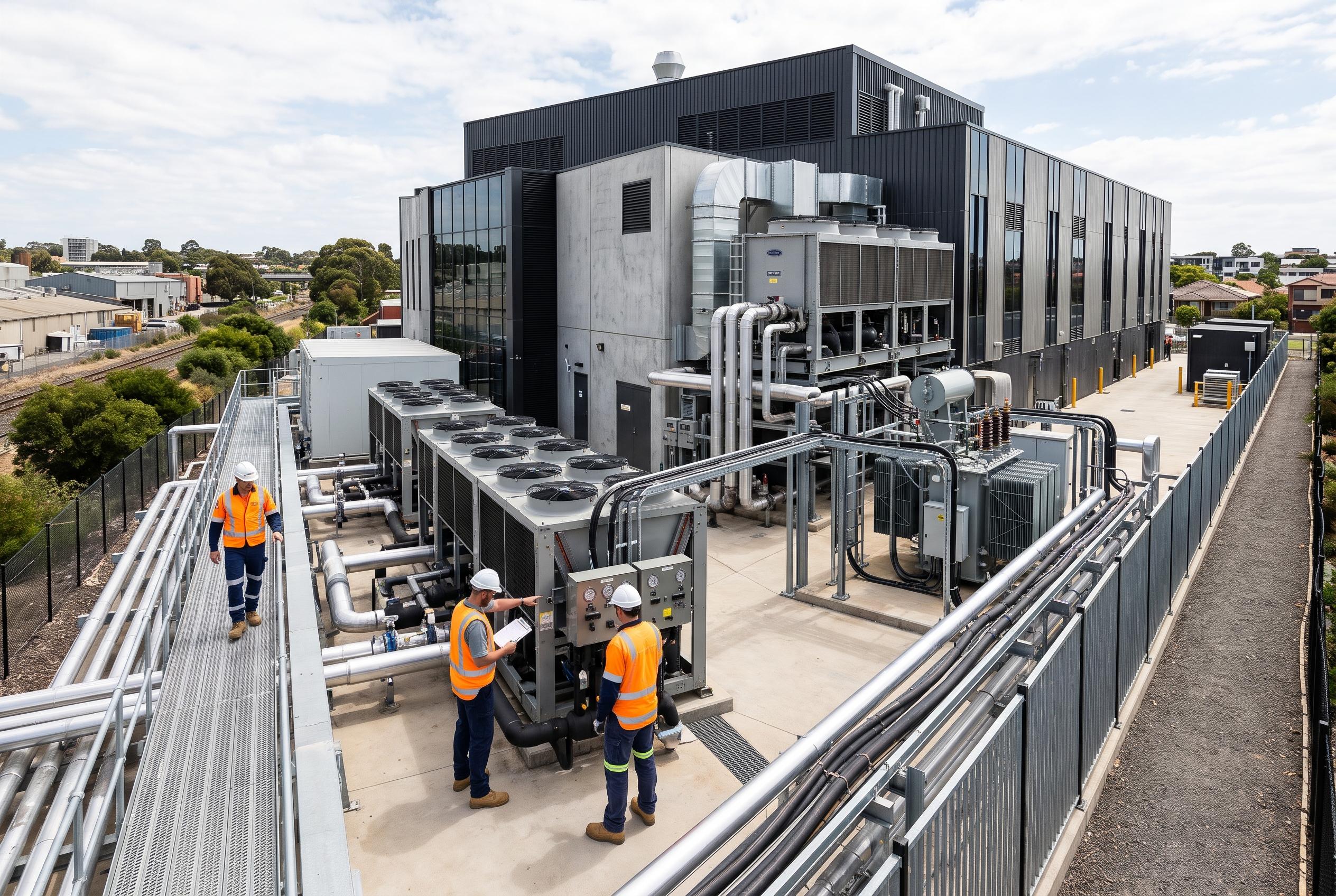

NITI Aayog’s new evaluation framework urges states to test whether proposed data centres can withstand rising AI workloads, resource constraints and climate pressures for decades to come.
India’s push into AI-era data centres will be judged less by how much capacity it adds than by whether the sites being planned today can cope with heavier power loads, tougher cooling needs and tighter resource constraints over the long term. As cloud use, enterprise digitisation and artificial intelligence drive demand, the sector is expected to expand sharply, with installed capacity projected to roughly quadruple by 2030.
That broader backdrop has now been sharpened by NITI Aayog’s newly released Data Centre Evaluation Framework, which urges state governments to check whether power supply, water availability and supporting infrastructure are genuinely ready before approving new projects. According to the framework, officials should look not only at present conditions but also at seasonal water availability and long-range resilience over a 20-to-30-year horizon.
The message matters because the most important sustainability decisions are made before construction begins. Once a facility is operating, it is possible to improve performance, but major changes to the power architecture, cooling systems or water design are far more difficult and expensive. In that sense, sustainability is not something to be added later; it has to be built into the original plan.
That is becoming more urgent as AI pushes data hall densities higher. Rack loads that once sat in the single digits of kilowatts are now often many times larger, and some AI deployments are far more demanding still. That means the same site must deliver more electricity and remove more heat than traditional enterprise facilities ever had to handle. The article points to Andhra Pradesh, which has moved to allow large data centre campuses to obtain their own power distribution licence and source electricity through open access, bilateral contracts and renewable power paired with storage. But a licence alone does not create the substations, conduits and control systems needed to make such flexibility usable in practice.
Water is just as critical. The article notes that major Indian data centre markets, including Chennai, already face seasonal or structural water stress. At the Chennai campus described in the piece, power, water and cooling were designed as one system from the outset, with water-cooled chillers and adiabatic cooling towers intended to cut water use sharply versus a conventional benchmark. Rainwater harvesting, greywater reuse and extensive green cover were also integrated into the site design, while the operator says roughly 80% of its power use comes from renewable sources. The broader point is that these measures work only when they are planned together, rather than bolted on later.
Measurement is also moving from an afterthought to a design requirement. Metrics such as Power Usage Effectiveness, Water Usage Effectiveness and Carbon Usage Effectiveness are only useful if the meters and monitoring systems behind them are accurate from day one. In February, the Bureau of Indian Standards adopted international ISO/IEC 30134 metrics for water use, carbon use and cooling efficiency as Indian standards, although they remain voluntary. That shift suggests disclosure expectations are moving towards greater scrutiny of how facilities perform in real operating conditions, not just on paper.
NITI Aayog’s framework could therefore shape where India’s next wave of data centre investment lands. By encouraging states to weigh long-term power availability, water security, climate exposure and implementation readiness, it may give an edge to locations with stronger infrastructure and more reliable renewable energy access, while making weak sites harder to justify. The central lesson is simple: for AI data centres, the real test of sustainability is not what a building claims after it opens, but how well it performs for decades after the first server is switched on.
Disclaimer: This article is intended to inform and educate, not to recommend or endorse any financial product, investment or strategy. Please consider your own financial circumstances and seek professional advice where appropriate before making financial decisions.



