

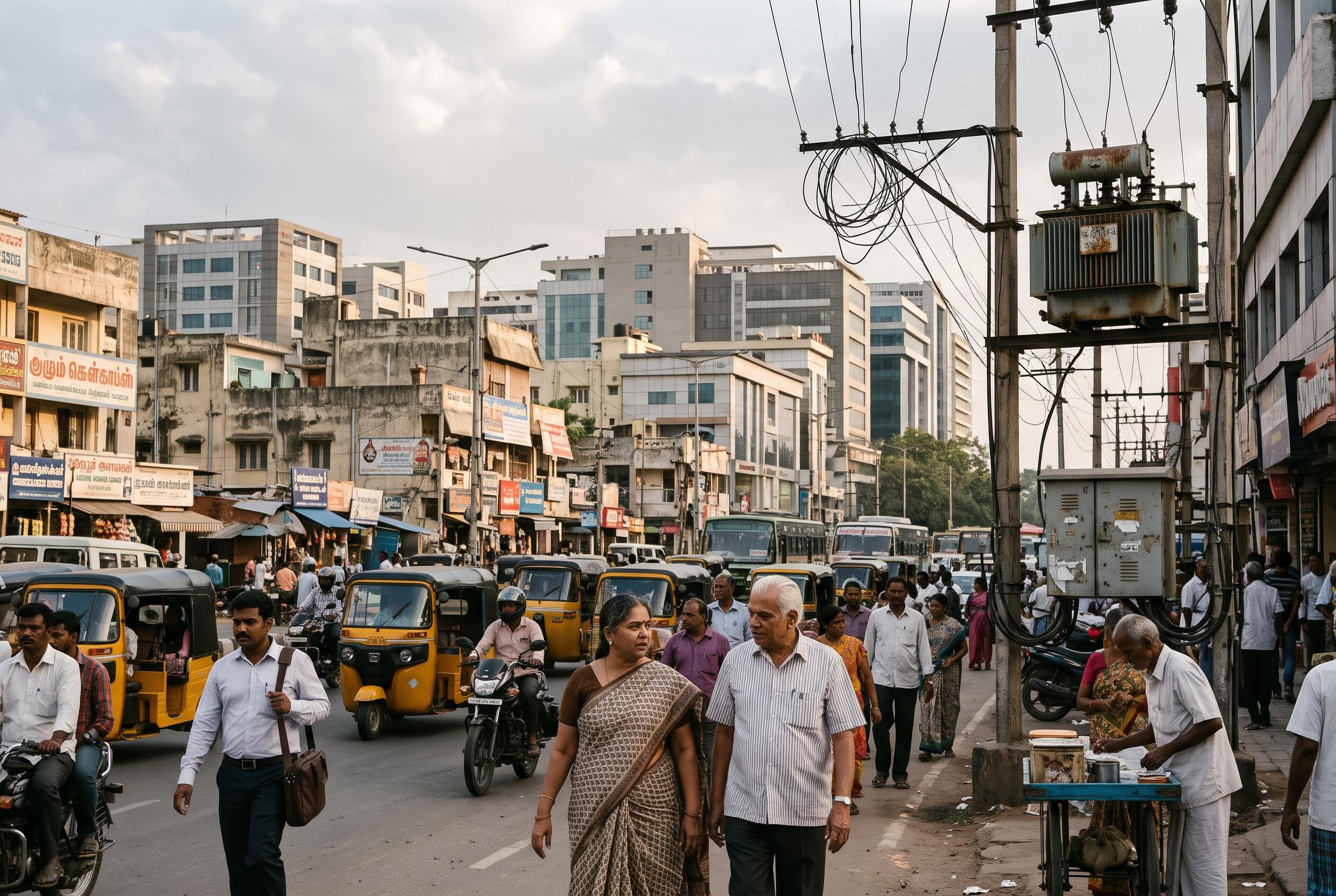

A proposed alliance of India’s five southern states would wield formidable economic clout, but ageing populations, mounting debt and troubled electricity utilities threaten to undermine its bid for greater influence in New Delhi.
Andhra Pradesh Chief Minister N. Chandrababu Naidu is floating an informal southern grouping that would bring together Andhra Pradesh, Tamil Nadu, Telangana, Karnataka and Kerala around a shared economic ambition: building a bloc worth more than $10 trillion by 2047. On paper, the case is strong. According to the Indian Express editorial, the five states account for less than a fifth of India’s population, but generate more than 31% of GDP, about 35% of manufacturing and foreign direct investment equity inflows, and roughly 26% of GST collections. Their major cities also dominate the national transport map, with Bengaluru, Hyderabad and Chennai operating some of the country’s busiest airports after Delhi and Mumbai, and Kochi close behind. The region’s draw is reinforced by its concentration of global capability centres, the offshore hubs run by multinational firms, which have made the southern metros central to India’s services economy.
Yet the same report points to a set of pressures that could limit how far this economic muscle can be converted into political leverage. The first is demography. Southern states are older, on average, than the rest of India, with median ages in the 33-36 range versus about 30 nationally, and far younger populations in Bihar and Uttar Pradesh. Kerala and Tamil Nadu have particularly high shares of residents over 60, which helps explain why factories, construction sites, hotels and farms in the region depend heavily on migrant workers from the north and east. That flow is not inherently problematic; if anything, it underlines the extent to which India’s labour market is already integrated. But it does mean the south’s growth model rests on a labour supply that is increasingly imported rather than locally replenished.
The sharper weakness is fiscal. The Indian Express highlighted Tamil Nadu’s outstanding liabilities of ₹10.4 lakh crore in the 2025-26 Budget, the largest state-level debt burden in the country, while Andhra Pradesh and Kerala both have debt-to-GSDP ratios above the all-state average. Business Standard has separately reported that Tamil Nadu’s debt load has climbed sharply in recent years, with much of the strain linked to the power sector and to guarantees issued for electricity utilities. The publication also noted that the state’s free power policy is poorly targeted, with the richest households still receiving a large share of the subsidy. Across the southern states, according to the editorial, state-owned electricity companies account for 45% of accumulated losses among such utilities nationwide, a reminder that the region’s headline prosperity masks serious balance-sheet stress.
That is the central paradox in Naidu’s idea of a southern alliance. The bloc has the industrial depth, tax base, airports, talent pools and corporate footprint to speak with unusual weight in national debates. But, as the Civilsdaily analysis observed, any credible collective bargaining position would first require the region to confront ageing, debt and power-sector losses rather than simply unite around them. The southern states may already be among India’s most productive, but if they want a stronger voice with the centre, they will need to show that their model is financially sustainable as well as economically impressive.
Disclaimer: This article is intended to inform and educate, not to recommend or endorse any financial product, investment or strategy. Please consider your own financial circumstances and seek professional advice where appropriate before making financial decisions.



