

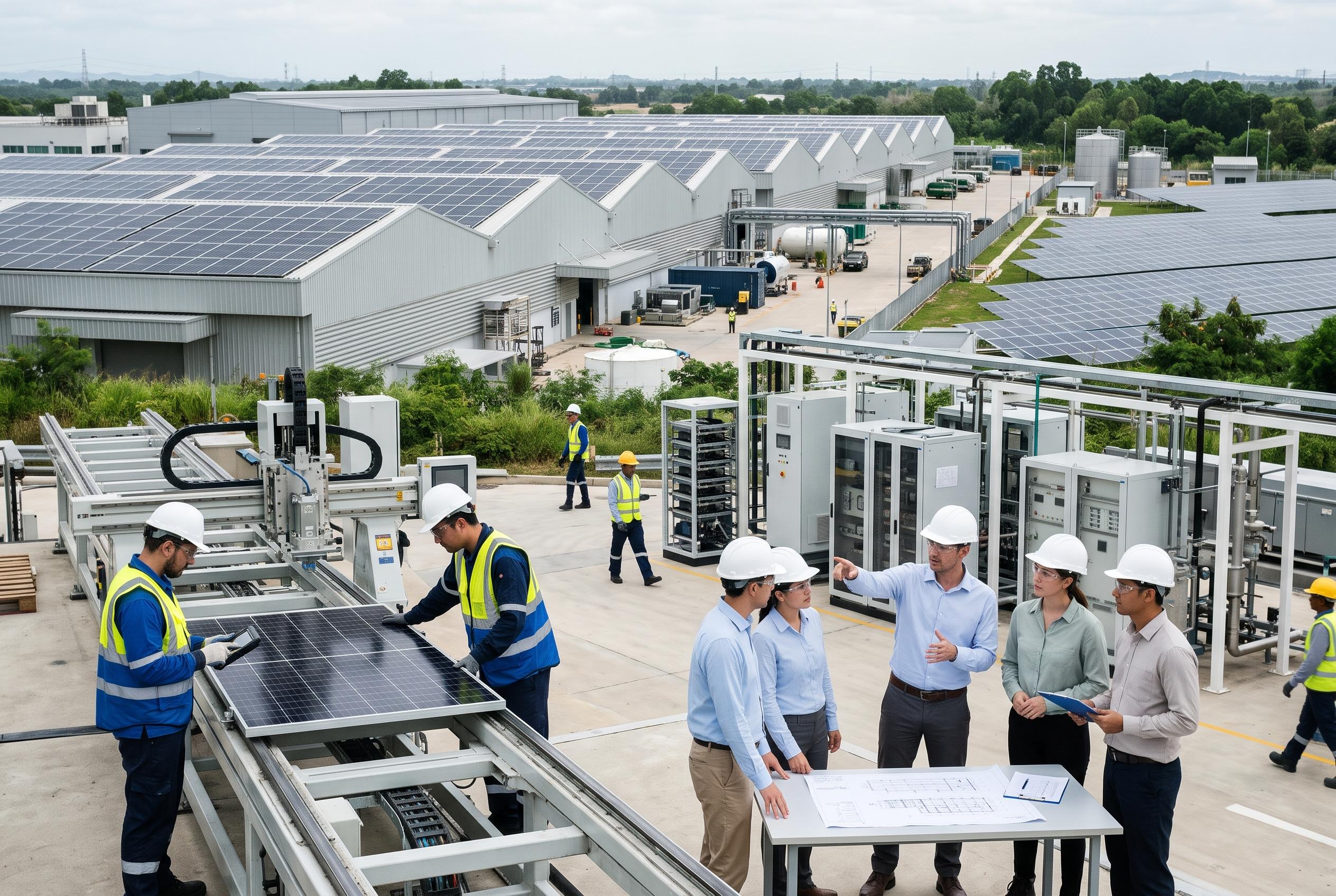

Avaada Group plans to turn its Butibori complex into an integrated solar manufacturing ecosystem, while exploring a major green methanol project alongside its operating cell and module capacity.
Avaada Group is turning Nagpur into the focal point of a broader clean-energy manufacturing strategy, with plans to expand its Butibori complex into a fully integrated solar industrial base and to add a green methanol project that could require about Rs 20,000 crore, according to reports in The Times of India and Mint. The company is presenting the site as more than a module assembly line, describing a long-term ecosystem that could eventually span raw materials, intermediate components and finished solar products.
Vineet Mittal, Avaada’s chairperson, told The Times of India that the group wants to build a fully integrated solar manufacturing plant at Butibori within two years, with production stretching from sand to completed modules. That ambition is being paired with a separate push into green molecules, including methanol and ammonia, as the company seeks to link renewable power generation with industrial fuels and downstream manufacturing.
Avaada already has 7.2 GW of solar cell capacity and 7 GW of solar module capacity operational in Nagpur, the urban-focused report said. Construction is under way on a solar glass plant, while facilities to turn polysilicon into silicon ingots and then wafers are also being developed. The glass unit is expected to be ready within a year, and further ancillary products are planned for addition by 2028.
The company’s model depends on keeping more of the supply chain inside one industrial campus. Mittal said glass would move by conveyor directly to the module line, reducing the need to shift heavy materials between separate plants. That matters in solar manufacturing, where bulky inputs must pass through several stages before they become finished panels, and where logistics can materially affect cost and efficiency.
Industry reporting suggests Nagpur is already emerging as a larger solar manufacturing cluster, rather than a single-company outpost. JRST Technology said Avaada Electro commissioned the first 3 GW phase of its 6 GW n-type TOPCon cell factory in Butibori in July 2026, while Waaree has started building a major ingot-and-wafer project in the same area. The cluster is gaining added relevance as domestic manufacturing requirements tighten under India’s Approved List of Models and Manufacturers regime.
The green methanol plan appears to be the most capital-intensive addition to Avaada’s Nagpur blueprint. Mint reported that the project is still in the conceptual stage, with land allocation and final investment sizing yet to be settled. The report said Avaada is also planning roughly Rs 40,000 crore of investment across green ammonia and methanol projects in Gopalpur, Odisha, and Nagpur, Maharashtra, as part of a wider diversification into low-carbon fuels.
The Nagpur methanol project remains policy-sensitive. Mittal has said it would need support from the Maharashtra government, according to The Times of India, which underscores that the proposal is not yet a fully locked-in build-out. The distinction matters: the solar cell and module capacity are already operating, while the methanol plant is still dependent on approvals, land and policy clarity.
Avaada is also tying the Butibori expansion to a larger industrial and energy narrative. Mittal has argued that India’s growing data generation should be matched by more domestic data-centre capacity, which would in turn lift electricity demand that could be met by solar power. He has also said the company is exploring nuclear energy as part of its future power strategy, although the supplied reports do not set out any formal plan on that front.
Taken together, the proposals suggest that Nagpur is being positioned as the company’s industrial nerve centre, not merely a regional manufacturing site. The model would combine solar glass, wafers, cells, modules, aluminium parts, junction boxes and batteries in one location, alongside possible hydrogen-linked products. If it proceeds as described, the project would be a test case for whether India can build not just renewable capacity, but an integrated manufacturing base around it.
For now, though, the scale of the vision remains ahead of the hard details. The available reports do not spell out employment numbers, water demand, waste treatment, transport infrastructure or the full approvals timetable. What is clear is that Avaada is using Nagpur to anchor a much wider industrial plan, one that connects solar manufacturing with low-carbon fuels and the longer-term reshaping of India’s clean-energy supply chain.
Disclaimer: This article is intended to inform and educate, not to recommend or endorse any financial product, investment or strategy. Please consider your own financial circumstances and seek professional advice where appropriate before making financial decisions.



