

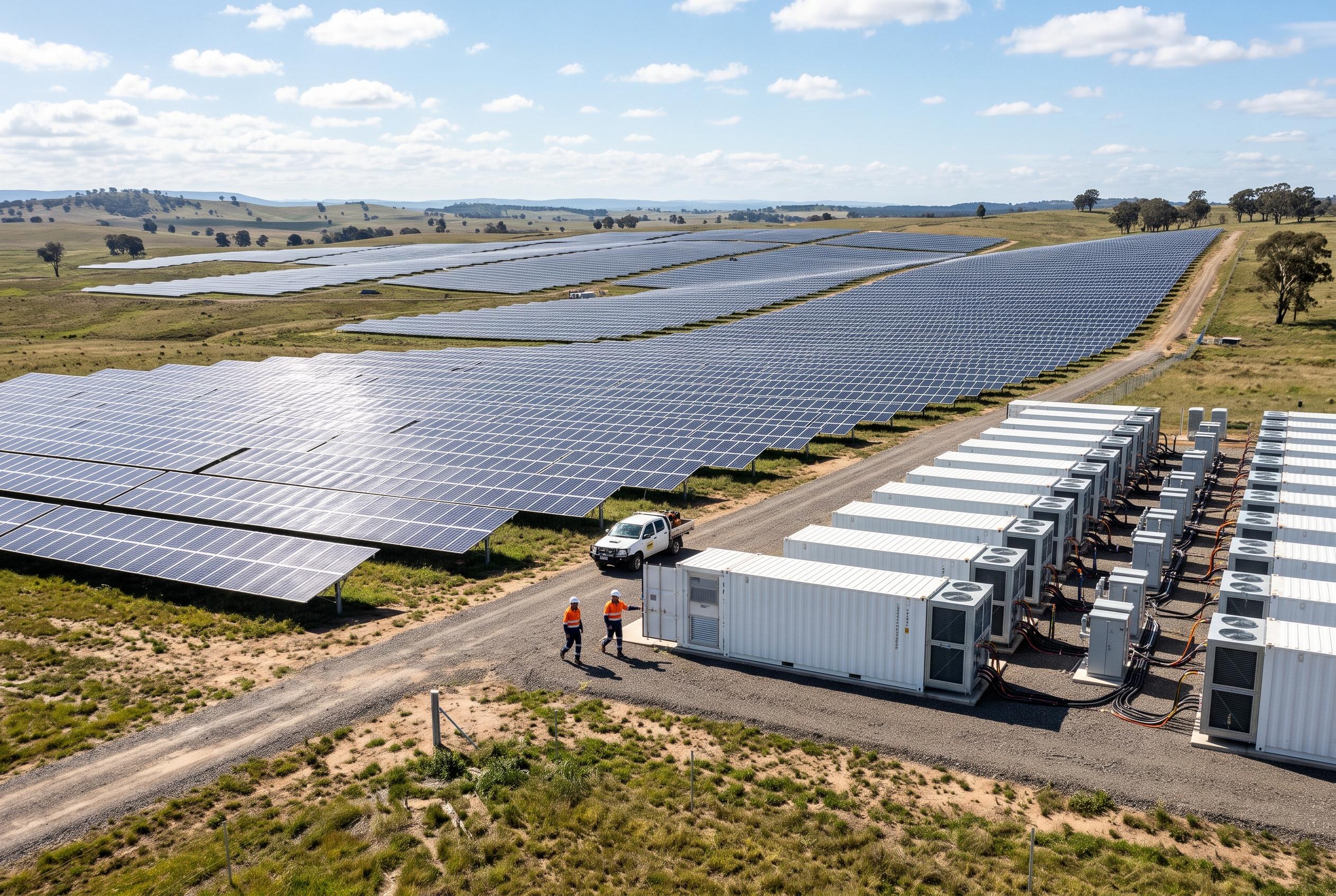

Adani Green Energy’s operational capacity has risen to 20.8GW, while battery storage at Khavda expands and a delayed transmission corridor threatens to slow further commissioning.
Adani Green Energy said its operational fleet has now passed 20 GW, marking a key scale milestone as the renewables developer pushes deeper into storage and firm power. In a statement on its first-half FY27 results, the company said energy sales rose 32% year on year to 25.7 billion units, helped by a 24% increase in operational capacity to 20.8 GW after adding 4,083 MW of greenfield projects. The group also said power-supply revenue climbed 36% to ₹8,299 crore and EBITDA rose 41% to ₹7,957 crore, leaving it with an EBITDA margin of 93%.
The strongest operational theme in the update was battery storage. Adani Green said it commissioned 3.08 GWh of battery energy storage at Khavda, taking installed capacity to 6.63 GWh, which it said is more than half of India’s operational battery energy storage system base. The company said it remains on course to exceed 10 GWh by the end of the fiscal year, with storage now positioned as a central part of its strategy to make renewable output more predictable and dispatchable.
Management, however, acknowledged that transmission constraints are still affecting delivery at Khavda. On the earnings call, chief executive Ashish Khanna said the Phase 3 evacuation line, which had earlier been expected by the end of calendar 2026, is now likely to be ready by the fourth quarter of FY27. He said the company has already completed the balance-of-system work needed to move quickly once the corridor is available, and still expects to commission 4.5 GW to 5 GW in the current fiscal year if the line arrives on that revised timetable.
The company also used the call to argue that its financial model is becoming more resilient. It said 72% of project loans are fixed-rate for three to five years, while the average cost of debt has fallen to 8.9% from 11.1% in 2019, helped by upgrades at some project vehicles. Chief financial officer Saurabh Shah said leverage should remain elevated into FY28 or FY29 before easing as operating assets expand and project loans amortise. He also pointed to the company’s longer-term capital plan of ₹2.4 lakh crore through FY30, which is intended to support 45 GW of renewable capacity, 5 GW of pumped storage and 40 GWh to 50 GWh of batteries.
Disclaimer: This article is intended to inform and educate, not to recommend or endorse any financial product, investment or strategy. Please consider your own financial circumstances and seek professional advice where appropriate before making financial decisions.



