

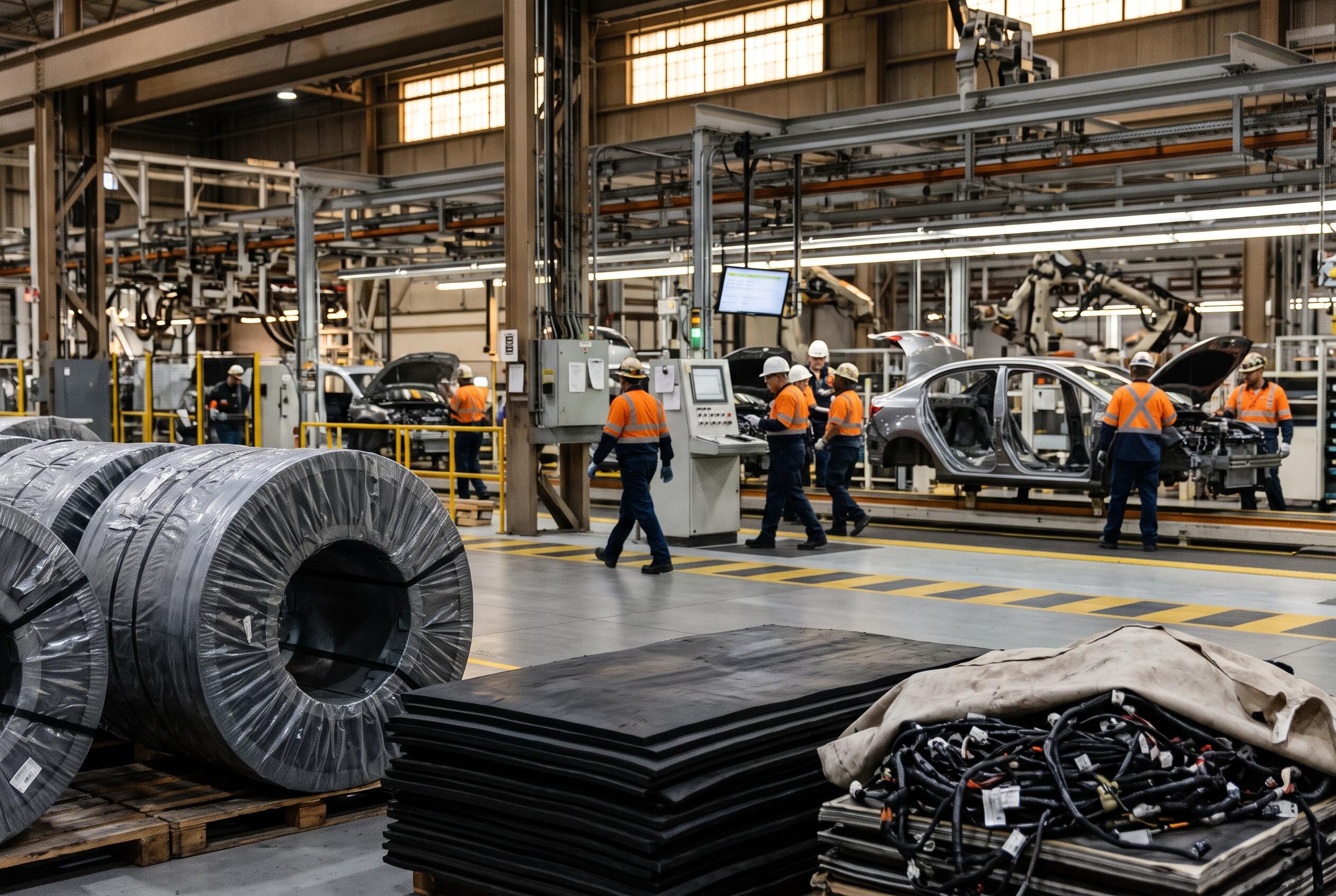

Tata Motors says rising steel and rubber costs are outpacing price increases, putting further pressure on margins despite efficiency gains and firm demand.
Tata Motors said rising commodity costs are outpacing the price increases it has been able to pass on this year, with the automaker warning of another 150 to 200 basis-point hit to costs in the December quarter.
On a call following its second-quarter FY2027 results, business operations officer Girish said raw-material inflation remained “a major headwind”. He said the year-on-year drag had reached almost 540 basis points, with about 200 basis points of that pressure building between the first and second quarters alone.
Steel and rubber are doing most of the damage. Girish said steel is already at a 52-week high and is up by almost 40% from a year earlier, leaving Tata Motors with input-cost pressure that has not been fully absorbed by recent increases in vehicle prices. The company has lifted prices four times this year, starting with about 1% in January, followed by 2% in April, 2.5% in July and a further 1% to 2% from 1 October, depending on the segment.
Tata Motors has also sought government intervention, asking for a review of the safeguard duty on steel, Girish said. The company is trying to defend margins through cost cuts and restrained pricing, arguing that aggressive increases could weaken demand. That balancing act is visible in the latest numbers: standalone revenue rose 42% to Rs 23,900 crore on wholesales of 135,100 units, while EBITDA increased 31% to about Rs 2,800 crore. Even so, the margin slipped to 11.7% from a year earlier, and EBIT margin eased to 9.7%.
Chief financial officer Ramanan said the commodity hit was largely offset by operating leverage, efficiency gains and better realisation. Profit before tax before exceptional items rose 51% to Rs 2,700 crore. Still, management signalled that the next quarter may be steadier rather than spectacular. Girish said demand had remained firm in the first three weeks of October, but third-quarter growth was likely to slow to high single digits or early double digits, compared with 21.5% in the same period a year earlier. He pointed to diesel prices and interest rates as key watch points, noting that a 25 basis-point rate increase has already been passed through.
Disclaimer: This article is intended to inform and educate, not to recommend or endorse any financial product, investment or strategy. Please consider your own financial circumstances and seek professional advice where appropriate before making financial decisions.



