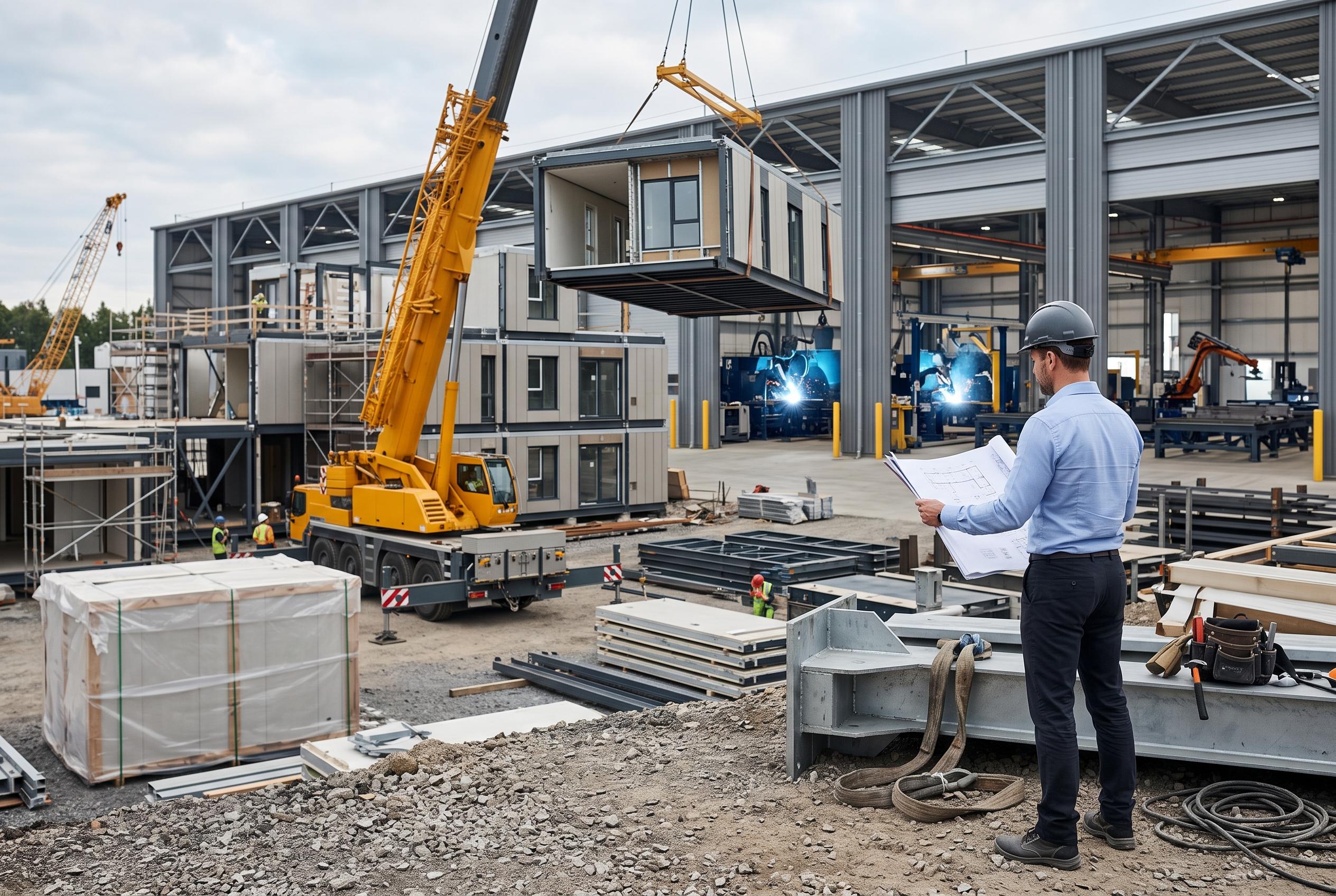

Indian engineering giant Larsen & Toubro forecasts a $30 billion opportunity in the $150 billion global modular construction market, leveraging factory-built modules and automation to disrupt traditional project delivery methods worldwide.
Larsen & Toubro is betting that modular construction will become a bigger part of global industrial project delivery as developers seek to cut costs and ease labour shortages. The Indian engineering group said the worldwide market is worth about $150 billion, and it believes roughly $30 billion of that could be up for grabs over the next five years. Its strategy combines factory-built modules with conventional construction, a model it says can help overcome transport limits on inland projects.
The company has just completed its first major modular job for Australia, shipping 110 modules weighing about 64,000 tonnes from its Kattupalli facility in Tamil Nadu to Karratha in Western Australia. The work formed part of Project Ceres, Perdaman Chemicals & Fertilisers’ urea plant, which Saipem and Clough are delivering under a joint venture. Saipem says the project is intended to become the world’s largest gas-stream ammonia-urea plant, with production capacity of 2.14 million tonnes a year, while Clough has said it is expected to support about 2,000 construction jobs.
L&T chairman and managing director S.N. Subrahmanyan said the Australian contract showed India could move beyond being a low-cost manufacturing base and become a source of integrated engineering and execution capabilities. The company is now looking at other uses for modularisation, including data centres, prefabricated bridges and precast columns, and has created a dedicated unit for small modular construction.
The group is also investing in more automation, including advanced cutting, bending, boring and welding equipment, alongside Industry 4.0 tools. Subrahmanyan said parts of its fabrication network could eventually become so automated that they resemble “dark factories”, where machines do most of the work. The company’s heavy engineering division already uses robotic welding, automated painting and 3D printing.
Subrahmanyan and deputy managing director and president Subramanian Sarma said modular projects demand large workforces and strict quality control, including hygiene standards for modules shipped to Australia. Sarma also said road transport can limit module size for inland sites, making a hybrid model more practical. L&T says it has nearly 2 lakh tonnes of fabrication capacity across sites including Oman, Hazira and Kattupalli, with about 1 lakh tonnes potentially available for onshore modular work after offshore needs are met. The company is also contending with higher logistics costs and delays in moving metal supplies, particularly from eastern markets, and is discussing some of those extra costs with customers.
Disclaimer: This article is intended to inform and educate, not to recommend or endorse any financial product, investment or strategy. Please consider your own financial circumstances and seek professional advice where appropriate before making financial decisions.