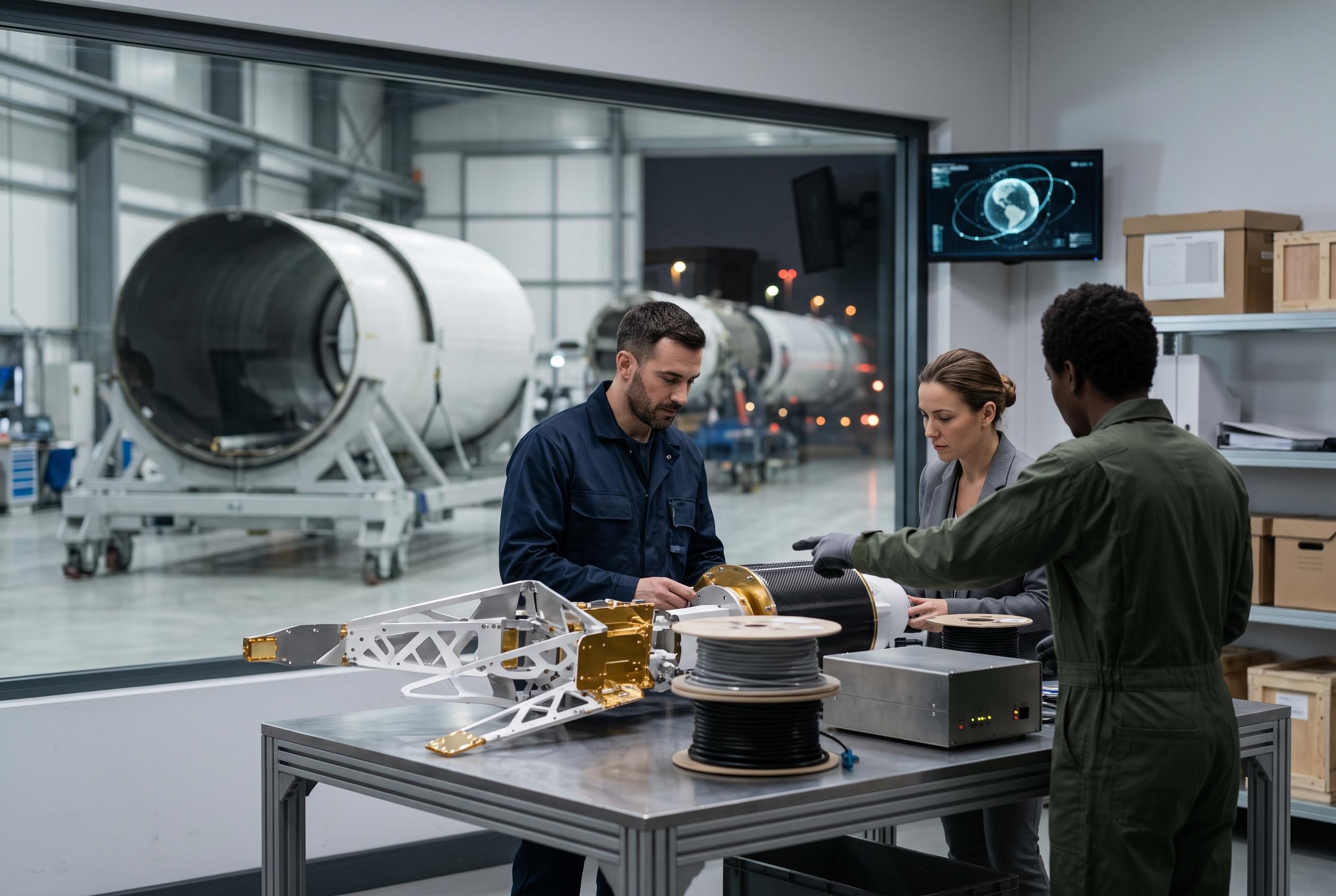

Australia has strengthened its presence in India’s private space sector through five new collaborations spanning satellite communications, research, launch technology, and orbital sustainability, marking a shift from government-led efforts to a thriving commercial partnership.
Australia is broadening its push into India’s private space industry, signing five new partnerships that span satellite communications, research and development, and launch and re-entry work, according to businessline. Nathan Davis, Austrade’s trade and investment commissioner in New Delhi, said the deals were finalised over the past two days alongside an Australian business delegation’s meetings at the Bengaluru Space Expo. The latest agreements reflect a relationship that has shifted from government-to-government cooperation to a more commercial phase, as India’s space startup ecosystem draws greater investor and industry interest.
Among the new tie-ups, Australian satellite communications company LatConnect 60 has partnered with NewSpace India Ltd, while the University of Western Australia and the Space Industry Association of India have agreed to work together on research, development and education. Three further agreements involve Space Machines, which has struck partnerships with Angel Technologies, Red Balloon Aerospace and Inbound Aerospace on launch and re-entry technologies.
The new deals build on a wider framework already in place between the two countries. Australia’s space agency and the Indian Space Research Organisation have a memorandum of understanding on space cooperation, and the two sides have been expanding collaboration through strategic and commercial channels. Australia’s space agency said the partnership includes work on satellite data sharing to support climate monitoring and disaster preparedness, while also opening the door to joint missions and industrial projects.
The Space Machines-NSIL relationship has already moved beyond initial discussions. Australia’s space agency said in 2026 that the two companies had reached an agreement to launch the 450-kilogram Optimus Orbital Servicing Vehicle, part of a mission called Space MAITRI that is intended to advance debris management and orbital sustainability. Canberra has also backed Indian human spaceflight efforts, including support for Gaganyaan crew recovery arrangements and a tracking terminal on the Cocos Islands. Davis said bilateral trade has now passed AUD 50 billion, and noted that Australia has put about AUD 20 million into grants for companies working with Indian organisations, alongside support from its National Reconstruction Fund.
Disclaimer: This article is intended to inform and educate, not to recommend or endorse any financial product, investment or strategy. Please consider your own financial circumstances and seek professional advice where appropriate before making financial decisions.