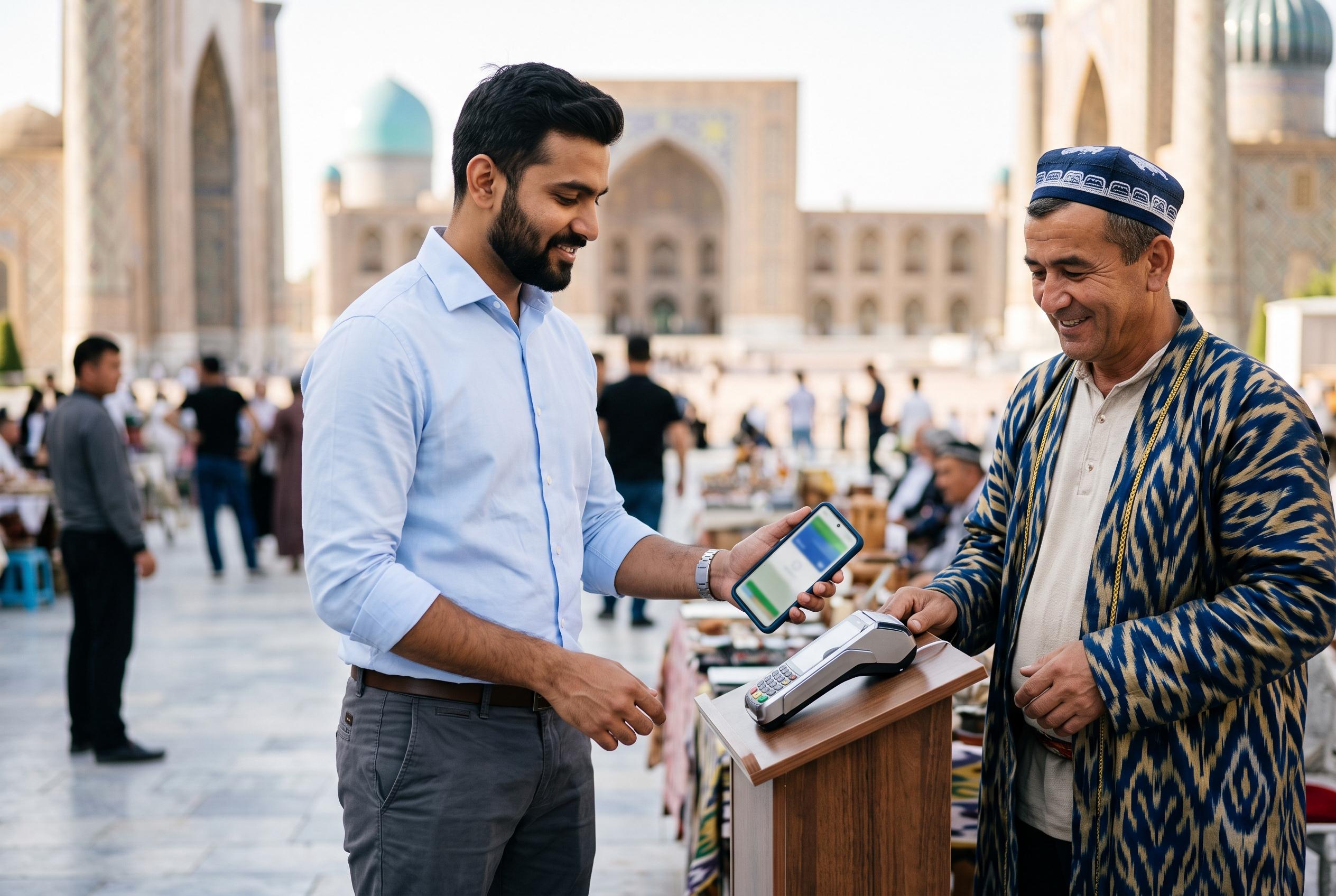

Indian travellers to Uzbekistan will soon be able to use UPI-enabled apps for seamless payments through a new agreement, marking a significant step in digital internationalisation and bilateral economic cooperation.
Indian travellers bound for Uzbekistan are set to gain a familiar way to pay abroad after NPCI International Payments Ltd signed a commercial agreement with the National Interbank Processing Centre, the operator of Uzbekistan’s HUMO payment system, to allow UPI transactions through the country’s UZQR network. The pact was signed on 30 August and announced the next day during Prime Minister Narendra Modi’s bilateral visit, turning a travel-convenience story into part of a wider India-Uzbekistan digital tie-up.
The arrangement is aimed not just at holidaymakers but also at business travellers and students. According to the Finance Ministry, they will be able to use ordinary UPI-enabled apps to scan Uzbekistan’s national interoperable QR code and pay merchants directly from Indian bank accounts. The ministry said the link should give users “near-universal acceptance across retail, hospitality, and service merchants in Uzbekistan” and allow person-to-merchant payments while “eliminating foreign exchange markup friction and reducing reliance on international cards or cash.”
Officially, the deal still had to clear a regulatory chain before being announced. The ministry said execution followed approvals from the Reserve Bank of India and the Central Bank of Uzbekistan, which designated HUMO as NIPL’s authorised partner for cross-border merchant acceptance. Indian officials have presented the scheme as part of a bigger push on digital public infrastructure, saying the payments link fits the two countries’ broader strategic and economic cooperation rather than being a stand-alone tourism measure.
On the Uzbek side, the payment route relies on UZQR, the national QR standard that Indian users will scan through their existing apps. Dainik Jagran English reported that Uzbekistan has been widening its QR-based payment ecosystem through UZCARD’s QR platform and the Tez QR service, which helps explain why the Indian side is talking about broad merchant coverage rather than a small pilot. Even so, the paper noted that travellers will need to look for participating merchants that support international UPI acceptance, so practical use on the ground may vary between a hotel chain in Tashkent and a smaller independent shop elsewhere.
The agreement also extends UPI’s overseas reach, although the arithmetic is not entirely tidy. The 31 August Finance Ministry release, echoed by The Economic Times and ETTravelWorld, said UPI was accepted in ten countries and listed Singapore, the United Arab Emirates, France, Mauritius, Nepal, Bhutan, Qatar, Sri Lanka, Cambodia and Greece. Yet the Free Press Journal’s IANS report also referred to the Maldives’ Favara-UPI link while repeating that ten-country list, underlining how official and media descriptions do not always distinguish clearly between merchant acceptance and other forms of cross-border integration.
There is some similar fuzziness over timing. Several reports described the facility as available now for Indian users scanning UZQR codes in Uzbekistan, while Moneycontrol said travellers “will soon be able” to make those payments. That distinction matters because the announcement sets out the legal and commercial framework, but the real test for travellers will be how quickly banks, apps and merchants make the option visible and dependable at check-out counters. For now, the clearest message is that India and Uzbekistan have agreed the rails, and that the service is intended to work across everyday spending categories rather than only at a few showcase outlets.
For travellers, that could remove one of the small but persistent frictions of going abroad: carrying extra cash, calculating card conversion charges, or wondering whether a local payment app is needed for routine purchases. For the two governments, the point is larger. The ministry has cast the arrangement as a step in digital public infrastructure cooperation, and coming during a high-level bilateral visit it doubles as a signal that India wants UPI to travel with its citizens, trade links and diplomacy. Uzbekistan, which has been modernising its own QR-payment landscape, is now the latest test of whether that ambition can work smoothly beyond South Asia.
Disclaimer: This article is intended to inform and educate, not to recommend or endorse any financial product, investment or strategy. Please consider your own financial circumstances and seek professional advice where appropriate before making financial decisions.