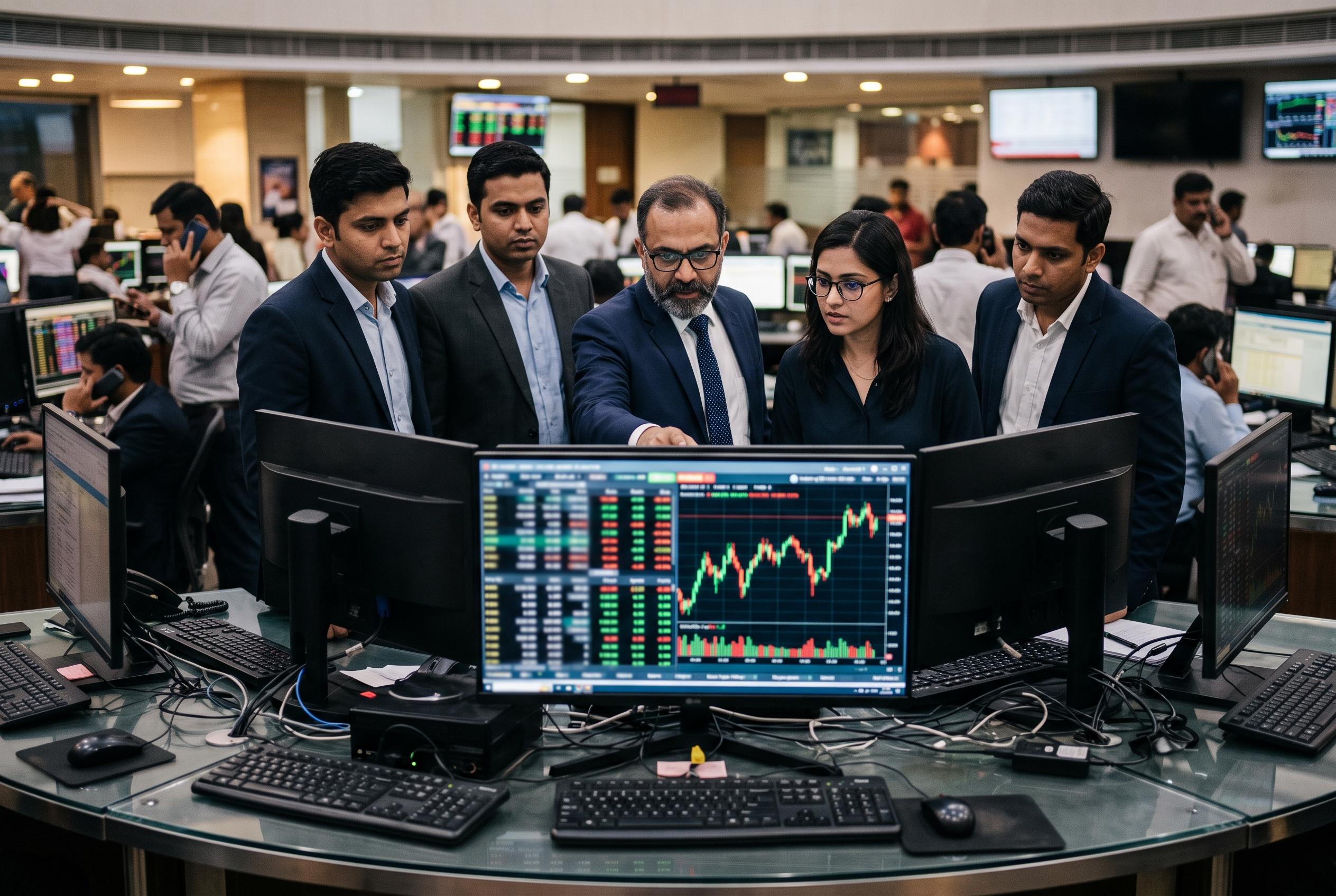

India’s newly implemented closing auction system, introduced after the MSCI index rebalance, is under scrutiny amid record trading volumes but persistent price swings and liquidity concerns. Regulators and exchanges seek solutions to stabilise the mechanism and improve reliability of market close prices.
India’s exchanges and regulator are already trying to shore up the country’s new closing auction after its first big index-rebalancing test showed that record turnover is not the same thing as dependable liquidity. On 2 September, BSE said it was talking to high-frequency firms, proprietary traders and retail investors because they “seem to be not seeing benefit of this system”, (economictimes.indiatimes.com) and on 3 September SEBI said it would review the way derivative contracts are settled under the new framework. (sebi.gov.in) Bloomberg’s reporting from Mumbai argued that the missing piece is market makers: firms willing to quote both buy and sell prices when natural counterparties are scarce. (theedgesingapore.com)
The immediate trigger was the MSCI index rebalance executed at the close on 31 August 2026, the first large-scale test since the Closing Auction Session, or CAS, began on 3 August. NSE said the auction handled ₹39,718 crore of trades, or roughly $4.1 billion to $4.2 billion depending on the conversion used by different publications, (business-standard.com) equal to about 21 per cent to 22 per cent of that day’s cash-market turnover. More than 98,000 unique investors took part, and NSE said it captured 99.9 per cent of CAS activity in that session. (livemint.com)
That surge in participation did not prevent abrupt moves in individual shares. Bloomberg, in the version carried by The Economic Times, said about 60 stocks finished the auction at their 3 per cent price limits, (theedgesingapore.com) while Reuters reported that Reliance Industries moved from a 0.6 per cent gain before the auction to an indicative 1.6 per cent fall during it, before ending 0.8 per cent lower. Eternal erased an intraday 3 per cent loss at the close, and Adani Energy Solutions dropped 10.4 per cent as index-linked orders hit specific counters. (sa.marketscreener.com) Traders cited by Reuters said the shock was largely confined to individual stocks rather than the broader benchmarks. (sa.marketscreener.com)
Business Standard’s comparison with ordinary sessions shows why the debate has shifted from volume to depth. During August, CAS averaged only about 1 per cent of NSE cash turnover; on Friday, 28 August, the window handled ₹945 crore, or 0.9 per cent of that day’s ₹1.1 trillion turnover. (business-standard.com) BSE displayed the same pattern on a much smaller base, with its closing auction rising to ₹59.5 crore on 31 August from a usual ₹9 crore to ₹22 crore range for most of the month outside derivatives expiry dates. (business-standard.com)
The reform was meant to solve an older problem in India’s market close. Under the previous volume-weighted average price system, continuous trading ran until 3.30pm and big late orders could sway the official close. The new design stops continuous trading at 3.15pm and runs a 20-minute call auction for derivatives-eligible shares, (outlookmoney.com) a structure Reuters noted is already used in China, Taiwan, Hong Kong and South Korea. (sa.marketscreener.com) In consultation papers first issued on 5 December 2024 and revised on 22 August 2025, SEBI said passive money had grown large enough to justify the change, citing roughly ₹20.5 lakh crore of passive foreign portfolio equity assets and another ₹9.18 lakh crore held by domestic mutual funds. (sebi.gov.in)
Even before the MSCI rebalance, the rollout had unsettled traders. Mint reported that on the first day of CAS the Nifty jumped nearly 200 points in the final two minutes of order closing, leaving the index up 1.6 per cent while the Sensex rose 0.7 per cent. (livemint.com) On 26 August, the same publication said, the Nifty then dropped 271.4 points in 30 seconds after the auction began, a move linked to a Bharti Airtel bid placed 3 per cent below the reference rate. (livemint.com) SEBI has already intervened in one alleged manipulation case: Mint said the regulator barred Copthall Mauritius Investment Ltd and Mansi Share and Stock Broking Pvt Ltd on 19 August and ordered them to deposit a combined ₹3.68 crore over trades executed during the 13 August Sensex closing auction, (livemint.com) while Value Research, citing SEBI’s interim order, said one foreign portfolio investor placed ₹66.58 crore of buy orders across all 30 Sensex stocks in the first two seconds of that session and later cancelled ₹98.12 crore of orders. (valueresearchonline.com)
The exchanges are putting different glosses on the same evidence. Sriram Krishnan, NSE’s chief business development officer, said after the 31 August session that the first month of CAS marked “an important milestone” and that investor participation amounted to “a strong endorsement of the mechanism”. (livemint.com) BSE’s Sundararaman Ramamurthy sounded more cautious, saying “Some minor changes will always be considered to make the system more efficient.” (economictimes.indiatimes.com) Jefferies, cited by Bloomberg in The Economic Times, said average daily turnover for index-options premium in August fell to its lowest level in about a year and a half, pointing to collateral damage in derivatives trading as the new closing structure beds in. (economictimes.indiatimes.com)
For now, the regulator appears committed to keeping the auction and adjusting the plumbing around it. Mint reported that SEBI has asked brokers to accept orders during the 3.15pm to 3.20pm transition window and to display the reference auction price more clearly on trading apps, (livemint.com) while chairman Tuhin Kanta Pandey said on 17 August that CAS was “here to stay for sure”. (livemint.com) The official move on 3 September was narrower than a rollback: SEBI said only that it would review settlement-price methodology for derivative contracts after feedback from exchanges, brokers, foreign investors and other participants. (sebi.gov.in) The lesson from 31 August is that India can channel huge index-driven orders into a closing auction; the tougher test is whether, on a normal day, enough liquidity turns up for the closing price to be discovered rather than merely endured. (theedgesingapore.com)
Disclaimer: This article is intended to inform and educate, not to recommend or endorse any financial product, investment or strategy. Please consider your own financial circumstances and seek professional advice where appropriate before making financial decisions.