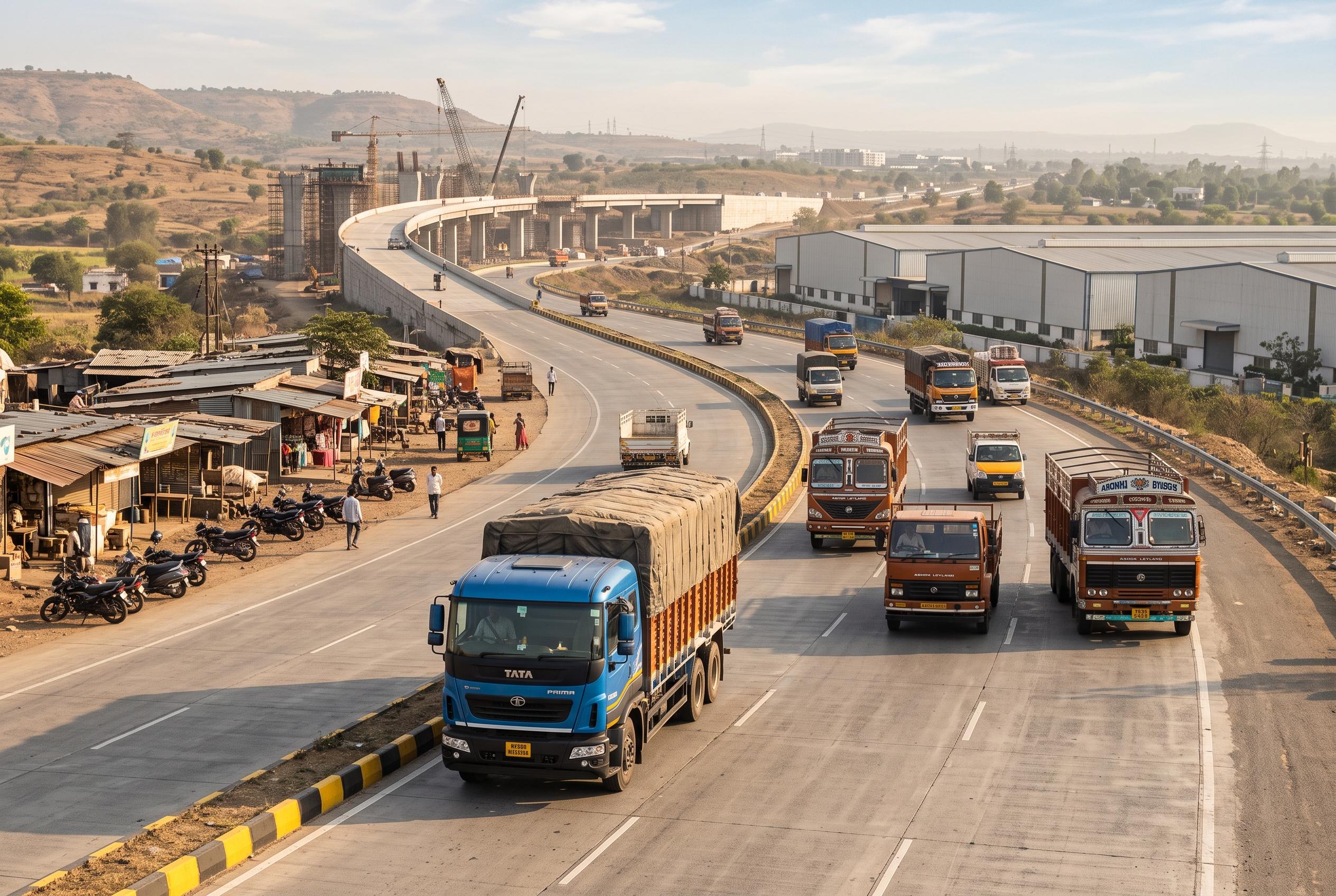

India’s commercial vehicle sales surged ahead of the festival season, driven by freight demand and infrastructure growth, with industry experts now viewing the recovery as more durable than expected, signalling a shift from passenger vehicle focus.
August’s sales data suggest India’s freight economy is giving vehicle makers a clearer lift than consumer demand. Domestic commercial-vehicle dispatches rose sharply across the main manufacturers ahead of the festival period, with Ashok Leyland up 43 per cent year on year, Tata Motors up 33 per cent, Mahindra’s sub-3.5-tonne range up 22 per cent and VE Commercial Vehicles up 19.8 per cent. Retail registrations were strong too, with VAHAN data cited by InCred Research showing a 22 per cent rise, indicating that the improvement was not simply a quirk of last year’s weak base. Against that backdrop, Nuvama’s latest call that trucks and construction equipment will outperform cars and tractors now looks less like a theoretical forecast and more like a reading of what is already happening on the ground. (business-standard.com)
Nuvama’s argument is that the global vehicle cycle is fragmenting rather than rising together. The brokerage says guidance from more than 20 companies points to heavy commercial-vehicle growth of as much as 16 per cent in North America and 11 per cent in Europe through the rest of calendar 2026, while construction-equipment demand in those markets could expand by up to 10 per cent. In India, it expects medium and heavy commercial vehicles to grow 6 per cent in calendar 2026 and the construction-equipment industry to expand by 12 to 15 per cent in FY27. Escorts, it said, sees the best momentum in mini excavators and cranes, with compactors and backhoe loaders also growing. ETAuto framed that assessment as a ranking of the market’s likely leaders, with freight-linked manufacturers and the component suppliers serving them expected to sit ahead of passenger-vehicle and tractor names. (auto.economictimes.indiatimes.com)
Recent macro and operating data help explain why that split is opening up. ETSupplyChain reported that the Index of Industrial Production rose 5.8 per cent year on year in the first quarter of FY27, with manufacturing up 6.3 per cent, infrastructure and construction goods up 6.8 per cent, and capital goods up 14 per cent. The Union Budget proposed capital expenditure of ₹12.2 lakh crore for FY27, up from ₹11.2 lakh crore in the FY26 Budget Estimates. At the same time, the PAIMANA portal was tracking 1,847 central-sector infrastructure projects worth ₹150 crore or more in June, including 1,022 under the road transport ministry. Girish Wagh of Tata Motors also pointed to e-way bill growth of 12.4 per cent and higher diesel consumption, while FleetEdge data showed month-on-month improvement in utilisation. The picture, as ETSupplyChain put it, is of a selective recovery led by actual freight movement and infrastructure activity rather than a general surge in buyer confidence. (supplychain.economictimes.indiatimes.com)
Truck makers are offering a similar reading. Vinod Aggarwal, managing director and chief executive of VECV, told Autocar Professional that “Volumes in the first half were slightly below expectations due to the extended monsoon period.” Even so, he said infrastructure investment, GST rationalisation, easing inflation and replacement demand should support a pickup in coming quarters. VECV said light and medium-duty trucks grew 9 per cent in the first half of FY26, exports rose 40 per cent and bus sales increased 7-8 per cent, while heavy-duty trucks managed only 0.2 per cent growth. Aggarwal also said operators were migrating towards higher-tonnage vehicles, with monthly truck productivity now at 20,000-25,000km against 10,000-12,000km earlier, a shift that can hold down unit sales while still encouraging faster replacement. (autocarpro.in)
The rebound is significant because it has only recently pushed the truck market beyond its pre-pandemic peak. The Times of India, citing SIAM data, reported that medium and heavy-duty truck sales reached about 3.56 lakh units in FY26, above the 3.51 lakh sold in FY19. Overall M&HCV wholesales, including buses, climbed to 4.23 lakh units, compared with 3.91 lakh in FY19. Tata Motors sold about 1.77 lakh medium and heavy-duty trucks in FY26, Ashok Leyland 1.07 lakh, and VECV 62,012, comfortably ahead of its FY19 tally of 40,456. Rajesh Kaul of Tata Motors told the newspaper that GDP growth, infrastructure spending, GST 2.0, freight movement and better highways had all helped lift utilisation and steady demand. (timesofindia.indiatimes.com)
That trajectory was far from obvious a year earlier. In August 2025, ICRA described commercial-vehicle volumes as flattish in the first quarter of FY2026 after early monsoons disrupted demand, and said the market would need a gradual recovery rather than a rapid snapback. The ratings agency said better construction and infrastructure activity, GST rate cuts, ageing fleets and government mandates would be the main supports, and projected full-year wholesale growth of 3-5 per cent for the industry and only 0-3 per cent for M&HCV trucks. Seen from September 2026, that earlier caution matters: the industry has shifted from asking whether freight-linked demand would revive at all to asking how durable the recovery can be once the easy comparisons pass. (icra.in)
There are still reasons not to mistake a recovery for a boom. Business Standard said part of August’s jump reflected a favourable comparison with August 2025, when dispatches were muted by uncertainty over GST changes. Vinod Sahay of Mahindra & Mahindra said truck and bus demand continued to be supported by infrastructure spending, freight demand and fleet replacement, but was also contending with higher input and fuel costs. Crisil’s Poonam Upadhyay told the Times of India that after growing 13 per cent in FY26, M&HCV volumes should “normalise to mid-single-digit growth in FY27”. Both Upadhyay and Kaul also warned that if the West Asia conflict drags on and fuel prices rise, fleet economics could come under pressure, while Business Standard noted that exporters with heavier exposure to the region had already seen disruption linked to the conflict in Iran. (business-standard.com)
That leaves the softer parts of the market looking exposed. Nuvama says Indian passenger-vehicle growth could slow to low single digits in the second half of FY27 because of a high base, while large tractor demand in North America remains under pressure from elevated input costs and weaker farm profitability. India may still post mid-single-digit tractor growth, according to the brokerage’s reading of Escorts and Mahindra commentary, but even there the timing of the festive season could make the second quarter weaker. If that assessment holds, the auto industry’s next gains are more likely to come from trucks, excavators and fleet renewal than from a broad consumer-led upswing. (auto.economictimes.indiatimes.com)
Disclaimer: This article is intended to inform and educate, not to recommend or endorse any financial product, investment or strategy. Please consider your own financial circumstances and seek professional advice where appropriate before making financial decisions.