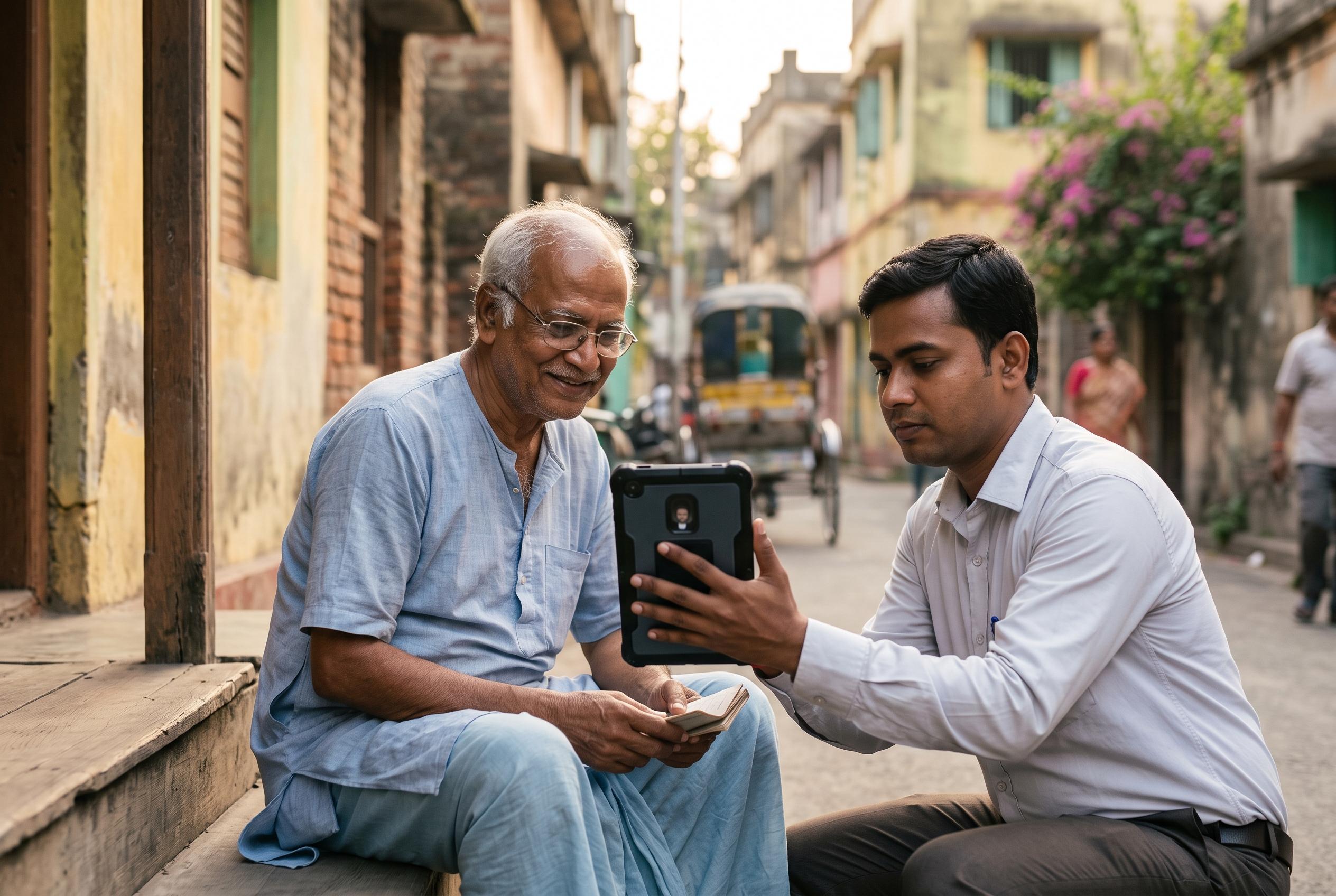

India enhances pension processes with a major shift to doorstep digital and face authentication services, aiming for wider inclusion and easier compliance for pensioners in 2026.
The most important change in India’s life-certificate system going into 2026 is not the deadline but the way the certificate can now be filed. Since 1 December 2025, pensioners under the Employees’ Pension Scheme have been able to use a doorstep Digital Life Certificate service run by the Employees’ Provident Fund Organisation with India Post Payments Bank, meaning a postal worker can come home and complete the process using face authentication or biometrics instead of making the pensioner travel to a bank or EPFO office.
That newer doorstep option sits inside a much larger annual drive. The Department of Pension & Pensioners’ Welfare said in August 2025 that pensioners must submit a life certificate each year in November for their pension to continue, and that its fourth nationwide campaign would run from 1 to 30 November across more than 1,850 districts, cities and towns, with 2,500 camp locations. The same release said the previous year’s campaign had already drawn 1.62 crore digital submissions across 845 cities, underlining how quickly the system has shifted away from the old branch-counter model.
Face authentication is now the centrepiece of that shift. Speaking at the launch of the fourth national campaign, Jitendra Singh said more than 25 lakh people had already adopted facial verification to generate their certificate. Akashvani reported that he also argued the move mattered particularly for older pensioners because earlier biometric methods were not always dependable for people aged 75 and above. He cited striking figures to make the case: more than 30,000 users of face authentication were aged over 90, and about 2,200 were over 100. NDTV’s account of the campaign said the facility could be used on Android as well as iOS devices.
The scale of the outreach explains why the process now reaches well beyond bank branches. According to NDTV, the 2025 campaign involved 19 banks, 1,600 district or sub-district post offices and 57 pensioners’ welfare associations, with a monitoring portal mapping 2,500 camp sites and 1,230 nodal officers. The broadcaster said banks were due to hold camps at more than 1,250 locations in 250 cities, while elderly, disabled and unwell pensioners would be assisted through home and hospital visits. The government’s own release added that India Post Payments Bank was using its network of about 1.8 lakh postmen and Gramin Dak Sevaks and would stage camps at 1,600 district and sub-divisional post offices.
For pensioners trying to work out what a home visit actually costs, the answer depends on which route they use. India Post Payments Bank says its assisted Digital Life Certificate service is open to both its own customers and people paid by other banks. It says pensioners can contact the nearest post office or ask for a visit from a postman or Gramin Dak Sevak, and that a Pramaan ID is generated instantly on successful completion. The bank’s published charge is Rs70, inclusive of GST and cess, for each successful certificate, with no separate doorstep fee. However, EPFO’s January 2026 announcement about the dedicated EPS arrangement took a different position for that group: regional provident fund commissioner Jayavadan Ingle said the service was “completely free of cost and no charges are payable by pensioners”.
Banks still remain part of the picture, and the digital route has not formally abolished the paper one. State Bank of India says Jeevan Pramaan was launched on 10 November 2014 as an Aadhaar-based Digital Life Certificate, but as an addition to, not a replacement for, physical submission. On SBI’s account, a pensioner can still use a nearby Common Service Centre, a bank branch or a government office to authenticate the certificate, and after successful submission receives an SMS carrying the transaction ID. The bank also says physical life certificates continue to be accepted if the pensioner prefers that method. What has changed is that digital authentication works only when the pension account has already been seeded with Aadhaar.
The government is also treating this as a broader digital-administration push rather than a narrow pension formality. The Department of Pension & Pensioners’ Welfare said its 2025 campaign adopted a saturation model and aimed for 2 crore certificates, with secretary V. Srinivas reviewing the preparations months in advance. Akashvani reported that Singh presented the effort as a “unique opportunity for digital empowerment of pensioners, aligned with Digital India”, and said the initiative had drawn interest from countries including Mongolia and the Maldives.
The practical message for 2026 is that the annual requirement remains, but the burden of complying with it is increasingly being shifted off the pensioner. For most people, the system now offers several assisted routes before a missed certificate becomes a payment problem: bank camps, post-office camps, Common Service Centres, branch counters and, in many cases, a visit to the home. The real dividing line is no longer whether a pensioner can stand in a queue. It is whether their pension account and Aadhaar details are already in order, and whether they know which channel applies to their pension.
Disclaimer: This article is intended to inform and educate, not to recommend or endorse any financial product, investment or strategy. Please consider your own financial circumstances and seek professional advice where appropriate before making financial decisions.