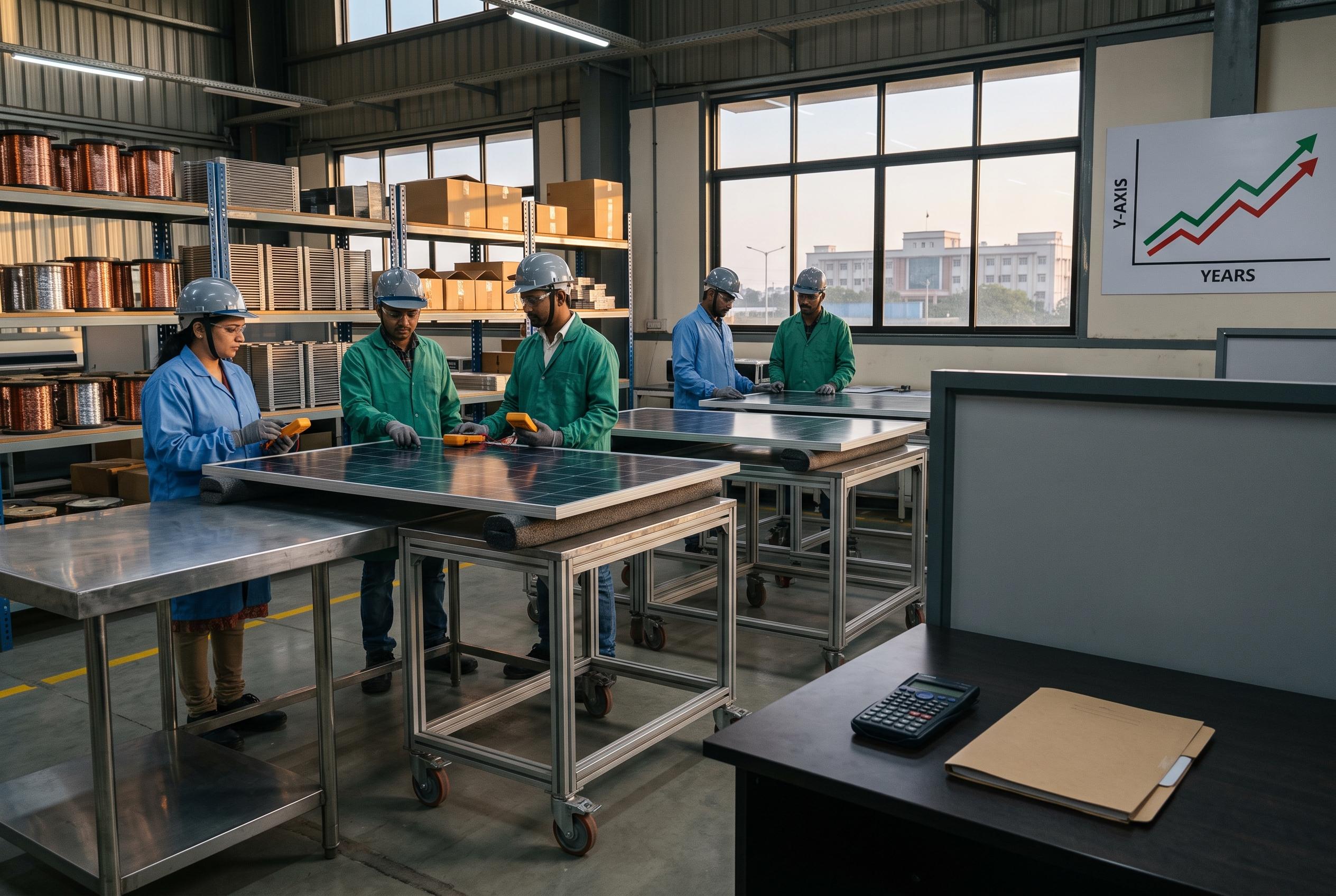

India’s transition from rapidly installing solar panels to building a competitive manufacturing sector faces challenges amid China’s supply chain dominance, but advances in technology and strategic investments could reshape its solar future.
India’s solar industry is moving from a story of fast-growing demand to one of industrial ambition. According to pv magazine India, the country’s next task is not simply to install more panels, but to build a manufacturing base that can compete globally across modules, cells, ingots and wafers.
That shift matters because the world’s solar supply chain remains heavily concentrated in China. pv magazine’s earlier analysis said China accounts for more than 80% of manufacturing capacity across the solar value chain, while India is still dependent on imported upstream inputs such as polysilicon and wafers. Even as India strengthens domestic policy support through measures such as the Production Linked Incentive scheme and the Approved List of Models and Manufacturers framework, the country remains exposed to foreign suppliers for critical components.
There are signs of momentum. Business Standard reported that India’s solar module manufacturing capacity could rise to more than 165 gigawatts by March 2027, from roughly 109 gigawatts at present, although that rapid expansion could create overcapacity and squeeze smaller companies’ margins. At the same time, Angel One said module imports fell sharply in fiscal 2026 as domestic capacity expanded, even though China still dominates the upstream end of the chain.
The deeper challenge, as pv magazine India argues, is not capacity alone but capability. Building a durable solar manufacturing sector will require process expertise, automation, digital quality systems and stronger research and development. The article makes the case that artificial intelligence and smart manufacturing can help factories improve yields, preserve know-how and learn faster, especially because much of India’s solar base is still being built from scratch rather than retrofitted. That could give Indian producers an advantage if they invest early in modern systems instead of trying to modernise ageing plants later.
Even so, the gap with China remains wide. NDTV reported that Beijing still dominates wafer production, while The Battery Magazine said China’s integrated solar manufacturing capacity across polysilicon, wafers, cells and modules is far ahead of India’s. For India, the real test is whether it can turn domestic demand into a broader industrial ecosystem that supports suppliers, engineers, research institutions and technology partners. If it can, the country may not replace China as the global leader, but it could emerge as a serious and resilient alternative.
Disclaimer: This article is intended to inform and educate, not to recommend or endorse any financial product, investment or strategy. Please consider your own financial circumstances and seek professional advice where appropriate before making financial decisions.