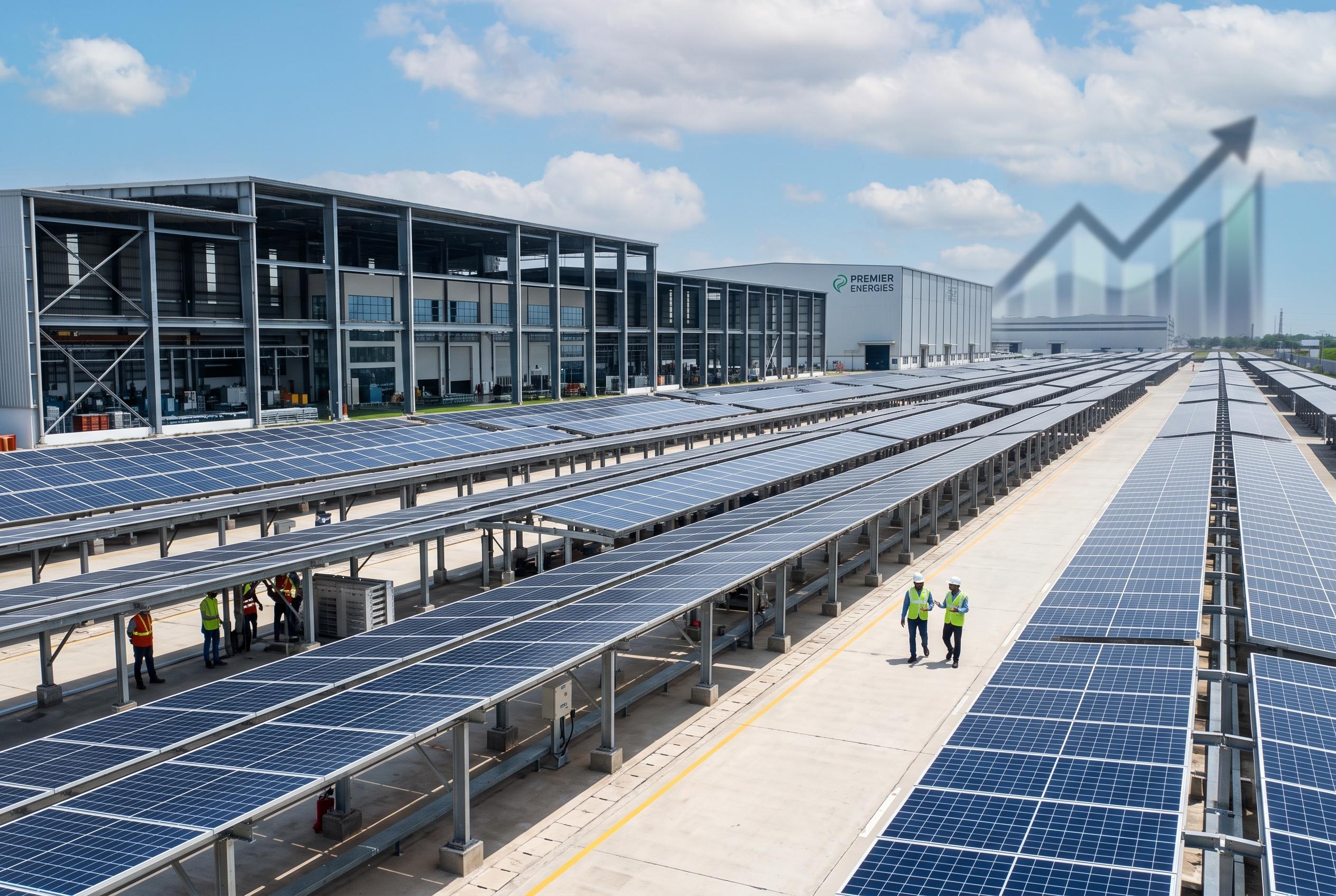

Premier Energies reports a 35% rise in quarterly revenue and secures over ₹3,000 crore in new solar orders, signalling rapid growth and expansion in India’s solar manufacturing sector.
Premier Energies has reported a sharp rise in first-quarter earnings, with revenue climbing 35.25% year on year to ₹24.63 billion in the quarter ended June 30, 2026, according to Mercom India. EBITDA rose 30.3% to ₹7.14 billion, while profit after tax increased 53.32% to ₹4.72 billion, helped by higher solar cell and module output, strong domestic demand, smoother order execution and gains from its transformer business.
The company’s manufacturing volumes rose across both core product lines. Solar cell production increased to 844 MW from 447 MW a year earlier, while module production rose to 953 MW from 735 MW. Mercom India said capacity utilisation reached 92% for cells and 73% for modules, though the module figure did not include output from the newly commissioned 5.6 GW Seetharampur plant in Telangana.
Premier Energies’ sales mix remained heavily domestic, with about 99% of revenue coming from India and exports accounting for roughly 1%, Mercom India reported. Modules contributed 71% of revenue, cells 24% and transformers about 4%. The transformer arm, Transcon, generated revenue of about ₹1.1 billion in the quarter, with EBITDA of ₹294 million and profit after tax of ₹183 million.
The company is also building a larger order pipeline and manufacturing base. Business Standard reported that Premier Energies secured orders worth ₹3,011 crore in the quarter for 1,846 MW of solar cells and modules, with deliveries spread across FY27 and FY28. As of June 30, 2026, Mercom India said the order book stood at ₹150 billion, or 9,867 MW, while the company continued expanding capacity, including module manufacturing rising from 5.5 GW to 11.1 GW and solar cell capacity expected to reach 10.6 GW by September 2026. Premier Energies also plans to invest around ₹6,000 crore over three years in ingot and wafer facilities as part of a capital spending programme of more than ₹12,000 crore.
Disclaimer: This article is intended to inform and educate, not to recommend or endorse any financial product, investment or strategy. Please consider your own financial circumstances and seek professional advice where appropriate before making financial decisions.