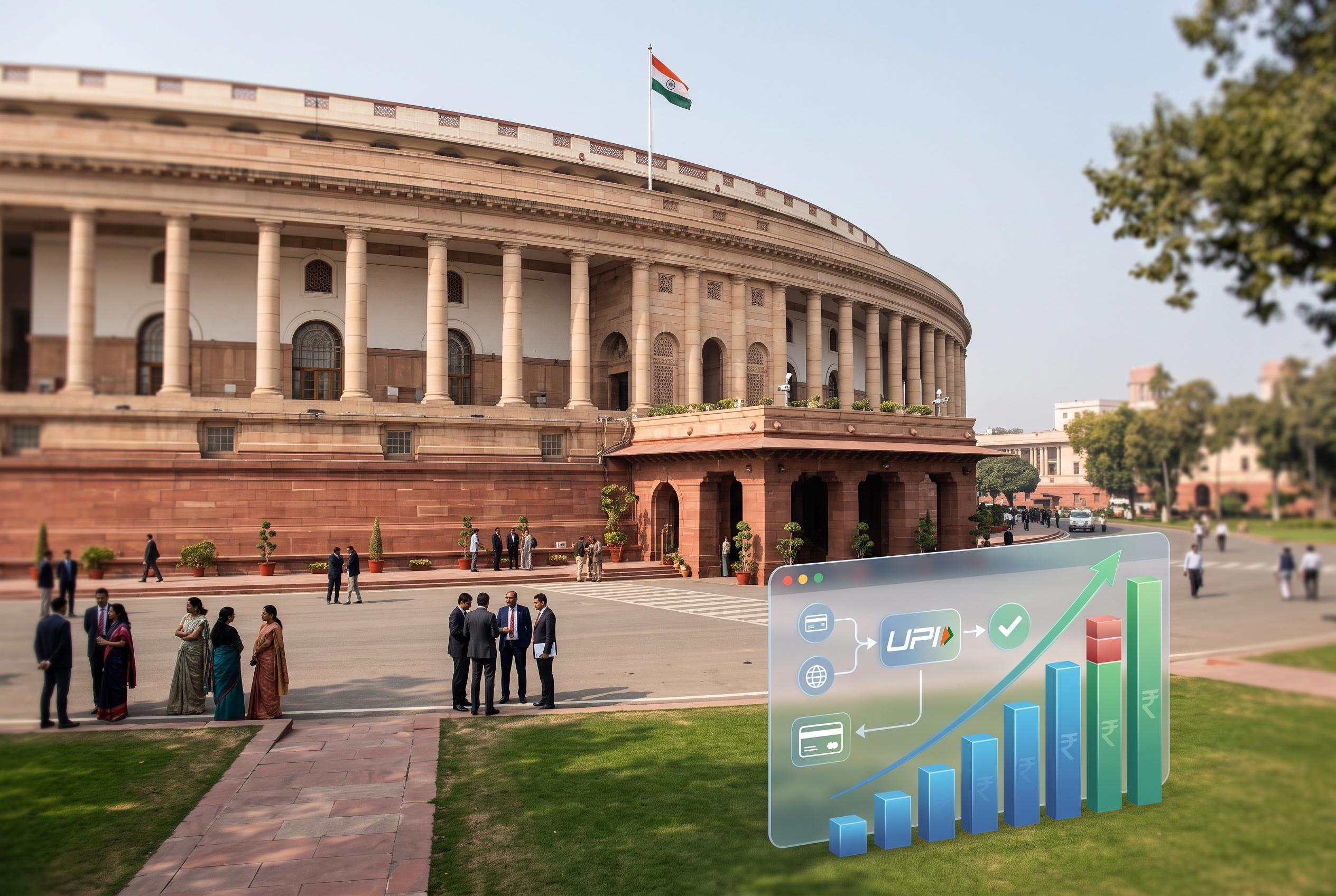

India’s Parliament has approved a tax amendment bill that could introduce charges on certain UPI transactions, marking a shift from the free-of-charge model that has driven digital payments growth since 2020, amid mounting costs for infrastructure and security.
India’s Parliament has taken a significant step towards reshaping how its fast-growing digital payments network is funded, after the Lok Sabha approved a tax amendment bill that opens the door to charges on some UPI transactions. The change does not impose a fee immediately, but it gives the government room to allow calibrated charges under the payments law, marking a shift away from the zero-cost approach that has defined UPI since 2020.
The move comes as UPI, the country’s flagship real-time payment system, has become deeply embedded in daily commerce. Industry data cited by the India Brand Equity Foundation shows the platform had 55.49 crore users by June 2026 and handled 24,161.69 crore transactions in financial year 2026, worth ₹314.23 lakh crore, or about US$3.56 trillion. That scale has intensified pressure to find a more durable funding model for infrastructure, security and fraud prevention.
For most consumers, however, the practical picture remains unchanged for now. ClearTax and other industry guides note that ordinary bank-to-bank UPI payments are generally free for users, whether they are sending money to friends or paying many merchants. Charges tend to arise only in narrower cases, such as some wallet-based merchant payments using prepaid payment instruments, where any interchange is typically paid behind the scenes rather than directly by the customer.
The debate reflects a broader tension between keeping digital payments cheap and paying for the systems that keep them reliable. During UPI’s early expansion, the zero-charge model helped drive adoption among small merchants and first-time users. But as transaction volumes have surged, the gap between the actual cost of processing payments and the subsidies available to cover them has widened, leaving banks and payment firms with less room to invest in capacity upgrades and security.
Disclaimer: This article is intended to inform and educate, not to recommend or endorse any financial product, investment or strategy. Please consider your own financial circumstances and seek professional advice where appropriate before making financial decisions.