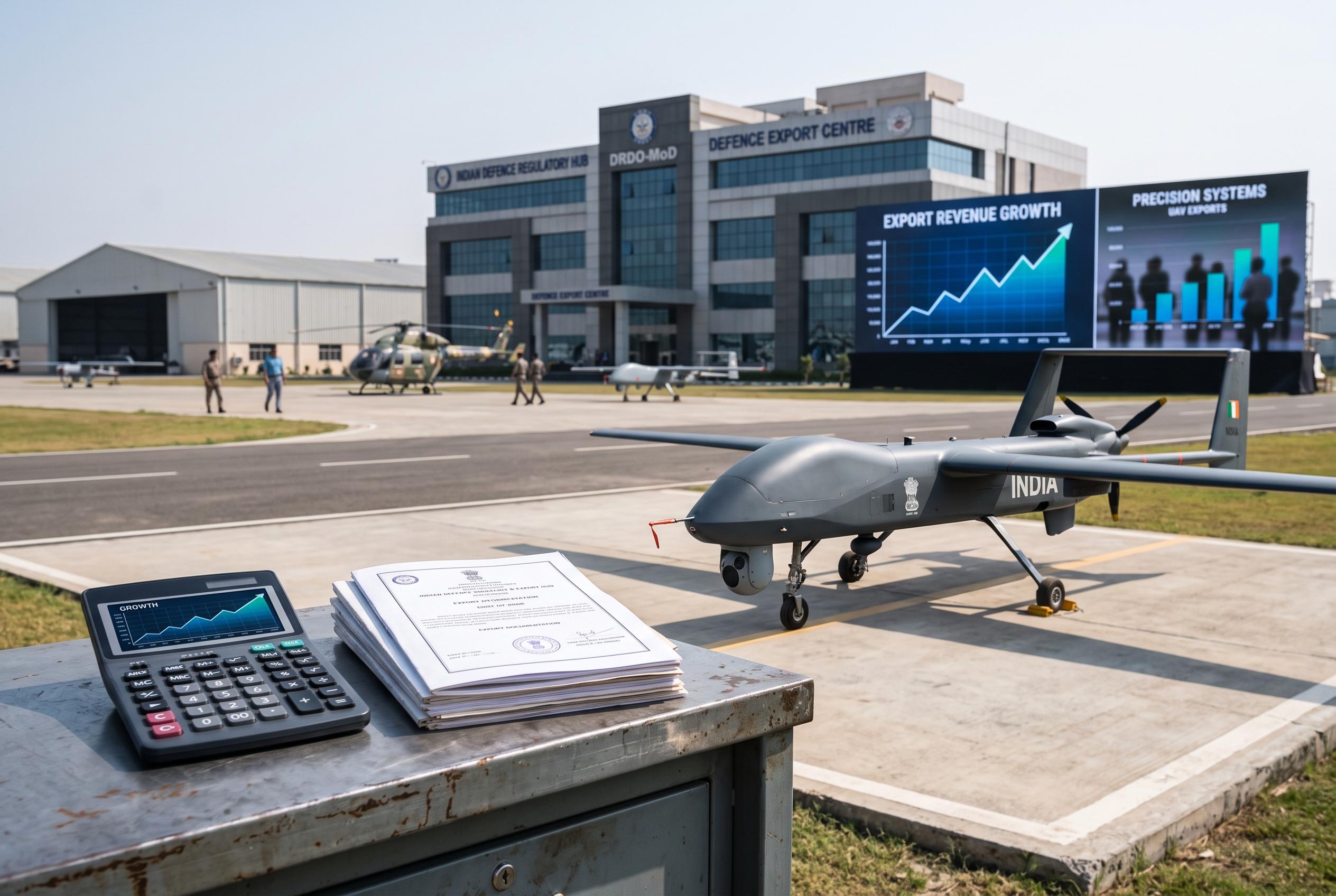

India’s defence export sector is experiencing a significant transformation, expanding beyond traditional missile systems to include drones, electronic warfare, and precision systems, with exports reaching a record ₹38,424 crore in FY26 and a growing global footprint.
India’s defence export story is no longer just about BrahMos. The supersonic cruise missile helped put the country on the map, but the bigger shift now underway is towards a broader mix of military hardware and technology, from drones and loitering munitions to electronics, precision systems and autonomous platforms.
That change comes as India’s defence exports have climbed to a record ₹38,424 crore in FY26, up 62.66% from the previous year, according to figures reported by the Ministry of Defence and covered by Business Standard, The Indian Express, The Economic Times and other outlets. The government says exports now reach more than 80 countries and the number of exporters has risen to 145 from 128, underscoring how quickly the sector has widened beyond a handful of flagship systems.
The demand picture has also changed. As recent wars have shown, armed forces are increasingly prioritising cheaper, more flexible systems such as drones, electronic warfare tools, precision-guided munitions and air-defence equipment over some traditional platforms. Indian firms are moving with that trend. One example is KAL, a long-range one-way attack drone developed by Noida-based IG Defence. The company says the system can fly up to 1,000 km, remain airborne for 7 to 8 hours and carry a 50-kilogram payload, although any export would still need official clearance.
India’s export basket is already spreading across more categories. According to the lead report, items being marketed abroad include counter-drone systems, radars, artillery, ammunition, protective gear and aircraft components. Pinaka rocket systems and ATAGS artillery have already found buyers overseas, while Akash air-defence systems and Swathi weapon-locating radars are also part of the push. The Philippines has bought BrahMos, Armenia has acquired Pinaka and artillery systems, and other customers are taking Dornier aircraft, helicopters, interceptor boats, torpedoes and aerospace parts.
A further sign of the sector’s evolution is the growing value of subsystems. Priyanka Singhal, chief executive of Ammunic Systems, argues that India’s opportunity lies not only in complete platforms but also in the electronics that make them effective, including fuses, sensors, guidance systems and precision modules. The lead report says Ammunic has worked with the armed forces and the Defence Research and Development Organisation on advanced munitions and electronic fuses, while DRDO is also working with IIT-Madras and Munitions India to turn conventional artillery shells into precision-guided weapons.
The export mix also reflects the changing balance between public and private industry. Government data cited in the lead report shows private firms contributed ₹17,353 crore in FY26, while defence public sector undertakings accounted for ₹21,071 crore. India has set a target of ₹50,000 crore in defence exports by 2029-30, and officials have said the goal is within reach. For now, the message from the numbers and the product mix is clear: BrahMos may have opened the door, but drones, sensors, subsystems and precision weapons are now carrying much more of the load.
Disclaimer: This article is intended to inform and educate, not to recommend or endorse any financial product, investment or strategy. Please consider your own financial circumstances and seek professional advice where appropriate before making financial decisions.