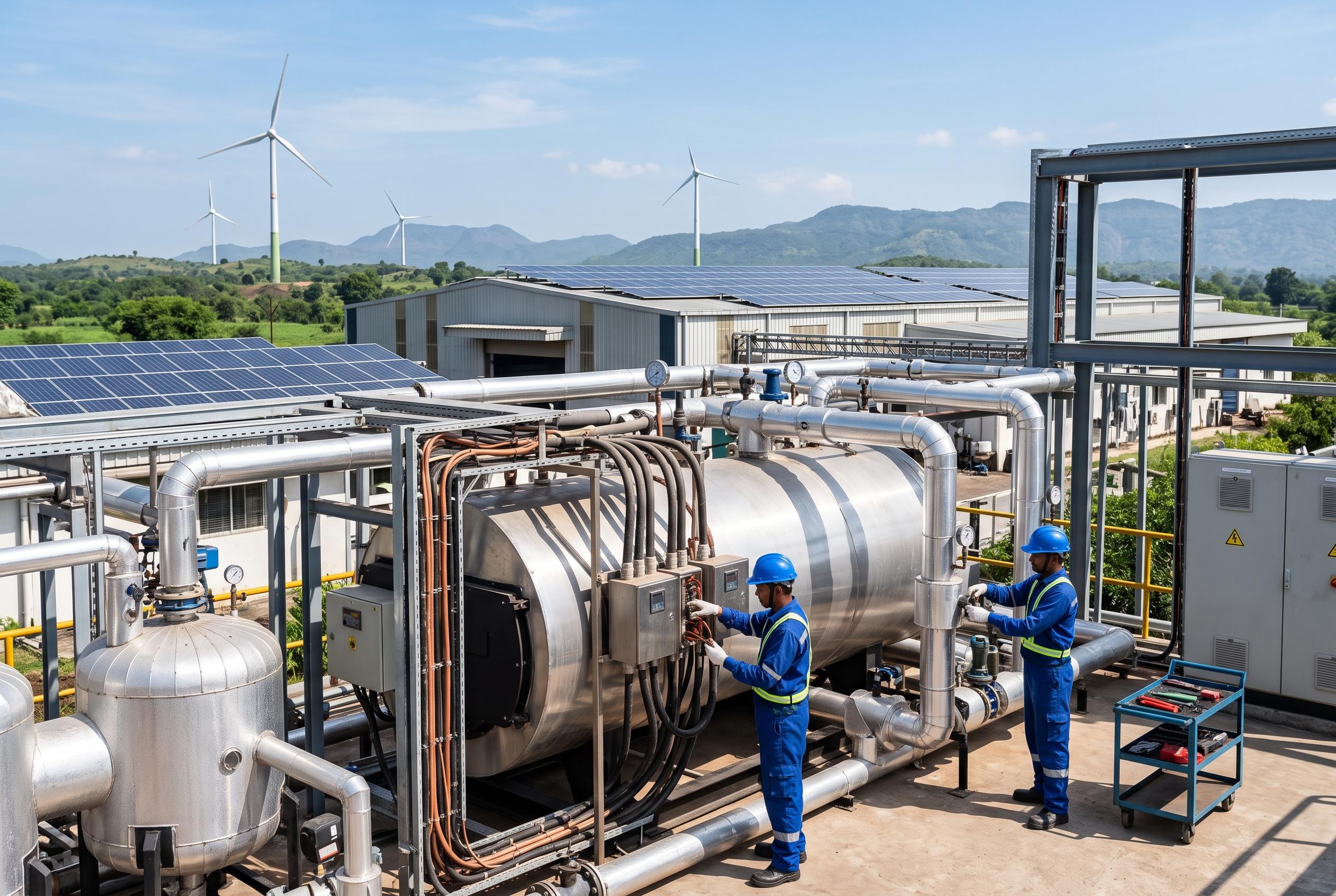

India’s push to decarbonise industry highlights the rising importance of electrifying process heat in small and medium-sized factories, driven by environmental goals and energy security concerns amid global fuel shocks.
India’s drive to cut industrial emissions is increasingly turning towards a part of manufacturing that is often overlooked: process heat. According to the policy brief from The Energy and Resources Institute, nearly two-thirds of energy used in Indian industry goes to direct heat needs, from drying and boiling to steam generation. That makes electrification of industrial heat, particularly in small and medium-sized factories, one of the most consequential but difficult parts of the country’s clean-energy transition.
The case is not only environmental. India imports more than 85% of its crude oil requirements, leaving manufacturers exposed to global fuel shocks, and recent disruptions have shown how quickly those pressures can hit factory floors. Mint reported that the West Asia conflict has fed power cuts, tighter diesel restrictions and higher operating costs for MSMEs, while Business Standard said industry groups have sought emergency support for energy-intensive clusters such as Morbi’s ceramics and Firozabad’s glass units. For many firms, that makes cleaner heat less a distant climate goal than a question of resilience and cost control.
The technology options are already better defined than they once were. Lower-temperature processes in sectors such as food, textiles and pharmaceuticals can often be served by heat pumps or electric boilers, while mechanical vapour recompression and thermal storage can improve efficiency in more specialised settings. The Vishnu IAS brief argues that electrification should not be treated as a simple swap of one boiler for another: energy audits, waste-heat recovery and process integration can reduce the amount of heat that needs to be supplied at all. SAMEEEKSHA, a platform linking industry, government, researchers and funding bodies, points to the value of that kind of cross-sector collaboration in promoting cleaner and more efficient technologies.
For MSMEs, the biggest barrier is usually finance rather than engineering theory. New equipment, grid upgrades, control systems and possible process changes can require substantial upfront spending, even where running costs may fall over time. The brief argues for cluster-based planning, so that factories in places such as Tiruppur, Morbi, Surat and Rajkot can pool demand, attract tailored finance and build demonstrations that can be copied elsewhere. It also calls for stronger access to renewable power, more skilled technical staff and policy support that treats industrial electrification as a system-wide upgrade rather than a narrow equipment replacement.
Disclaimer: This article is intended to inform and educate, not to recommend or endorse any financial product, investment or strategy. Please consider your own financial circumstances and seek professional advice where appropriate before making financial decisions.