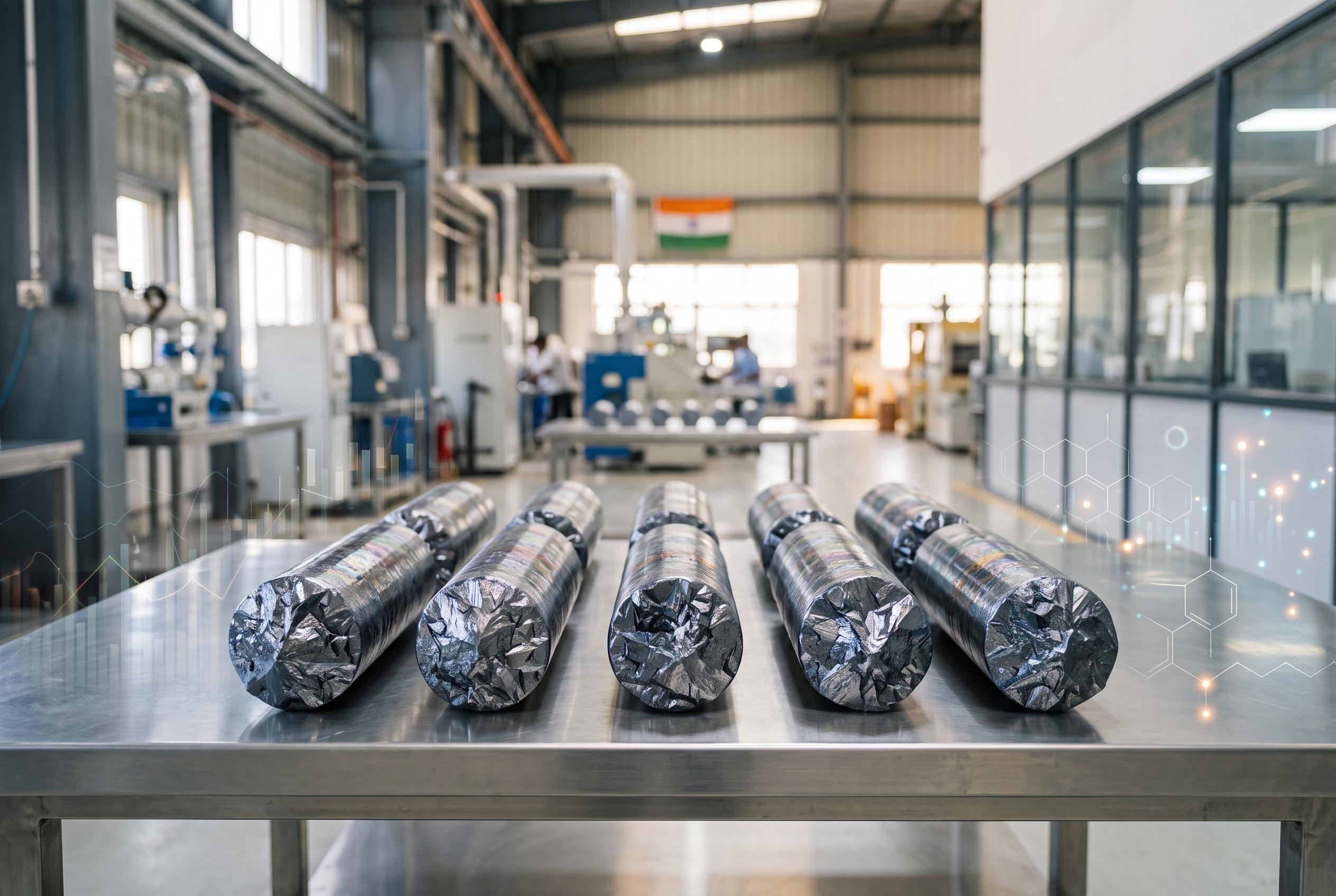

India’s energy ministry is evaluating a new support scheme for polysilicon production to strengthen the country’s solar supply chain, diversify into electronics manufacturing, and cut reliance on imports amid sluggish progress in the sector.
India’s energy ministry is weighing a new incentive package for polysilicon manufacturing as it seeks to deepen domestic solar production and cut reliance on imports, according to reporting by The Indian Express and LiveMint. Santosh Kumar Sarangi, the secretary at the Ministry of New and Renewable Energy, said the government is working on a support scheme for the sector, which sits at the most upstream end of the solar manufacturing chain.
Polysilicon is the purified form of silicon used to make ingots, wafers, solar cells and ultimately photovoltaic modules. Business Standard reported that polysilicon accounts for the primary raw material in more than 95% of solar panels globally, underlining why policymakers see it as strategically important. At present, India depends heavily on overseas supplies for the material, leaving the country exposed to disruptions in international trade and prices.
The proposed support would build on the existing production-linked incentive programme for high-efficiency solar PV modules, which the ministry says is intended to create a fuller domestic manufacturing ecosystem. That scheme was designed to boost local capacity, improve quality control and encourage sourcing of Indian materials, but implementation has been slower in the upstream stages, especially in polysilicon, ingots and wafers, according to ministry material and recent analysis cited by IEEFA.
The new thinking goes beyond solar power alone. Officials are also considering polysilicon as an industrial segment in its own right because refining the material requires substantial chemical processing and could support other advanced manufacturing areas. Higher-purity polysilicon also has potential uses in semiconductors, giving the proposal added weight as India tries to strengthen both its renewable energy and electronics supply chains.
That broader ambition comes as analysts question how far the current solar incentive framework has delivered. A study by JMK Research and IEEFA found that, as of June 2025, the overall achievement rate of awarded capacity was about 29%, with only 56% of module capacity and 14% of polysilicon capacity realised. The report argued that future support measures may need to combine fiscal help, upfront capital subsidies and longer policy certainty if India is to build a more resilient manufacturing base.
Disclaimer: This article is intended to inform and educate, not to recommend or endorse any financial product, investment or strategy. Please consider your own financial circumstances and seek professional advice where appropriate before making financial decisions.