
As India sets its sights on becoming a ‘Viksit Bharat’ by 2047, experts highlight the challenges of scaling GDP, fostering inclusion, and ensuring sustainable development to truly transform the nation.
India’s push to become a “Viksit Bharat” by 2047 is more than a patriotic slogan. As Dr Mohan Kumar writes in an opinion piece for Tela Nón, the centenary of independence offers a deadline by which India must measure whether it has become a truly developed nation, not simply a larger one.
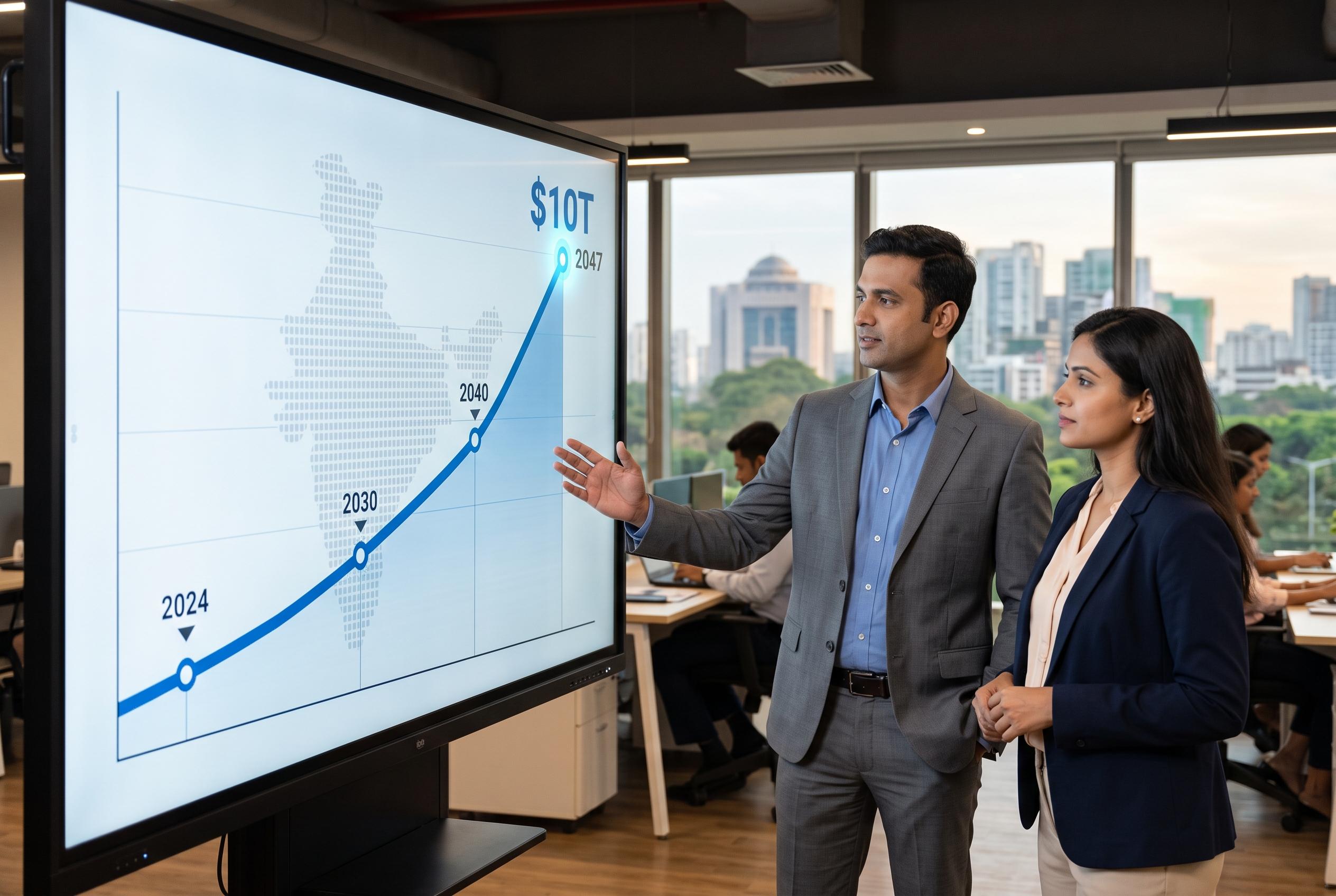
Kumar argues that the first test is economic scale. He says India’s gross domestic product, at about $4.5 trillion, is still too small for a country of nearly 1.5 billion people and would need to rise to at least $10 trillion for the development target to be credible. He links that goal to a far bigger role in global trade, including a much larger share of exports, alongside a sharp rise in foreign direct investment. Reuters has previously reported that Indian officials and economists increasingly frame the 2047 agenda around long-run growth, deregulation and policy stability rather than headline numbers alone.
That view is echoed in other commentary and official discussion. According to India’s commerce and industry ministry, long-term planning for a $10 trillion economy has centred on research and development, policy reform and a more predictable business environment. The Indian Express reported that Chief Economic Adviser V Anantha Nageswaran has also stressed deregulation and sustainable growth as essential if India is to realise that ambition. At the same time, commentators have warned that size alone will mean little unless it is matched by better living standards, stronger infrastructure and a broader spread of opportunity.
Kumar places particular emphasis on inclusion. He says growth must reach people at the bottom of the income ladder and not remain concentrated among the already well placed. He points to government programmes such as Pradhan Mantri Garib Kalyan Yojana, but argues that job creation for young people has to become a national priority. The real challenge, in his view, is to build an ecosystem in which young Indians become entrepreneurs and employers, not just jobseekers, while the state works to reduce levels of inequality that he describes as unsustainable.
He also says India’s education system needs a major overhaul. Kumar criticises an approach that still relies too heavily on rote learning and leaves many graduates unprepared for work. He calls for stronger vocational training, closer links between industry and academia, more digital and artificial intelligence skills, higher spending on education and a much greater emphasis on research. That argument aligns with comments from policy makers and economists cited by the Economic Times, who have said India’s long-term growth will depend on productivity, innovation and a workforce equipped for a knowledge economy.
Health and sustainability, Kumar argues, are equally central to the development plan. He notes that India’s health system has improved through digital tools, more hospitals and schemes such as Ayushman Bharat and Ayushman Arogya Mandir, but says public spending remains too low and chronic disease poses a growing threat. On energy and growth, he says India should not copy the high-carbon path taken by richer economies or China’s coal-heavy model. Instead, he presents India as uniquely placed to pursue low-carbon development while moving towards high income status. His conclusion is that the next two decades will be decisive and will require a mission-driven, whole-of-government effort if India is to turn the 2047 promise into reality.
Disclaimer: This article is intended to inform and educate, not to recommend or endorse any financial product, investment or strategy. Please consider your own financial circumstances and seek professional advice where appropriate before making financial decisions.