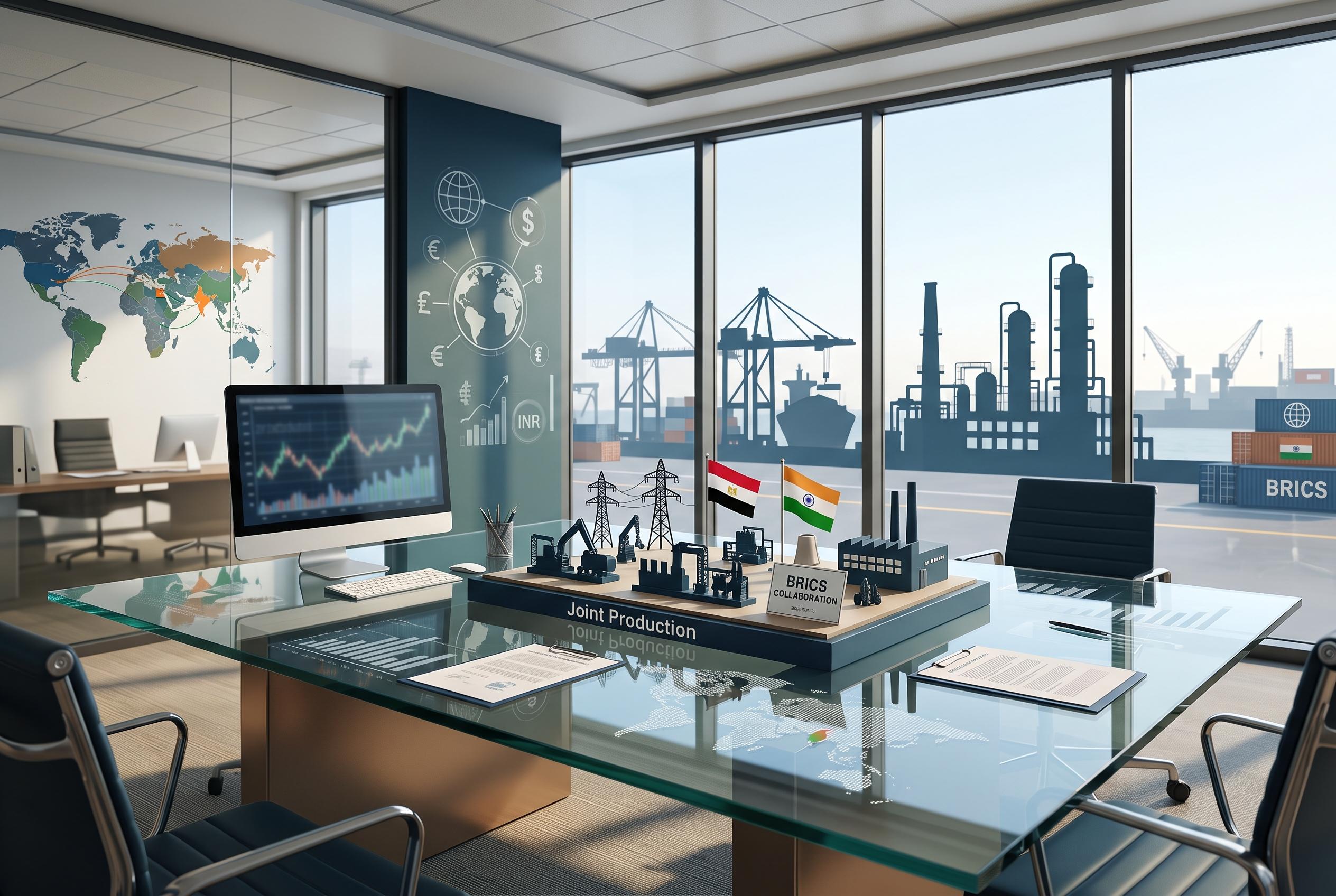

Egypt and India are intensifying efforts to deepen industrial cooperation, focusing on joint production, investment, and technology transfer, as they leverage strategic ties and the recent expansion of BRICS.
Egypt and India are stepping up efforts to turn a broad political relationship into a more concrete industrial partnership, with both sides now discussing joint production, investment and technology transfer across sectors ranging from cars and medicines to renewable energy and digital payments.
Egypt’s industry minister, Kamel El-Ghamry, met India’s commerce and industry minister, Piyush Goyal, in Jaipur on the sidelines of a BRICS industrial meeting, according to the Egyptian account of the talks. El-Ghamry said the two countries still had far more room to expand cooperation than their current level of trade and investment suggests, and argued that the focus should move towards practical projects rather than general statements of intent.
The meeting also reflected a wider diplomatic push that has gathered pace since Egypt’s entry into BRICS. Indian Prime Minister Narendra Modi backed the bloc’s expansion in 2023, when Egypt was invited to join alongside other emerging economies, and Indian officials have since described Egypt as a promising partner for trade, investment and access to strategic markets. In May 2026, Egypt’s foreign minister, Badr Abdelatty, held similar discussions with Goyal in New Delhi, underscoring a steady effort by Cairo to position itself as a manufacturing and export base for Indian companies serving Africa, the Arab world and Europe.
Trade data cited by Egypt Business suggests the relationship has already deepened, with India ranking as Egypt’s fourth-largest trading partner in 2022 and bilateral trade reaching $6 billion. Egyptian officials have also been looking ahead to a target of $12 billion in trade by 2027, a goal that would require more diversified industrial links than the current pattern of imports and exports.
The Jaipur talks pointed to several sectors that could anchor that expansion, including vehicles and components, pharmaceuticals, medical equipment, fertilisers, phosphates, machinery, engineering industries, financial technology and support services for small and medium-sized firms. The two sides also discussed digital payments, the possibility of using local currencies more often in trade settlement and the creation of a joint mechanism to identify production opportunities, supply-chain links and export prospects. Goyal said the similarities between the two economies could support a long-term partnership and offered India’s experience with insolvency reform as a possible area for technical cooperation.
Disclaimer: This article is intended to inform and educate, not to recommend or endorse any financial product, investment or strategy. Please consider your own financial circumstances and seek professional advice where appropriate before making financial decisions.