

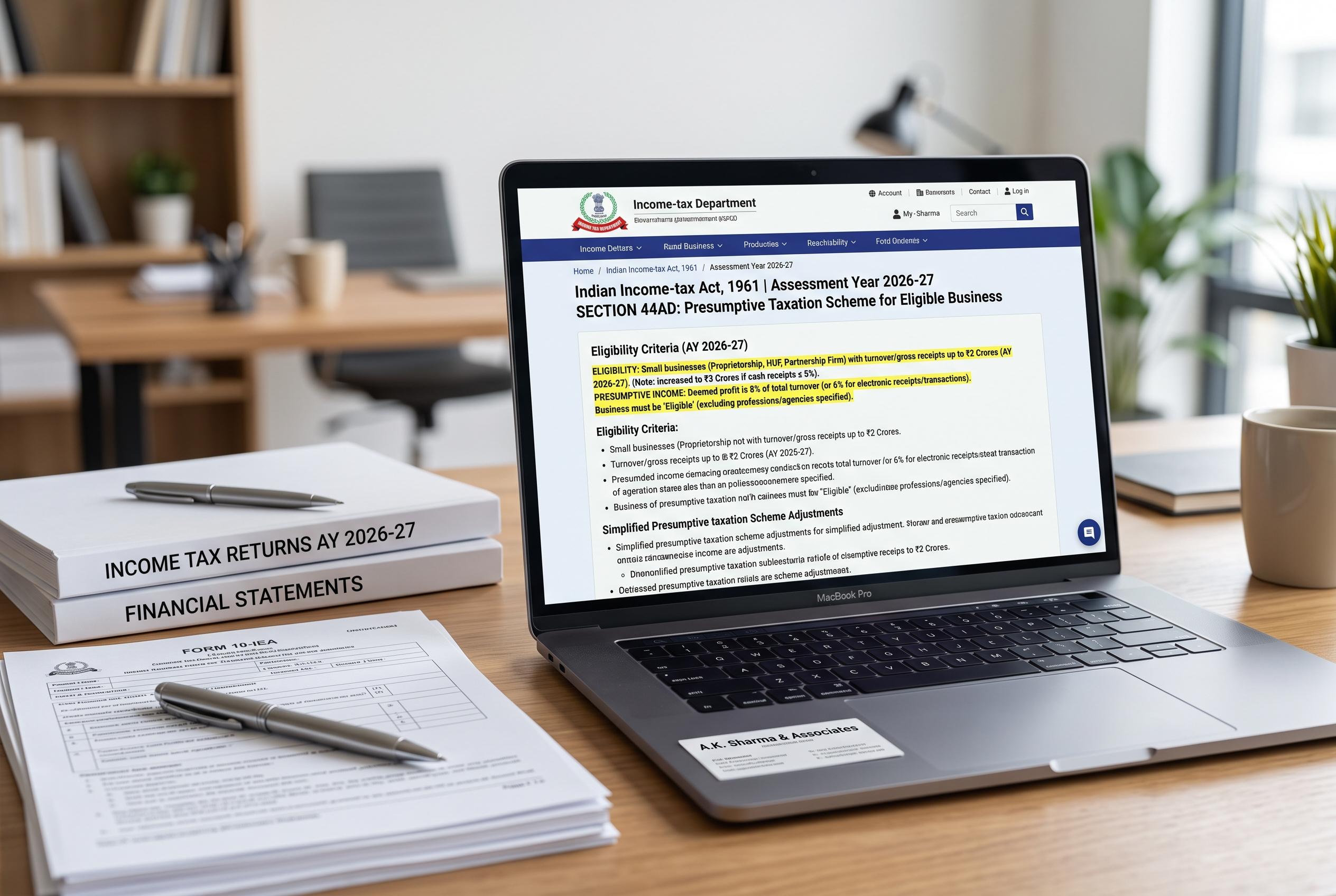

Section 44AD, a key provision for small Indian entrepreneurs, sees adjustments in eligibility and compliance requirements for the assessment year 2026-27, affecting how small businesses report taxable income under the Income-tax Act 1961.
Section 44AD remains one of the simplest ways for small businesses in India to compute taxable income under the Income-tax Act, 1961. The scheme allows eligible taxpayers to declare profits on a presumptive basis rather than maintaining detailed books and calculating every expense line by line, which can substantially reduce compliance work for traders, retailers and other small operators. According to the Income Tax Department of India, the provision is designed to make tax administration easier for qualifying businesses while preserving the legal framework for income reporting.
For assessment year 2026-27, the scheme is generally available to resident individuals, Hindu undivided families and partnership firms other than limited liability partnerships. Industry guides on presumptive taxation say the key test remains whether the taxpayer is carrying on an eligible business and stays within the relevant turnover limit for the year. They also note that taxpayers should confirm eligibility carefully before opting in, particularly where business receipts or business structure may complicate the position.
The main attraction of Section 44AD is the simplified profit calculation. Where the conditions are met, income is presumed at 8% of cash or other non-prescribed receipts and 6% of receipts routed through banking channels or prescribed digital modes before the due date. This encourages electronic payments and gives businesses with clean collections a lower effective compliance burden. Example calculations commonly used in practitioner guides show how this can produce a taxable figure without the need to map out every deductible cost.
The scheme is aimed at small, straightforward businesses such as retail shops, wholesale traders, small manufacturers, kirana stores, garment businesses and general trading operations. It is not available to LLPs, agency businesses, commission agents or brokerage businesses, or certain other excluded categories under the Act. ClearTax and other tax advisory publications also point out that the scheme is not a blanket option for every small enterprise, and the exclusion list matters just as much as the turnover threshold.
One of the biggest practical advantages is that detailed books of account are usually not required when the presumptive route is valid. Tax audit is also generally avoided in those cases. However, practitioners warn that the position can change if a taxpayer declares income below the prescribed presumptive rate or does not meet the conditions attached to the scheme. In addition, the decision to opt out later can have consequences under the Act, so business owners need to consider their longer-term tax position rather than only the current year.
The return form used in most cases is ITR-4, also known as Sugam, provided the taxpayer satisfies the conditions for filing it. Business expenses such as rent, salaries, electricity, travel and office costs are not claimed separately because the presumptive income is treated as already reflecting ordinary business outgoings. Separate depreciation is also not claimed in the usual way, although the written down value of assets continues to be tracked under the rules.
For small businesses looking for a lower-complexity filing route, Section 44AD can be a practical choice, but only if the business model fits the scheme. Tax advisers say the key is to compare expected margins, turnover mix and future expansion plans before deciding. For enterprises with stable, relatively healthy profit margins, the presumptive route can save time and cost; for businesses with thinner margins, the standard tax computation may still be the better option.
Disclaimer: This article is intended to inform and educate, not to recommend or endorse any financial product, investment or strategy. Please consider your own financial circumstances and seek professional advice where appropriate before making financial decisions.



